1. Airbag system fundamentals
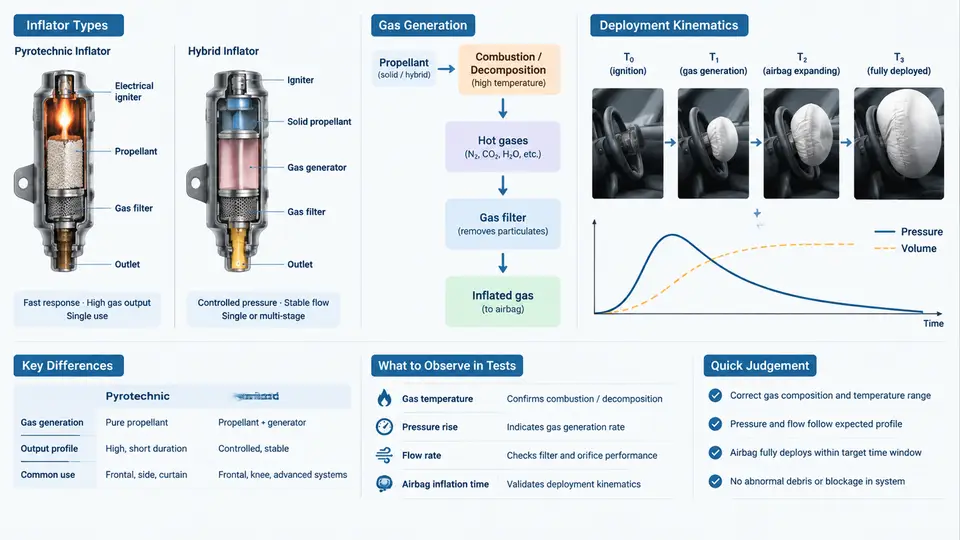
An airbag is a controlled chemical gas generator that must convert a small solid or hybrid charge into a cushion of gas within roughly 20–50 ms of a crash pulse. Everything in this chapter — inflator chemistry, gas mass flow, bag unfolding, and occupant kinematics — is governed by that timing budget. Understanding the inflator as a pressure-vessel-plus-propellant system, rather than as a simple "explosive," is the foundation for every static inflation test you will run later in this course.
1.1 The Two Inflator Architectures
Modern frontal airbags use one of two inflator families. Pyrotechnic (solid-propellant) inflators burn a sodium azide–based or non-azide propellant grain inside a steel or aluminum housing. The combustion products are hot gas and solid particulates; a filter and slag trap remove most condensable and particulate matter before the gas enters the bag. Hybrid inflators combine a small pyrotechnic initiator/booster with a stored compressed gas (typically argon–helium or argon–nitrogen at 20–40 MPa). The burning booster heats the stored gas and adds combustion products, so the delivered gas is cooler and cleaner than a pure pyrotechnic inflator, which is why hybrid designs dominate passenger-side and side-airbag applications where bag fabric and occupant proximity are more sensitive.
A third variant, the dual-stage or variable-output inflator, is not a separate chemistry but a control strategy: two independent initiators and propellant charges in one housing, fired with a time offset or selectively by the Restraint Control Module (RCM) based on crash severity, occupant size, and seat position. This is the practical reason a static inflation test must specify which stage is fired and at what delay.
1.2 Gas Generation: What Actually Leaves the Inflator
For a pyrotechnic inflator, the propellant burn is a rapid, self-sustaining exothermic reaction. A representative non-azide formulation reacts to produce primarily N₂, CO₂, and H₂O, with a flame temperature in the 1,500–2,200 K range at the grain surface. The gas then passes through a cooler/heat sink and filter, so the gas entering the bag is typically 400–900 K. The key engineering quantities are:
- Gas yield (mol gas per gram of propellant) — determines total moles available.
- Burn rate — pressure- and temperature-dependent; sets the mass flow vs. time curve.
- Chamber pressure — must stay below housing burst limits while driving flow through the exit ports.
- Particulate and condensable loading — affects filter sizing and bag fabric scorching.
For a hybrid inflator, the stored gas mass is fixed by the fill pressure and bottle volume (ideal-gas estimate: m = PV/(RT)), and the booster adds a smaller, fast-rising contribution. The delivered gas temperature is lower because the stored gas absorbs heat, which reduces the thermal load on the bag.
1.3 Deployment Kinematics: From Signal to Cushion
Deployment is a sequence of coupled events, not a single explosion. The RCM closes the firing circuit, the initiator fires, the booster or propellant ignites, chamber pressure rises, the burst disc or exit ports open, gas flows into the folded bag, the bag unfolds and inflates, and the occupant loads the bag. Each stage has a characteristic time constant, and the sum must fit the crash timeline.
Two kinematic quantities matter most for test design. First, bag fill time — the interval from initiator current onset to the bag reaching a defined internal pressure or a defined forward-most position. Second, bag forward excursion velocity — the speed at which the bag surface approaches the occupant. A bag that inflates too slowly fails to cushion; one that inflates too aggressively can cause "punch-out" injury, especially for out-of-position (OOP) occupants. This is why OOP static tests use a instrumented surrogate at a defined distance and measure both bag pressure and surrogate loading.
1.4 A Worked Static-Inflation Example
Consider a driver-side hybrid inflator with a 60 cm³ stored-gas bottle at 30 MPa and 293 K, filled with argon (R = 208 J·kg⁻¹·K⁻¹). The stored gas mass is approximately:
m = PV / (RT)
  = (30e6 Pa)(60e-6 m³) / (208 J/kg·K × 293 K)
  ≈ 0.0295 kg  (≈ 29.5 g argon)
If the booster adds 0.8 g of propellant yielding roughly 0.025 mol gas per gram, that is about 0.02 mol of additional gas — small compared with the stored argon (≈ 0.74 mol), but it raises the gas temperature and therefore the pressure. In a static inflation test at 23 °C ambient, you would expect the bag to reach its working pressure within roughly 25–35 ms of initiator current onset. If the measured fill time is 60 ms, the likely causes are a restricted exit port, a partially blocked filter, or a bag that is folded too tightly and cannot unfold fast enough — not a propellant problem.
1.5 Reading the Deployment Sequence
The SVG below maps the causal chain from firing signal to occupant cushioning, with the measurable quantities at each stage. Use it as a mental checklist when you instrument a static test: every arrow is a place where a sensor can be placed, and every box is a place where a parameter can be varied.
1.6 Practical Implications for Static Inflation Testing
Three design decisions follow directly from the fundamentals above. First, choose the inflator family before the test fixture: a hybrid inflator's lower gas temperature means you can use a lighter bag fabric and a smaller filter, but the stored-gas bottle dictates the fixture's pressure rating and the safe handling distance. Second, instrument the causal chain, not just the bag: a chamber pressure transducer and a bag pressure transducer together let you separate an inflator problem from a bag problem. Third, define the reference frame explicitly: bag forward excursion is measured from the module mounting plane, positive toward the occupant; state this in every test report so results are comparable across fixtures.
With these fundamentals in place, the next chapters move from the inflator's internal behavior to the test bench itself — fixture design, sensor selection, data acquisition, and the safety procedures that make a pyrotechnic static inflation test repeatable and defensible.