1. Side pole impact crash scenario
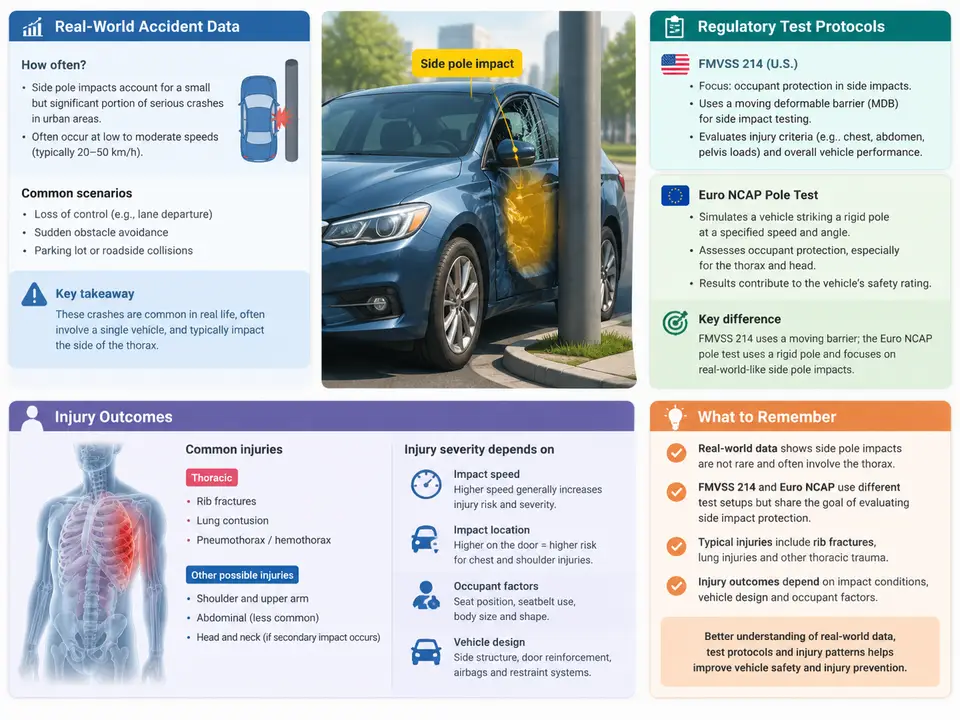
A side pole impact is one of the most demanding collision modes a passenger vehicle can experience. Unlike a flat barrier or a moving deformable barrier, a narrow rigid pole concentrates the entire collision energy into a small contact patch on the door structure, typically at a height that aligns with the occupant's chest and abdomen. The result is a short-duration, high-severity intrusion event in which the struck-side occupant has almost no survival space and very little time for restraint systems to act. Understanding this scenario is the foundation for everything that follows in thoracic injury analysis: the loading path, the intrusion kinematics, and the injury metrics all originate from the physical reality of a pole strike.
Why the Pole Is Different: Real-World Accident Evidence
Field accident data consistently show that side impacts account for a disproportionate share of serious thoracic injuries relative to their frequency. Within that category, impacts with narrow fixed objects — utility poles, trees, signposts, and bridge columns — are over-represented in fatal and serious-injury cases. The reason is geometric. A pole of roughly 200–300 mm diameter engages only a narrow strip of the door and B-pillar region, so the force is not distributed across the sill and roof rails as it would be in a barrier impact. The door outer panel deforms locally, the door beam bends, and the intrusion velocity into the occupant compartment can remain high even as the vehicle's overall deceleration is moderate.
Real-world pole crashes also tend to occur at higher speeds than many barrier tests, frequently in rural or semi-rural environments where run-off-road events are common. Occupant kinematics in these events are dominated by lateral translation of the struck-side occupant toward the pole, combined with the vehicle's yaw and lateral acceleration. Because the pole often strikes slightly forward or rearward of the occupant's H-point, the occupant can be loaded by both the intruding door trim and the seat structure, producing complex thoracic loading that is difficult to reproduce with a single simplified test.
Regulatory and Consumer Test Protocols
Two protocols dominate the engineering landscape for side pole testing: FMVSS 214 in the United States and the Euro NCAP pole test. They differ in intent, setup, and injury criteria, and a vehicle developed for one market is not automatically compliant with the other.
| Attribute | FMVSS 214 (Side Pole, SICE) | Euro NCAP Pole Test |
|---|---|---|
| Primary purpose | Regulatory minimum occupant protection | Consumer rating / star score |
| Impact object | Rigid pole, 254 mm diameter | Rigid pole, 254 mm diameter |
| Impact angle | 75° to vehicle longitudinal axis (perpendicular to struck side) | 90° to vehicle longitudinal axis (perpendicular) |
| Impact speed | 32 km/h (20 mph) | 32 km/h |
| Dummy | SID-IIs (struck side) | WorldSID 50th percentile male |
| Key injury metrics | Rib deflection, abdominal force, pelvic force | Rib deflection, thoracic injury criteria, head and pelvis |
The FMVSS 214 pole test uses a 75° impact angle, which introduces a longitudinal component to the loading and is intended to represent a vehicle sliding into a pole during a run-off-road event. Euro NCAP uses a perpendicular 90° strike, which maximizes lateral intrusion and is generally the more severe configuration for the struck-side occupant's chest. Both tests use a rigid pole, meaning the pole does not deform or absorb energy — all deformation is absorbed by the vehicle structure and, ultimately, by the occupant restraint system.
Injury Outcomes and the Thoracic Focus
The pole test is fundamentally a thoracic injury test. Because the pole contacts the door at roughly chest height, the struck-side occupant's rib cage is loaded directly through the intruding door trim and armrest. The dominant injury mechanisms are rib fractures — particularly multiple adjacent fractures that produce a flail chest — and, in more severe cases, aortic and solid-organ injury. The SID-IIs and WorldSID dummies are instrumented to measure rib deflection, which is the primary surrogate for rib fracture risk. In FMVSS 214, the compliance criteria include limits on rib deflection, abdominal force, and pelvic force; in Euro NCAP, rib deflection is converted into a thoracic injury criterion that feeds the star rating.
What makes the pole scenario so injurious is the combination of high intrusion velocity and limited restraint effectiveness. A side airbag and curtain airbag can cushion the occupant, but they cannot prevent the door structure from intruding into the occupant's space. The occupant's chest is therefore loaded by two mechanisms simultaneously: the direct contact with the intruding trim and the inertial loading from the lateral deceleration of the vehicle. This dual loading is why pole tests often produce higher rib deflections than barrier tests at comparable vehicle deceleration levels.
Reading the Scenario as an Engineer
When you examine a pole impact test or a CAE simulation, the first thing to establish is the intrusion profile at the occupant's chest height. This is measured at the door inner panel and at the armrest, and it is the boundary condition for everything the restraint system must handle. A typical passenger car in a 32 km/h pole test may show 150–250 mm of residual intrusion at the chest reference point, with peak intrusion velocity occurring in the first 30–50 ms after contact. These values are vehicle-specific and must be taken from the actual test or model, not assumed.
The second thing to establish is the timing relationship between intrusion and restraint deployment. A side airbag must be fully inflated before the occupant's chest reaches the intruding trim. In a pole impact, the time available is short — often less than 20 ms from contact to occupant loading — which is why pole tests place such high demands on side airbag sensing and inflator performance. If the airbag is late, the chest loads directly against the trim; if it is early, the airbag may be deflated by the time the occupant arrives. The pole scenario is therefore a timing problem as much as a structural one.
Finally, the injury outcome must be interpreted through the correct metric for the protocol. FMVSS 214 compliance is judged against rib deflection limits and force limits measured on the SID-IIs; Euro NCAP converts WorldSID rib deflection into a thoracic injury criterion that contributes to the star rating. A vehicle that passes FMVSS 214 is not automatically a strong Euro NCAP performer, because the WorldSID dummy, the 90° angle, and the scoring methodology all differ. Engineers developing for global markets must therefore evaluate both configurations and understand where the structural and restraint design compromises lie.
The side pole impact scenario thus sets the stage for the rest of this course. The narrow rigid pole, the high intrusion velocity, the short timing window, and the thoracic focus of the injury metrics are the boundary conditions within which every structural, restraint, and CAE decision must be made. The next step is to examine how the thorax responds to this loading in detail — the rib kinematics, the deflection patterns, and the injury thresholds that connect physical loading to clinical outcome.