1. Out-of-position (OOP) airbag deployment
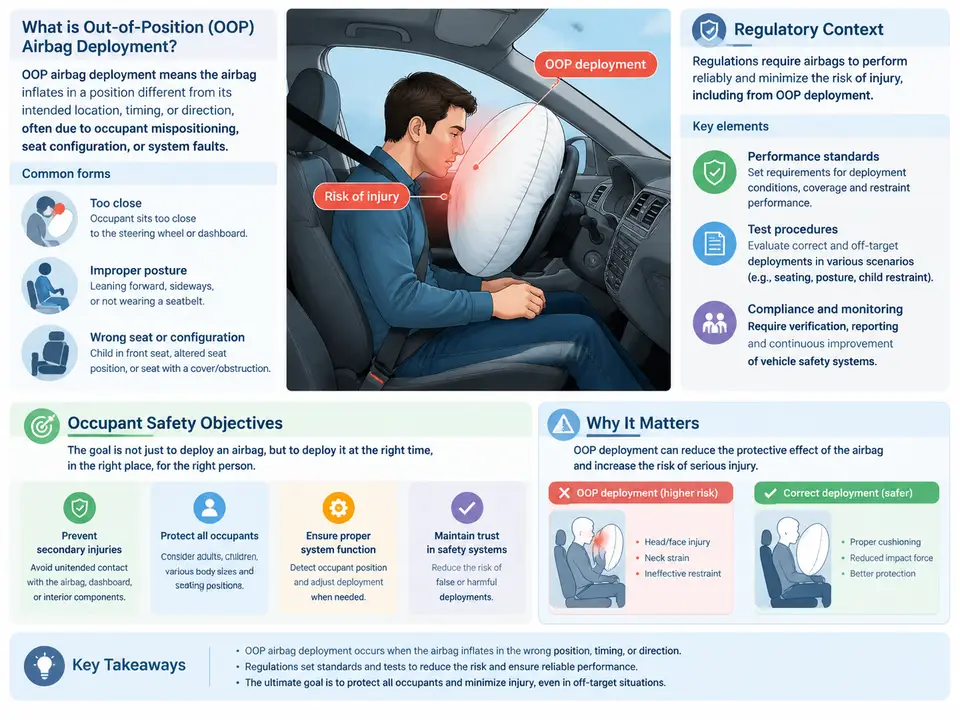
An airbag is a pyrotechnic restraint device designed to inflate in tens of milliseconds and absorb occupant energy through a controlled cushion. Its protective benefit, however, depends on a critical assumption: that the occupant is seated in a nominal, upright position when deployment occurs. When that assumption fails, the same energy that saves a properly positioned occupant can injure one who is too close to the module, leaning forward, or out of the seat entirely. This chapter establishes the vocabulary, regulatory framework, and safety objectives that underpin the entire discipline of out-of-position (OOP) airbag deployment.
Defining Out-of-Position Occupancy
An out-of-position occupant is any occupant whose body geometry, posture, or location at the moment of deployment deviates from the nominal design position used to validate the restraint system. The nominal position is typically defined by standardized seating procedures — for example, a 50th-percentile male manikin seated with the H-point at the design location, torso against the seat back, and feet on the floor. Any deviation that reduces the clearance between the occupant and the deploying airbag module, or that places a body region directly in the airbag's expansion path, constitutes an OOP condition.
OOP conditions fall into several practical categories:
- Forward-leaning or "in-position-too-close" occupants — drivers reaching for the glovebox, adjusting the radio, or bracing for a perceived crash, placing the chest or head within the airbag's deployment zone.
- Rear-facing child restraints — an infant seat installed on the front passenger seat places the child's head directly adjacent to the passenger airbag module.
- Children standing or kneeling on the seat — common in unrestrained or improperly restrained child passengers.
- Occupants leaning into the door or center console — lateral OOP postures that bring the head or thorax into the side airbag path.
- Occupants positioned outside the seat cushion — for example, a child kneeling on the floor in front of the seat, or an occupant whose torso is over the seat bolster.
The key engineering variable is standoff distance: the distance between the occupant's body surface and the airbag module's trim cover at the instant of deployment. Small standoff distances mean the airbag contacts the occupant while still expanding at high velocity, before the cushion has had time to vent and soften. This is the physical mechanism behind most OOP injuries.
Why OOP Matters: The Injury Mechanism
During a frontal deployment, the inflator generates gas that fills the cushion in roughly 20–50 ms. The cushion's leading edge can reach velocities on the order of 150–250 m/s during the initial expansion phase. For a properly positioned occupant, the airbag is fully inflated before the occupant's forward excursion brings the chest into contact, so the occupant loads a vented, energy-absorbing cushion. For an OOP occupant, the body is already in the expansion path; the cushion strikes the occupant while still accelerating, and the occupant experiences a concentrated, high-velocity impact rather than a distributed deceleration.
The resulting injury patterns are well documented: head and neck injuries from direct cushion impact, thoracic injuries from membrane loading, and in the case of rear-facing child restraints, severe head and cervical spine trauma. These outcomes are not failures of the airbag in the nominal sense — they are consequences of deploying a device outside the envelope for which it was validated.
Regulatory Context
OOP deployment is governed by a combination of performance standards, test procedures, and labeling requirements. The most influential framework is FMVSS 208 (Federal Motor Vehicle Safety Standard 208, "Occupant Crash Protection") in the United States, which introduced dedicated OOP test requirements for frontal airbags. FMVSS 208 specifies a set of static deployment tests using instrumented anthropomorphic test devices (ATDs) positioned at defined OOP locations relative to the airbag module. The standard defines test matrices that include:
- Driver-side OOP tests — ATD positioned close to the steering wheel hub, with the chest or head at specified distances, and the airbag commanded to deploy.
- Passenger-side OOP tests — including a rear-facing child restraint (RFCR) positioned on the passenger seat, and child ATDs in standing, kneeling, and seated-leaning postures.
- Low-risk deployment (LRD) requirements — the airbag must not exceed specified injury criteria (e.g., head injury criterion, neck injury criteria, chest deflection) when deployed against these OOP ATD positions.
In Europe, ECE R94 and the associated OOP provisions, together with UN R137 (which addresses frontal impact restraint performance), establish comparable requirements. The Global Technical Regulation No. 9 (GTR 9) harmonizes pedestrian protection but also informs broader restraint design philosophy. For side airbags, OOP considerations appear in FMVSS 214 and in OEM-specific validation protocols, since side airbag modules are typically closer to the occupant and have less available standoff.
The regulatory logic is consistent across jurisdictions: rather than requiring that OOP occupants be protected as well as nominal occupants (which is physically difficult given the short standoff), the standards require that OOP deployment not produce unreasonable risk of injury. This is the "low-risk deployment" concept — the airbag may still deploy, but its output must be moderated or its timing adjusted so that injury measures stay below threshold values.
Occupant Safety Objectives
The safety objectives for OOP deployment can be organized around three tiers:
| Objective | Description | Typical Engineering Lever |
|---|---|---|
| Prevent hazardous deployment | Avoid deploying a full-output airbag into an occupant with critically small standoff | Occupant classification, suppression logic, seat position sensing |
| Moderate deployment severity | Reduce inflator output or delay deployment when OOP is detected or likely | Dual-stage inflators, adaptive venting, tethering, deployment timing |
| Limit injury metrics | Ensure HIC, Nij, and chest deflection stay below regulatory thresholds in OOP tests | Cushion shape, vent sizing, inflator characterization, module geometry |
These objectives interact. A dual-stage inflator that fires only the first stage in an OOP event reduces peak cushion velocity but may also reduce nominal protection if the occupant classification is wrong. The engineering task is therefore not simply to "make the airbag softer" but to design a deployment strategy that is robust across the range of occupant states the system can reliably detect.
Practical Framing: From Definition to Design Input
For a working engineer, the OOP definition translates directly into design inputs. Consider a driver frontal airbag program. The team must establish:
- The OOP test matrix — which ATD positions, which standoff distances, which ATD sizes (e.g., 5th-percentile female, 50th-percentile male, and child ATDs such as the CRABI or Hybrid III 3-year-old).
- The injury thresholds — the regulatory or OEM-internal limits for HIC, neck injury, and chest deflection at each position.
- The detection envelope — what the occupant sensing system can actually measure (seat track position, occupant weight, belt status) and how quickly it can report before the deployment decision must be made.
- The actuation authority — whether the inflator is single-stage or dual-stage, whether venting is fixed or adaptive, and what deployment delay is permissible without compromising nominal performance.
A representative example: a dual-stage inflator may be calibrated so that stage 1 alone produces approximately 60–70% of full gas output, with stage 2 adding the remainder after a calibrated delay. In an OOP event where the occupant is detected close to the module, the restraint control module (RCM) may command stage 1 only, or stage 1 with an extended stage-2 delay. The validation question is whether the resulting cushion — smaller, slower, and less stiff — keeps the OOP ATD injury metrics below threshold while still meeting nominal occupant protection requirements in the standard 56 km/h frontal barrier test.
This is the essential tension of OOP engineering: the same hardware must serve two conflicting requirements. The nominal occupant needs a fast, firm cushion to absorb energy in a severe crash; the OOP occupant needs a slower, softer deployment to avoid being struck by the cushion itself. The resolution lies in sensing, staging, and cushion design — not in a single fixed inflator output.
With these definitions and objectives established, subsequent chapters can examine the specific sensing technologies, inflator architectures, cushion design parameters, and validation procedures that turn this framework into a production restraint system.