1. Introduction to occupant submarining
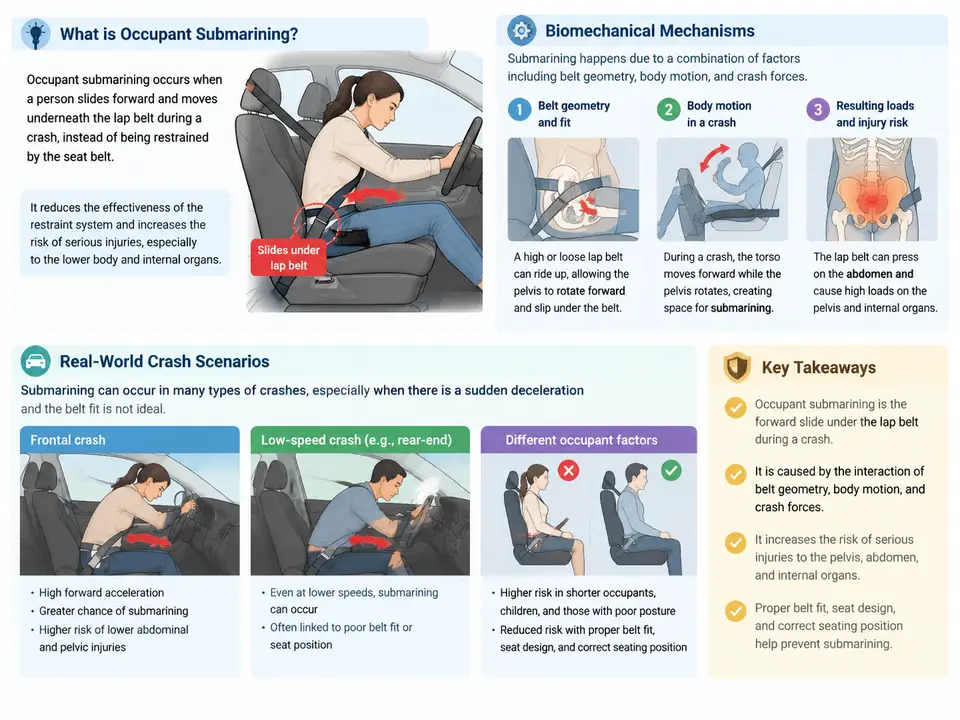
Submarining is one of the most consequential failure modes in occupant restraint design, yet it is frequently misunderstood because it is invisible in the crash test film until the damage is already done. In its simplest definition, submarining occurs when an occupant's pelvis slides forward and downward beneath the lap portion of the seat belt, allowing the torso to rotate or translate forward while the belt loads soft abdominal tissue and the iliac crest escapes the restraint path. The belt then migrates from its intended position across the anterior superior iliac spines (ASIS) into the abdomen, and the occupant "submarines" under the restraint instead of being held back by it.
This chapter establishes the vocabulary and physical intuition needed for the rest of the course: what submarining is, why the pelvis is the critical structure, how the belt–pelvis–seat interaction produces the failure, and which real crash configurations make it most likely.
Why the Pelvis Is the Load Path
A three-point belt is designed to distribute restraint loads through the body's strongest load-bearing structures. The shoulder belt routes force through the clavicle, sternum, and rib cage into the spine; the lap belt is intended to route force through the pelvic bone — specifically across the anterior iliac spines and the pubic symphysis — into the seat structure. The pelvis can tolerate high belt loads because it is a stout bony ring. The abdomen cannot: it contains compressible viscera, the aorta, the liver, and the spleen, none of which are designed to act as anchor points.
Submarining is therefore fundamentally a geometry and kinematics problem. The lap belt must remain positioned over the bony pelvis throughout the crash pulse. If the belt starts too high, if the occupant's pelvis slides forward on the cushion, or if the seat pan geometry allows the buttocks to ramp downward, the belt crosses the soft abdomen and the occupant's torso rotates forward around a point that is no longer restrained.
The Biomechanical Mechanism, Step by Step
The sequence is well documented in sled testing and cadaver studies. It typically unfolds as follows:
- Pre-impact posture. The occupant sits with the lap belt positioned somewhere between the ASIS and the mid-abdomen. Slouch, reclined seatback angles, and thick clothing all shift the belt upward relative to the pelvis.
- Early crash phase (0–30 ms). Vehicle deceleration begins. The occupant's torso loads the shoulder belt, generating a forward-and-downward force component on the upper body. The lap belt tension rises as the retractor locks.
- Pelvis ramping. The seat cushion compresses and the occupant's buttocks slide forward along the seat pan. If the seat pan angle or cushion stiffness permits, the pelvis rotates into a more reclined orientation, lowering the ASIS relative to the belt.
- Belt migration. The lap belt slips off the iliac crest and settles across the lower abdomen. Once this happens, the belt's load path is no longer bony.
- Submarining and abdominal loading. The torso continues forward, the belt digs into the abdomen, and the occupant's pelvis translates under the belt. Belt forces are now applied to soft tissue, producing high abdominal penetration, possible lumbar spine flexion beyond physiological limits, and in severe cases aortic or visceral injury.
The critical threshold in most published work is the belt–pelvis engagement angle: the lap belt should sit at or below the ASIS, with the belt-to-seat-pan angle typically held between roughly 45° and 60° in normalized seating. When the belt sits above the ASIS, submarining risk rises sharply regardless of belt pretensioner performance.
Visualizing the Failure Path
The diagram below traces the load path and pelvis kinematics from pre-impact posture through the submarining event, and contrasts it with the intended restrained path. Note the reference convention used throughout this course: +X is forward (vehicle direction of travel), +Z is upward, and the seat pan is the datum for pelvis position. All angles are measured in the sagittal plane.
Real-World Crash Scenarios Where Submarining Appears
Submarining is not a laboratory curiosity. Field data and reconstructed crashes point to several recurring configurations:
- Reclined seating. Seatback angles beyond roughly 25–30° from vertical reduce the lap belt's ability to stay on the iliac crest. Modern "relaxed" seating positions in rear rows and autonomous-vehicle concepts amplify this risk.
- Slouched or slumped occupants. A slouched posture pre-positions the belt high on the abdomen before the crash even begins. This is common among fatigued drivers and children in booster seats.
- Small occupants and children. Shorter occupants have a smaller pelvis-to-belt geometry margin; a belt that fits an average adult may sit above the ASIS on a smaller occupant. Booster seat design exists largely to correct this geometry.
- Rear-seat occupants. Rear seats often lack pretensioners and load limiters, and their cushion geometry is less optimized. Submarining rates in rear-seat field data are correspondingly higher.
- Far-side and oblique impacts. Lateral and oblique loading can rotate the pelvis and allow the belt to slip off the iliac crest even when the frontal geometry is correct.
- Pregnant occupants. The uterus displaces the belt path and changes the pelvis–belt relationship; correct routing below the abdomen is essential and is a specific design consideration.
What "Prevention" Means in This Course
Preventing submarining is not a single fix. It is a system-level property of the belt geometry, seat pan design, cushion stiffness, pretensioner and load-limiter calibration, and occupant posture. Later chapters will treat each of these as a design variable and show how they interact. For now, the key takeaway is that submarining is a predictable kinematic failure with a clear physical signature: the lap belt crossing above the ASIS, the pelvis ramping forward on the cushion, and the torso rotating around a restraint point that has moved into soft tissue.
With this foundation — the definition, the load-path logic, the kinematic sequence, and the crash scenarios that trigger it — the next chapters can move into measurement methods, test protocols, and design countermeasures with a shared vocabulary.