1. Introduction to occupant CAE model credi
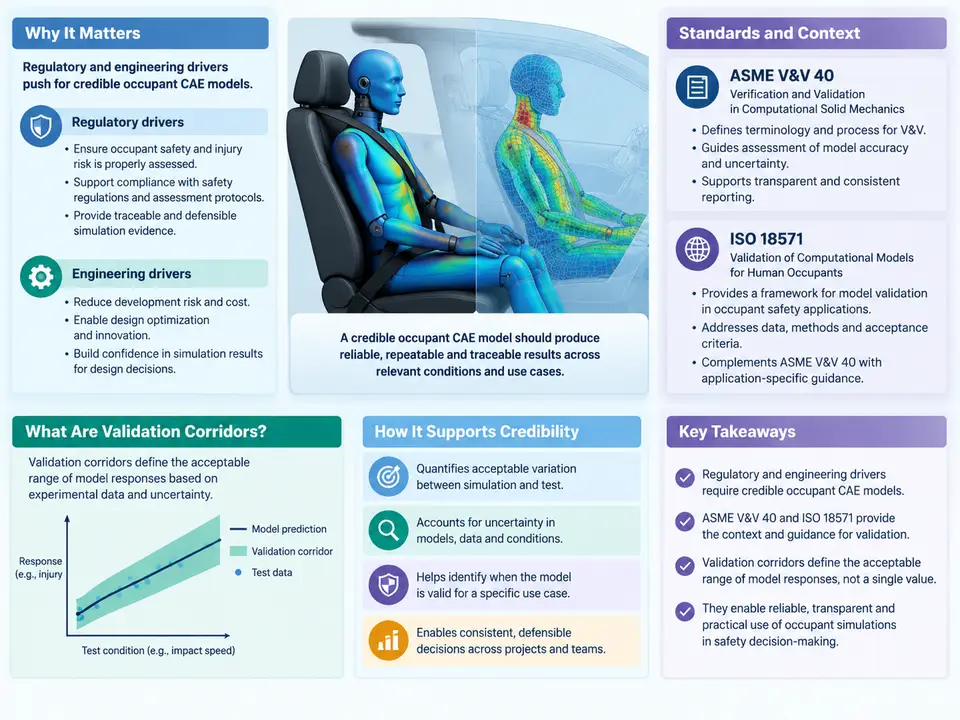
Occupant safety simulation sits at an uncomfortable intersection: the predictions it produces are used to make decisions about hardware, tooling, and certification strategy, yet the underlying models — dummy finite element meshes, material cards, contact definitions, restraint system representations, and the injury criteria post-processors — are all approximations. The discipline of model credibility exists to make the gap between approximation and decision explicit, quantified, and defensible. This chapter establishes why that discipline has become mandatory rather than optional, how the governing standards frame it, and where validation corridors fit into the workflow.
Why credibility became a regulatory and engineering requirement
Two pressures converged. The first is regulatory. Frontal and side impact regulations, pedestrian protection rules, and the newer occupant protection protocols increasingly accept or expect CAE evidence alongside — and sometimes instead of — physical testing. When a simulation result influences a compliance argument, the burden shifts from "the model runs" to "the model is adequate for this specific use." Regulators and type-approval bodies have responded by asking for documented verification and validation evidence, not just a deck and a report.
The second pressure is engineering economics. A full vehicle program may run thousands of occupant simulations. Each one is cheap relative to a sled or barrier test, but the aggregate cost of acting on a wrong model is enormous: a restraint tuning decision made on an unvalidated model can propagate into tooling, and tooling changes are measured in months. Engineers therefore need to know, before they trust a trend line, how much of the predicted difference between two design variants is real and how much is model noise. Credibility assessment answers exactly that question.
The ASME V&V 40 framework
ASME V&V 40 (Assessing Credibility of Computational Modeling through Verification and Validation: Application to Medical Devices) is the most widely referenced structured framework, and although its title names medical devices, its logic has been adopted across mechanical and safety simulation. Its central idea is context of use (COU): credibility is never absolute, it is always relative to a stated question. The framework asks you to define, up front:
- the question of interest — e.g., "does restraint configuration B reduce chest deflection relative to A at 56 km/h frontal impact?";
- the modeling context — the physics, the output quantities, and the decision the model informs;
- the risk associated with an incorrect decision — higher risk demands stronger evidence;
- the verification and validation activities that generate evidence, each graded for relevance and rigor.
Evidence is then assembled into a credibility argument: code verification (does the solver implement the equations correctly?), calculation verification (is the discretization converged?), validation (does the model reproduce physical measurements?), and uncertainty quantification. The output is not a single pass/fail number but a structured judgement that the model is adequate — or not — for the declared COU.
ISO 18571 and objective correlation
Where V&V 40 provides the argument structure, ISO 18571 provides a measurement instrument. It defines objective metrics for comparing transient signals — typically acceleration-time and force-time histories from tests and simulations — and combines them into a single correlation score. The standard evaluates several complementary aspects: corridor or phase agreement, magnitude agreement, and shape similarity, each normalized so that a score near 1.0 indicates close agreement and near 0 indicates poor agreement.
The practical value is comparability. Before ISO 18571, "the model correlates well" was an opinion; after it, two teams can quote the same metric on the same signal and argue about thresholds rather than about definitions. A typical working target in occupant crash simulation is a composite score above roughly 0.7–0.8 for primary signals such as head resultant acceleration and chest acceleration, with tighter expectations for signals that directly drive injury criteria. These thresholds are program-specific and should be agreed with the receiving authority, not assumed.
What a validation corridor actually is
A validation corridor is the band of acceptable response around a reference signal, derived from test-to-test variability rather than from a single nominal curve. If five repeat sled tests of the same configuration produce chest acceleration traces that spread by ±8% about their mean in the peak region, that spread defines the corridor. A simulation trace that stays inside the corridor is consistent with the physical population; one that exits it is making a claim the test data does not support.
Corridors matter because they convert validation from a curve-matching exercise into a statistical statement. They also expose a common failure mode: engineers tune a model to a single test, achieve an excellent ISO 18571 score against that one trace, and then discover the model cannot reproduce the scatter seen across the test series. The corridor makes that over-fitting visible.
How the pieces connect in practice
The workflow that ties these concepts together is deliberately front-loaded. Before a single simulation is run, the analyst writes a short credibility plan: the COU, the output quantities of interest, the test data available, the corridor definition, the ISO 18571 signals and thresholds, and the risk level. This plan is what a reviewer or regulator will eventually audit, and it prevents the most common failure — deciding after the fact which signals "look good."
A concrete example makes the sequence tangible. Suppose the COU is a frontal 56 km/h sled comparison of two restraint variants, with chest deflection and head resultant acceleration as the decision-driving outputs. The plan would specify: five repeat tests of the baseline for corridor construction; SAE J211 CFC 1000 filtering for head acceleration and CFC 600 for chest deflection; ISO 18571 composite score targets of 0.75 for head acceleration and 0.70 for chest deflection; and a requirement that the simulation remain inside the corridor through the peak region, not merely achieve a good whole-history score. If the model passes the score threshold but exits the corridor at the peak, the plan should state that the result is flagged for review rather than accepted — because the peak is precisely where the injury criteria live.
What this course builds toward
The remaining chapters develop each element of this argument in depth: constructing corridors from real test scatter, selecting and filtering signals, computing and interpreting ISO 18571 metrics, structuring a V&V 40 credibility argument, and documenting the result so that it survives review. The through-line is consistent — credibility is a claim about fitness for a stated purpose, supported by evidence whose relevance and rigor are matched to the risk of the decision. Validation corridors and objective correlation metrics are the two instruments that make that claim measurable.