1. Far-side impact fundamentals
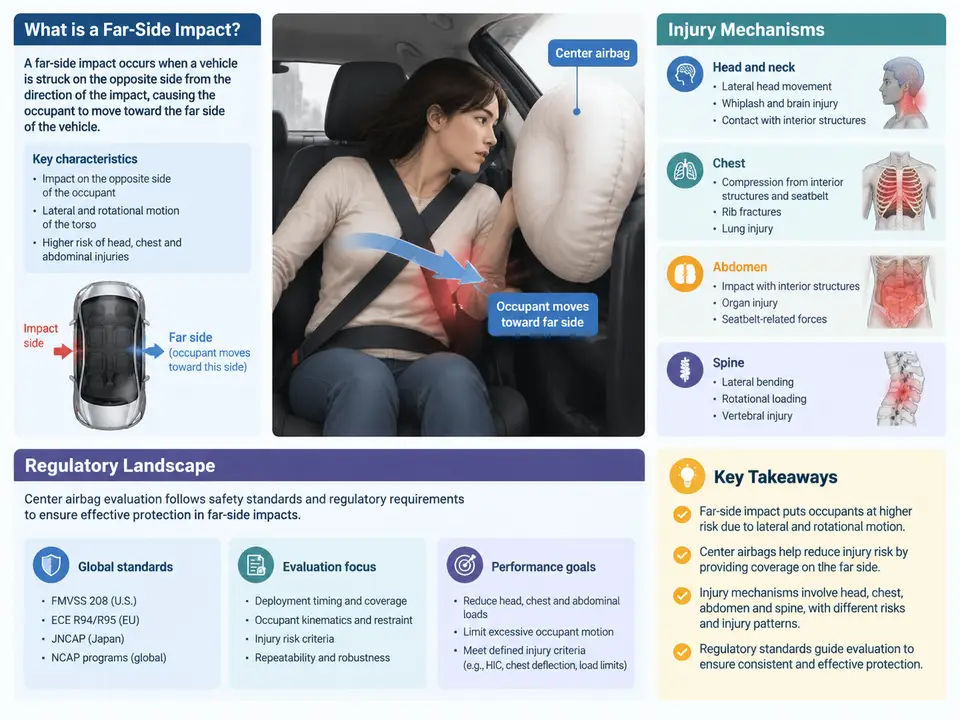
Far-side impact refers to a crash configuration in which the occupant seated on the side opposite the struck side is loaded by the vehicle's lateral response rather than by direct contact with the intruding structure. In a left-hand-drive vehicle struck on the driver's side, the front right passenger is the far-side occupant; in a right-hand-drive vehicle struck on the right, the front left passenger is the far-side occupant. The struck-side occupant is restrained primarily by the door trim, side airbag, and curtain; the far-side occupant has no such barrier between the body and the vehicle interior, and is instead retained only by the seat belt and — increasingly — by a center airbag deploying from the inboard side of the seat or from the center console.
The distinction matters because the two loading environments are physically different. Near-side occupants experience a short, high-magnitude intrusion pulse transmitted through the door and side structures. Far-side occupants experience a longer, lower-magnitude lateral acceleration of the whole cabin, which sets the occupant into lateral motion relative to the interior. The far-side occupant therefore tends to slide out of the shoulder belt, rotate the torso, and translate toward the vehicle centerline, where the head can strike the opposite seat, the center console, or the opposite occupant. This is the defining kinematic signature of far-side loading and the reason a dedicated restraint device is required.
Why the Far-Side Case Is Structurally Different
Three geometric and kinematic factors separate far-side from near-side loading. First, the belt geometry: the shoulder belt anchors on the outboard side of the seat, so under lateral acceleration toward the struck side the belt's retraction path pulls the occupant diagonally, and the torso can slip beneath or out of the shoulder section. Second, the absence of an inboard counter-surface: nothing arrests lateral excursion until the occupant reaches the center console or the opposite seat. Third, the head's inertial path: because the head is roughly 0.6–0.7 m above the seat cushion and is not laterally supported, it accumulates lateral displacement relative to the torso, producing head rotation and lateral bending of the neck.
These factors combine into a characteristic injury pattern. The most frequently cited far-side injuries in field data and in matched-pair crash reconstructions are:
- Head injuries — contact with the opposite seat back, center console, or the opposite occupant's head; also diffuse axonal injury from rotational acceleration without direct contact.
- Neck injuries — lateral bending and axial rotation of the cervical spine, producing facet loading and, in severe cases, vertebral artery or cord injury.
- Thoracic injuries — rib loading from the shoulder belt as the torso rotates out of position, and contralateral rib fracture from belt loading on the inboard side.
- Abdominal injuries — submarining and belt loading of the abdomen when the lap belt migrates superiorly during lateral excursion.
The center airbag addresses the first two directly. By deploying into the gap between the two front seats, it provides a compliant counter-surface that limits lateral head and torso excursion, reduces head-to-head and head-to-console contact, and lowers the rotational acceleration that drives diffuse brain injury. It does not, and is not intended to, replace the seat belt; the belt remains the primary restraint, and the center airbag is a supplementary device whose performance is evaluated in combination with the belt.
The Regulatory and Rating Landscape
Far-side protection has moved from a research topic to a regulated and rated requirement over roughly the last decade. The principal instruments are summarized below; the table is a working reference, not a substitute for the current published text of each regulation.
| Instrument | Scope relevant to far-side / center airbag | Evaluation approach |
|---|---|---|
| FMVSS 208 (US) | Occupant crash protection; includes belted and unbelted frontal and lateral provisions | Barrier tests with instrumented dummies; injury criteria against limits |
| FMVSS 226 (US) | Ejection mitigation; establishes the side-window and curtain context in which far-side occupants are retained | Head-form and dummy ejection tests |
| UN R137 (Europe) | Restraint systems in frontal impact; far-side occupant protection is addressed through the belted-occupant test matrix | Offset deformable barrier and full-width tests; dummy injury criteria |
| Euro NCAP far-side test | Dedicated far-side mobile progressive deformable barrier (MPDB) and oblique pole configurations with a far-side occupant | THOR or WorldSID dummy; head, neck, chest, and abdomen criteria scored |
| China NCAP (C-NCAP) | Far-side occupant protection added to the management rules in recent revisions | Far-side barrier test with instrumented dummy; criteria-based scoring |
| IIHS (US) | Far-side occupant protection rating introduced as a separate evaluation | Moving deformable barrier at oblique angle; dummy-based criteria |
Two features of this landscape deserve emphasis. First, the test configurations are not identical across programs: barrier mass, impact angle, impact speed, and dummy type differ, so a center airbag tuned to one program's pulse is not automatically compliant with another. Second, the evaluation is criteria-based rather than pass/fail on a single number: head injury criterion (HIC), neck injury criteria (Nij and lateral bending moments), chest deflection, and abdominal pressure are each scored, and the overall result depends on the combination. A design that reduces head excursion but increases neck lateral bending can score worse overall than a more balanced calibration.
How the Evaluation Chain Fits Together
The figure below traces the far-side evaluation chain from the physical event through to the scored outcome, showing where the center airbag acts and which measurements feed the criteria.
What This Means for Center Airbag Evaluation
The chain above defines the practical task. A center airbag is not evaluated in isolation; it is evaluated as one element in a restraint system responding to a specific pulse, with a specific dummy, against a specific set of criteria. Three consequences follow for anyone designing or reviewing a far-side evaluation.
Calibration is pulse-specific. The airbag must be fully inflated before the occupant's head reaches the inboard gap, but must not be so stiff that it becomes the injury source. In a typical far-side barrier test the time from impact to peak occupant lateral velocity is on the order of 60–100 ms, and the head reaches the centerline region roughly 100–150 ms after impact. Deployment timing, inflator output, and vent area are therefore tuned against the measured head lateral displacement trace, not against a generic target.
Criteria interact. Increasing airbag pressure reduces head excursion and HIC but can raise neck lateral bending moment by arresting the head while the torso continues to rotate. The evaluation must therefore be read as a vector of criteria, and a calibration change should be checked against all of them, not just the one that was initially marginal.
Configuration must be documented. Because barrier mass, angle, speed, and dummy differ across programs, any reported result is only meaningful with its full configuration stated. A center airbag that scores well in one program's far-side test may be untested — not necessarily failing — in another.
With these fundamentals established — the definition of far-side loading, the injury mechanisms the center airbag is intended to mitigate, and the regulatory and rating instruments that define how performance is judged — the subsequent chapters can move into the test hardware, dummy instrumentation, and calibration workflow in detail.