1. Requalification fundamentals
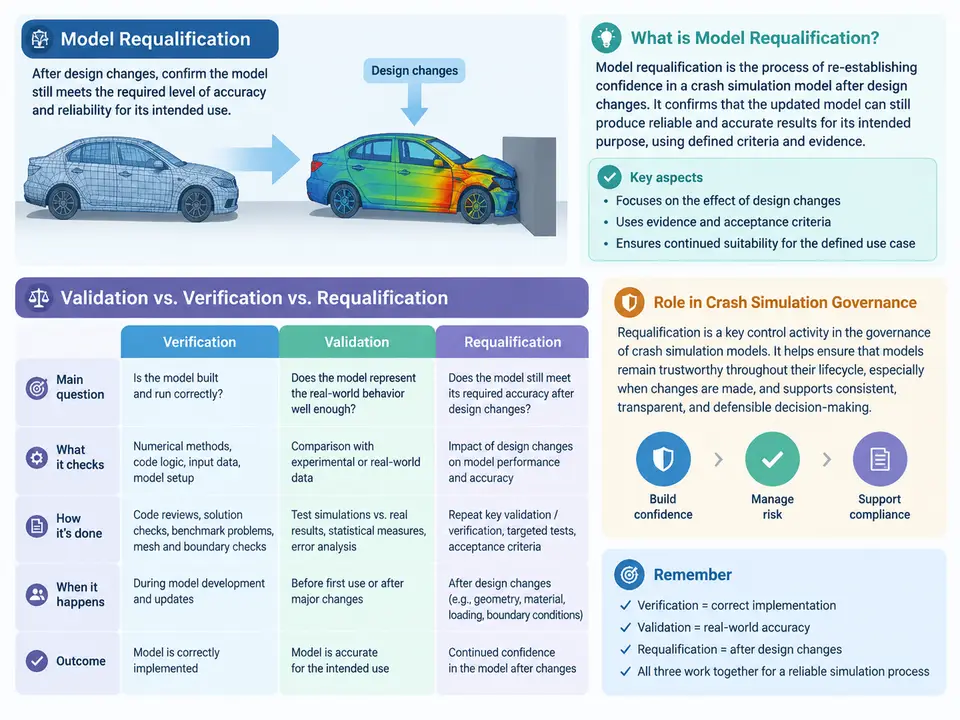
In crash simulation governance, a finite element (FE) model is never "done." It is a living engineering asset whose credibility is tied to a specific configuration of geometry, materials, connections, boundary conditions, and solver settings. When a design change alters any of those inputs, the model's demonstrated agreement with physical test data can no longer be assumed. Model requalification is the controlled process of re-establishing and documenting that credibility after a change, before the model is used to support safety-critical decisions.
A precise working definition is useful: requalification is the structured re-evaluation of an existing, previously qualified crash model against its qualification basis — the evidence set (physical tests, component tests, sled tests, full-vehicle barrier tests, and the associated correlation metrics) that originally justified its use — following a defined change. It is not a full re-validation from scratch, and it is not a routine sanity check. It is a scoped, evidence-based re-establishment of fitness for purpose, with explicit acceptance criteria and traceable sign-off.
Why requalification exists as a governance control
Crash simulation supports decisions that carry regulatory, legal, and human consequences: occupant restraint tuning, structural energy management, battery enclosure integrity, and homologation predictions. Governance frameworks (internal engineering standards, ISO 26262-adjacent process expectations for simulation credibility, and OEM-specific CAE quality gates) therefore require that any model used for a decision has documented evidence of validity for that decision's configuration. Requalification is the mechanism that keeps that evidence current across the design lifecycle. Without it, teams drift into using models whose correlation was demonstrated on a superseded geometry — a failure mode that is silent until a physical test disagrees.
Three governance properties make requalification distinct from ordinary model maintenance:
- Traceability: every change is linked to a requalification record that names the affected responses, the evidence used, and the acceptance decision.
- Proportionality: the depth of requalification scales with the change's potential to alter validated behavior — a material card update is not treated like a full body-in-white (BIW) topology change.
- Independence of judgment: acceptance criteria are defined before correlation results are examined, preventing post-hoc rationalization of a model that no longer matches test data.
Validation, verification, and requalification: the distinction that matters
These three terms are frequently conflated, and the confusion causes real process defects — most commonly, teams "verify" a changed model (it runs, it is stable, it looks plausible) and mistakenly treat that as requalification. The distinction is best understood by what question each activity answers and what evidence it produces.
| Activity | Core question | Typical evidence | Failure it catches |
|---|---|---|---|
| Verification | Is the model built and solved correctly according to its intended specification? | Mesh quality metrics, energy balance, hourglass energy ratio, mass scaling checks, solver termination status, unit consistency | Numerical and modeling errors: negative volumes, excessive added mass, unconverged implicit steps, unit mismatches |
| Validation | Does the model reproduce physical reality with sufficient accuracy for its intended use? | Correlation against physical test data: acceleration pulse, intrusion, force–displacement, occupant injury metrics, with defined tolerances | Modeling assumptions that are numerically sound but physically wrong: incorrect material failure strain, wrong joint stiffness, missed deformation mode |
| Requalification | After a defined change, does the previously validated model still meet its validation basis, or does it require re-validation? | Change impact assessment, targeted re-correlation of affected responses, delta comparison against the prior qualified state, formal acceptance record | Silent loss of validity: a model that still runs and verifies but no longer matches the physical behavior it was qualified against |
The logical ordering is verification → validation → (change occurs) → requalification. Requalification presupposes that verification and validation were already achieved; it re-examines whether the change has invalidated them. A useful mental model: verification asks "is the math right?", validation asks "is the physics right?", and requalification asks "is the physics still right for this new design?"
The requalification decision flow
The figure below shows how a design change is routed through impact assessment into one of three outcomes: verification-only closure, scoped requalification, or full re-validation. The key governance element is the impact assessment gate, which classifies the change before any correlation work begins.
What a requalification actually contains
A credible requalification record is more than a pass/fail stamp. In practice it contains four linked elements. First, a change description that identifies exactly what moved: a gauge change on a front rail, a new adhesive in the B-pillar joint, a revised material card for a crash box. Second, an impact assessment that maps the change to the responses it can plausibly affect — for a front rail gauge increase, that is typically the frontal barrier pulse, longitudinal intrusion, and the resulting occupant chest acceleration. Third, targeted correlation against the relevant physical test data, using the same metrics and tolerances as the original validation. Fourth, an acceptance decision with named sign-off, recorded before the model is released for downstream use.
Consider a concrete example. A BIW front rail is changed from 1.6 mm to 1.8 mm high-strength steel. The impact assessment flags the frontal 40% offset deformable barrier (ODB) pulse and the occupant restraint inputs as affected. The engineer re-runs the ODB load case, extracts the left and right sill acceleration and the toe-pan intrusion, and compares them against the original physical test corridors. Suppose the peak sill acceleration rises from an example 42 g to 47 g and the intrusion decreases by 8 mm — both within the corridor's tolerance band, but the pulse shape shows a new high-frequency oscillation. Verification checks confirm energy balance and hourglass energy remain below thresholds, so the oscillation is physical (a rail folding-mode change), not numerical. The requalification record documents the delta, the corridor comparison, and the acceptance rationale. Had the peak exceeded the corridor, the outcome would be a failed requalification and a mandatory model update — not a waiver.
Where requalification sits in the wider governance chain
Requalification is the bridge between design change management and simulation credibility. Upstream, it consumes engineering change notifications and CAD releases; downstream, it gates the release of simulation results into occupant safety assessments, regulatory submissions, and design decisions. Its outputs — the acceptance record and the updated qualification basis — become the reference state for the next change. This is why the process must be repeatable and auditable: each requalification either confirms the existing basis or establishes a new one, and the chain of records must let an independent reviewer reconstruct why the model was trusted at any point in the program.
The remaining chapters build on this foundation: how to classify changes rigorously, how to select the affected responses and test evidence, how to define acceptance criteria before correlation, and how to document and govern the resulting records across a vehicle program.