1. Thoracic injury assessment landscape
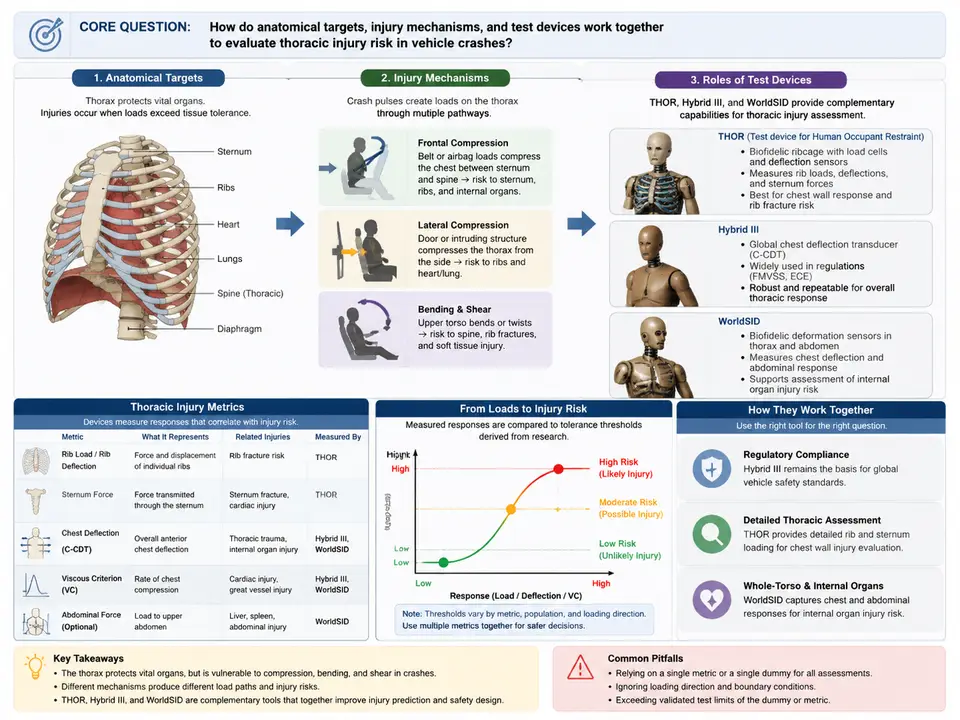
Thoracic injury remains the second leading cause of fatality in frontal motor-vehicle crashes, behind head injury, and the leading cause of serious non-fatal trauma in side impacts. For the engineer building or interpreting a crash test, the thoracic region is uniquely demanding: the rib cage is a compliant, rate-sensitive structure whose failure depends on load magnitude, load distribution, and the geometry of whatever is loading it. A single force threshold cannot describe it. This chapter establishes the anatomical targets, the mechanical injury mechanisms, and the division of labor among the three anthropomorphic test devices (ATDs) that dominate modern thoracic evaluation — THOR, Hybrid III, and WorldSID.
Anatomical targets and what the ATD must represent
Thoracic injury assessment is organized around a small set of anatomical structures, each with its own tolerance and its own loading pathway:
- Ribs and costal cartilage — the primary load-bearing structure. Rib fractures are the most frequent thoracic injury (AIS 2), and multiple rib fractures produce flail chest, a life-threatening AIS 4+ condition.
- Sternum — load path for belt and airbag forces in frontal loading; sternal fracture often co-occurs with underlying cardiac contusion.
- Thoracic spine and vertebral bodies — compression and flexion-distraction injuries under vertical and belt-induced loading.
- Heart and great vessels — aortic rupture (typically at the isthmus) is a leading cause of rapid death in high-severity frontal and side impacts; cardiac contusion follows blunt sternal loading.
- Lungs and pleura — pneumothorax and hemothorax from rib penetration or parenchymal laceration.
- Liver and spleen (upper abdomen) — frequently injured when the thorax deflects into the abdominal cavity, which is why thoracic and abdominal assessment are coupled in side impact.
The ATD must therefore reproduce not just the mass and exterior geometry of the human thorax, but its compliance — the force–deflection characteristic of the rib cage — and its rate sensitivity, since rib tolerance drops markedly at higher loading rates. This is the design problem that separates the three devices.
Injury mechanisms and the metrics that capture them
Three mechanisms dominate thoracic injury in crash loading, and each maps to a measurable quantity:
| Mechanism | Physical description | Representative metric |
|---|---|---|
| Compression / deflection | Anterior-posterior or lateral crushing of the rib cage | Chest deflection (mm), normalized deflection (%) |
| Viscous loading | Rate-dependent soft-tissue and rib response; high velocity at moderate deflection | Viscous criterion VC = V(t) × C(t) |
| Acceleration / inertial | Whole-body deceleration transmitted through the spine and belt | Spine acceleration (3 ms clip), chest acceleration |
The viscous criterion is worth dwelling on because it is the metric most often misread. VC is the instantaneous product of chest deflection velocity V(t) (m/s) and the normalized chest compression C(t) (dimensionless, deflection divided by half-chest depth). It is expressed in m/s and is evaluated as a maximum over the event, not an average. A chest that reaches 30% compression slowly may be tolerable; the same 30% reached at high velocity may exceed a VC tolerance of roughly 1.0 m/s. This is why a test that "passes" on peak deflection can still fail on VC — the two metrics interrogate different mechanisms.
The three devices and their roles
The assessment landscape is divided by crash mode and by fidelity requirement.
Hybrid III is the regulatory workhorse. Its thorax is a steel rib cage with a damped, non-rate-sensitive deflection element, instrumented for chest deflection via a chest potentiometer (in the 50th-percentile male) and for chest acceleration. It is durable, repeatable, and thoroughly correlated to decades of field data, which is why FMVSS 208 and most frontal regulations are written around it. Its limitation is fidelity: the rib cage is stiffer and less biofidelic than the human thorax, it lacks a compliant abdomen and realistic shoulder structure, and its deflection measurement is a single-point, rod-based quantity that does not capture the spatial deflection pattern.
THOR (Test Device for Human Occupant Restraint) was developed to close that gap for frontal and oblique loading. Its thorax uses four rib modules with independent deflection measurement, a realistic clavicle and shoulder, a compliant abdomen, and a more biofidelic spine. This gives it the ability to report spatially resolved chest deflection and to respond correctly to oblique and belt-path loading that Hybrid III misrepresents. THOR is the reference device for advanced frontal restraint evaluation and for research and rating protocols that need biofidelity beyond regulation.
WorldSID is the side-impact counterpart. Its thorax is a molded, compliant rib cage with multiple rib deflection potentiometers (typically three ribs on the struck side), an abdominal rib set, and a shoulder designed to interact realistically with side airbags and door trim. WorldSID is the device of choice for side-impact regulation (FMVSS 214, UN R95) and for side airbag and pole-impact evaluation, where its lateral compliance and multi-point deflection measurement are essential.
How the pieces fit together
The figure below maps the assessment landscape: the anatomical targets, the mechanisms that load them, the metrics that quantify the loading, and the device best suited to each crash mode. Read it as a routing diagram — from "what can be injured" through "how it is loaded" to "which ATD measures it."
Practical implications for the test engineer
Three working rules follow from this landscape. First, select the device by crash mode and fidelity need, not by convenience: a frontal oblique test evaluated only with Hybrid III will under-report the spatial deflection pattern that THOR is designed to capture, and a side-impact test requires WorldSID's lateral compliance. Second, report deflection and VC together, with the normalization reference stated, because they interrogate different mechanisms and a single number hides the rate dependence. Third, keep criteria device-specific: injury risk curves and pass/fail thresholds are derived from, and valid only for, the ATD that produced the measurement.
With this map in place, the chapters that follow can move from the landscape to the specifics — sensor channels, signal conditioning, test setup, and the interpretation of thoracic response in real crash pulses.