1. Introduction to occupant injury biomecha
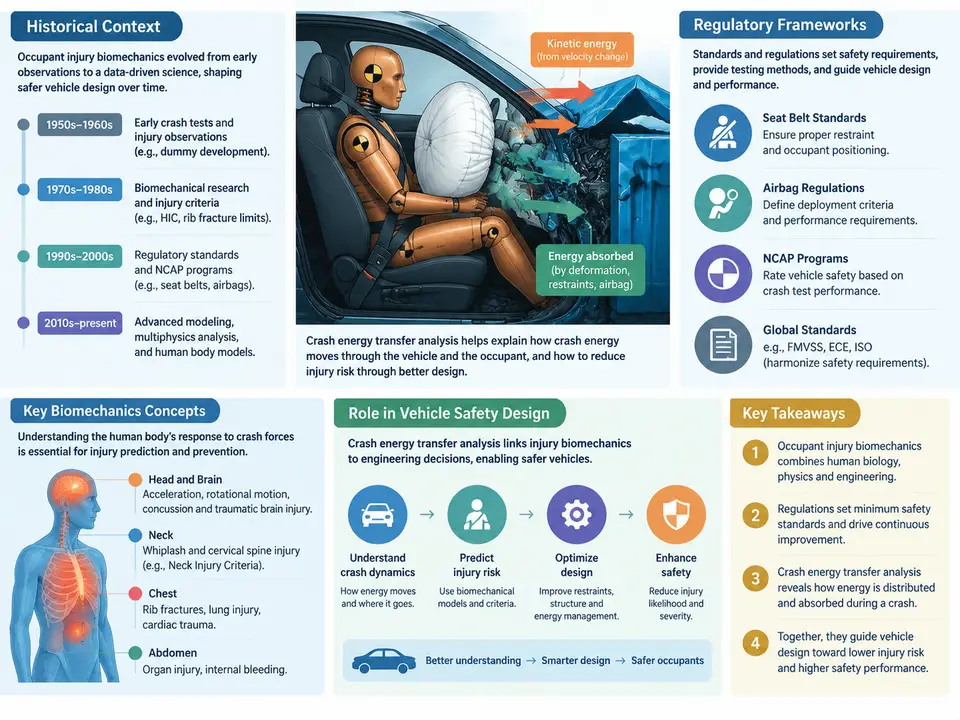
Occupant injury biomechanics is the study of how mechanical loads generated during a crash are transmitted through the human body, and how the resulting stresses and strains produce tissue damage. It sits at the intersection of mechanical engineering, anatomy, and regulatory policy. For the vehicle safety engineer, the discipline answers two practical questions: what does the occupant experience during a collision, and how should the vehicle structure and restraint system be shaped so that the occupant's exposure stays below injury thresholds. Crash energy transfer analysis is the quantitative bridge between those two questions — it converts a crash pulse and a structural deformation pattern into the accelerations, forces, and deflections that ultimately reach the occupant.
From Cadaver Tests to Anthropomorphic Test Devices
The field's modern history begins in the mid-twentieth century, when military aviation and early automotive research programs began systematic impact testing. Pioneering work by researchers such as Colonel John Paul Stapp on human deceleration tolerance, and Hugh DeHaven's observations on survivable falls, established the central insight that the body tolerates deceleration far better when the load is distributed over a large area and over a longer duration. These findings directly motivated the seat belt, the padded instrument panel, and the collapsible steering column.
Because human testing is ethically impossible for injurious exposures, the field developed surrogates. The anthropomorphic test device (ATD) — commonly called a crash test dummy — is a calibrated mechanical representation of the human body with instrumented head, chest, pelvis, and femur. The Hybrid III family, introduced in the 1970s and still the regulatory mainstay for frontal impacts, and the THOR and WorldSID devices for advanced frontal and side applications, are the direct descendants of that early work. Each ATD is defined by a specific percentile (50th male, 5th female, 95th male) and by biofidelity corridors derived from post-mortem human subject (PMHS) and volunteer testing.
Injury Criteria and Their Physical Meaning
Regulatory and consumer tests do not measure "injury" directly; they measure physical responses and compare them to thresholds derived from epidemiological and biomechanical data. The most important criteria are:
- HIC (Head Injury Criterion) — a time-weighted integral of resultant head acceleration, capturing both magnitude and duration. The regulatory limit for a 50th-percentile male in FMVSS 208 is HIC15 ≤ 700.
- Chest deflection and viscous criterion (VC) — chest compression in millimetres and the rate-dependent VC product, which correlates with rib fracture and soft-tissue injury.
- Femur axial force — a load-path indicator for lower-extremity injury, typically limited to around 10 kN in frontal regulation.
- Nij (Neck Injury Criterion) — a combined axial force and bending moment measure for neck injury in frontal and rear impacts.
Each criterion is a proxy. HIC, for example, does not distinguish focal contusion from diffuse axonal injury; it is a scalar summary of the acceleration history. Understanding this limitation is essential when interpreting a test result: a passing HIC does not guarantee the absence of injury, and a marginal failure may be a measurement artifact rather than a real hazard.
Regulatory and Consumer Frameworks
Three layers of requirements shape vehicle design. Type-approval regulation — FMVSS 208 in the United States, UN Regulation No. 94/95 in Europe, and GB 11551 in China — sets mandatory minimum performance for frontal and side impact, typically using barrier tests at defined speeds with belted and unbelted ATDs. Consumer rating programs — Euro NCAP, US NCAP, and C-NCAP — apply more demanding protocols, including offset deformable barrier tests, pole impacts, and whiplash assessments, and publish star ratings that strongly influence market position. Emerging occupant-protection standards, such as UN R129 for child restraints and the evolving side-impact and far-side requirements, extend coverage to smaller occupants and more complex loading directions.
The practical consequence is that a vehicle must satisfy a matrix of load cases, not a single test. A structure tuned only for the 56 km/h full-frontal barrier may perform poorly in the 64 km/h offset deformable barrier, where intrusion and occupant compartment integrity dominate. The engineer therefore designs against the envelope of regulatory and consumer cases, and uses energy transfer analysis to understand why one case behaves differently from another.
Why Crash Energy Transfer Analysis Matters
A crash is an energy-conversion event. The vehicle's initial kinetic energy, E = ½mv², must be absorbed by structural deformation, friction, and restraint interaction. The rate and path by which that energy is dissipated determine the crash pulse — the acceleration-time history of the occupant compartment — and therefore the loads on the occupant. Two vehicles with identical mass and impact speed can produce very different occupant outcomes if their front-end stiffness and crush geometry differ.
Consider a worked example. A 1,500 kg vehicle strikes a rigid barrier at 50 km/h (13.9 m/s). The kinetic energy is ½ × 1500 × 13.9² ≈ 145 kJ. If the front structure crushes 600 mm before the occupant compartment begins to decelerate, the average force required is F = E/d ≈ 145,000 / 0.6 ≈ 242 kN, giving an average deceleration of about 16.4 g. If the same energy is absorbed over only 400 mm, the average force rises to roughly 363 kN and 24.7 g. The occupant, restrained by a belt that engages after some free travel, experiences a pulse shaped by this structural response. A stiffer, shorter crush zone raises peak deceleration and increases the risk of chest and head injury criteria exceedance — even though the total energy absorbed is identical.
Reading the Energy Path: A Structural View
The figure below traces the energy path from the initial impact through the structural crush zone, the occupant compartment, and the restraint system to the occupant. It also shows where the two key design levers — crush distance and restraint coupling — act on the pulse that reaches the body.
The diagram makes the central design logic explicit. The crush zone converts kinetic energy into deformation work; the shape of its force–displacement curve sets the crash pulse; the restraint system then couples the occupant to that pulse in a controlled way. A longer, softer crush zone lowers the average force but may increase intrusion risk if the occupant compartment is compromised. A stiffer crush zone raises the pulse but preserves survival space. The engineer's task is to balance these competing effects against the injury criteria, and energy transfer analysis is the tool that makes the trade-off visible and quantifiable.
What This Course Will Build
The chapters that follow develop this framework in depth: the anatomy and injury mechanisms of each body region, the derivation and limitations of the injury criteria, the construction and validation of ATD and human body models, the mechanics of crash pulses and structural energy absorption, and the design of restraint systems that manage occupant loading. Throughout, the emphasis is on the chain from energy input to occupant response — because that chain, not any single test result, is what determines whether an occupant walks away from a crash.