1. Baseline Occupant Model Setup and Injury
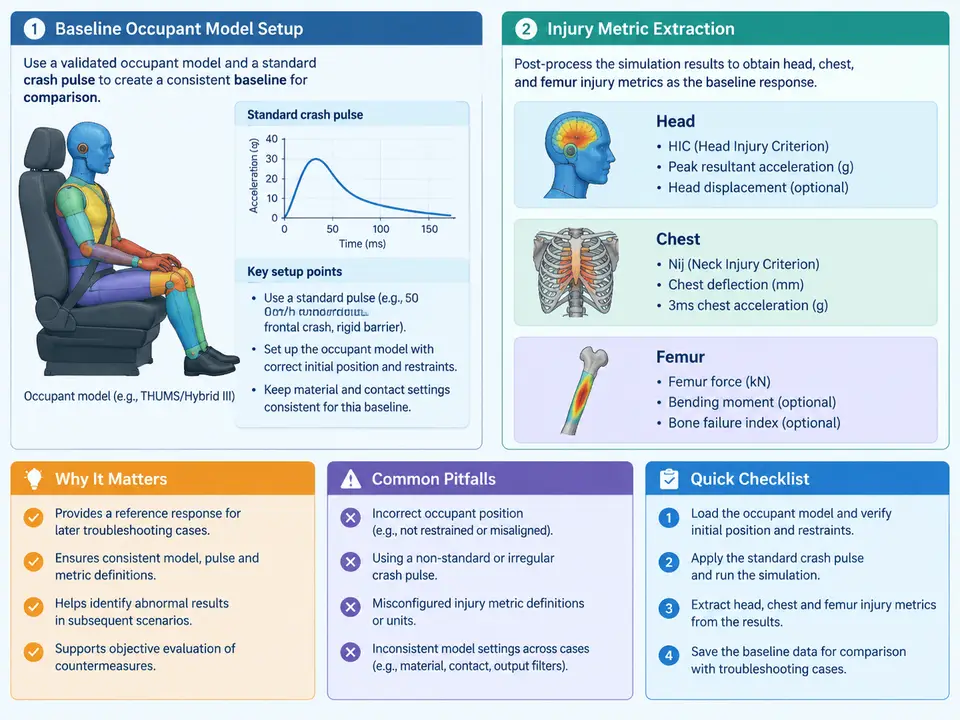
Why a Baseline Must Be Built Before Any Troubleshooting
Every subsequent case in this course — hourglassing artifacts, negative volume terminations, belt-routing errors, contact instabilities — is judged against a reference response. Without a clean, documented baseline, a "fix" is indistinguishable from a change in loading, mesh, or output frequency. This case builds that reference: a single-seat occupant sled model driven by a standard crash pulse, with head, chest, and femur injury metrics extracted in a form that can be compared case-to-case.
The baseline must satisfy three properties to be useful as a reference: it must run to termination without numerical errors, it must be physically plausible (occupant kinematics and belt loads in the expected range), and it must be reproducible (same deck, same solver settings, same extracted values). The work below is organized around those three properties rather than around a generic workflow.
Model Composition and the Crash Pulse
A practical baseline for occupant injury work is a Hybrid III 50th percentile male seated in a rigidized seat, restrained by a three-point belt, with the sled prescribed by a boundary condition. The essential components and their roles are:
- Sled / rigid body — carries the seat and belt anchorages; driven by
*BOUNDARY_PRESCRIBED_MOTION_RIGIDwith a*DEFINE_CURVEacceleration pulse. - Dummy — Hybrid III 50th percentile, positioned per the seating procedure; contact defined against seat cushion, seatback, and knee bolster.
- Belt — 2D seatbelt elements with
*MAT_SEATBELT, routed through a retractor (*ELEMENT_SEATBELT_RETRACTOR) and slipring, with a pretensioner if the pulse requires it. - Contacts —
*CONTACT_AUTOMATIC_SURFACE_TO_SURFACEfor dummy-to-seat and dummy-to-belt, with a consistent friction coefficient (0.3 is a common starting value for belt-to-clothing).
The crash pulse is the single most important input for comparability. A standard 50 km/h frontal pulse with a rise to approximately 30 g over 30 ms and a total duration of 120 ms is a defensible baseline. The pulse must be defined as acceleration in the sled's local X direction, with the sign convention stated explicitly: positive X is forward (direction of travel), so the pulse decelerates the sled, meaning the prescribed acceleration is negative in the forward direction. Getting this sign wrong is the most common cause of an occupant that "flies forward" instead of loading the belt.
*DEFINE_CURVE
$      LCID        SIDR       SFA        SFO        OFFA       OFFO
          1          0       1.0        1.0        0.0        0.0
$       A1                  O1
       0.0                 0.0
      10.0               -12.0
      20.0               -28.0
      30.0               -30.0
      50.0               -22.0
      80.0               -10.0
     120.0                 0.0

*BOUNDARY_PRESCRIBED_MOTION_RIGID
$      PID       DOF       VAD        LCID       SF        VID
         1         1         2           1      1.0         0
Here DOF=1 is translation in X, VAD=2 selects acceleration input, and LCID=1 references the curve above. The negative ordinates encode deceleration in the forward direction; the sign convention must be documented in the deck header so that later cases do not silently flip it.
Injury Metric Extraction
Three metrics are extracted for the baseline: HIC15 for the head, chest deflection (and the 3 ms chest acceleration clip) for the chest, and femur axial force for each leg. These are computed from *DATABASE_HISTORY_NODE and *DATABASE_ASCII output, then post-processed. The extraction must be defined once and reused verbatim in every later case, otherwise comparisons are meaningless.
- Head — resultant translational acceleration at the head CG node, filtered per SAE J211 CFC 1000, then HIC15 computed over the 15 ms window that maximizes the integral.
- Chest — chest deflection from the chest potentiometer (or the IR-TRACC equivalent), filtered CFC 600; the 3 ms clip is taken on the resultant chest acceleration, CFC 180.
- Femur — axial force at the knee load cell, filtered CFC 600, reported as peak per leg.
The filtering class matters: reporting an unfiltered HIC against a CFC 1000 reference will overstate the value and break comparability. The baseline deck should carry the filter classes as comments next to each output request so the post-processing script and the deck stay in sync.
Reading the Baseline Response
The figure below shows the signal chain from pulse input to the three extracted metrics, with the expected qualitative behavior at each stage. It is the reference against which later cases will be compared: a chest deflection spike that does not appear here, or a head acceleration that departs from this envelope, is the signal that something in the model has changed.
Verification Before Accepting the Baseline
A baseline is only a reference if it passes a short acceptance check. Run the deck to TERMINATION and confirm the following before recording any metric:
| Check | Expected observation | Failure symptom |
|---|---|---|
| Energy balance | Hourglass and internal energy small relative to kinetic; no negative sliding energy | Rising hourglass energy → suspect mesh or control (see later cases) |
| Termination | Normal termination at t = 120 ms | Negative volume or time-step collapse → stop, do not extract metrics |
| Belt routing | Belt stays on shoulder and lap; retractor pays out then locks | Belt slip-off → geometry or slipring error |
| Kinematics | Head moves forward, chest loads belt, knees contact bolster | Occupant "floats" → pulse sign or contact missing |
| Metric plausibility | HIC15, chest deflection, femur force within published Hybrid III ranges for this pulse | Order-of-magnitude outlier → filter class or node ID wrong |
Only after all five checks pass should the extracted values be written into the baseline record. The record should include the pulse curve ID, the filter classes, the node and element IDs used for each metric, and the solver version — these are the fields that later cases will hold constant while changing one variable at a time.
Baseline Record (Deliverable)
The following record is the artifact this case produces. It is intentionally minimal: only the fields that later cases must hold constant or compare against. Fill it with the values from your own run; the structure is what matters.
| Field | Value to record |
|---|---|
| Pulse | LCID 1, 50 km/h frontal, peak ≈ 30 g @ 30 ms, duration 120 ms |
| Sign convention | +X forward; sled deceleration negative in X |
| Dummy | Hybrid III 50th percentile, seated per procedure |
| Belt | 3-point, *MAT_SEATBELT, retractor + slipring, μ = 0.3 |
| Head metric | a_res @ head CG, CFC 1000, HIC15 over 15 ms window |
| Chest metric | Deflection CFC 600; a_res 3 ms clip CFC 180 |
| Femur metric | Axial force CFC 600, peak per leg |
| Solver | LS-DYNA version, CPU count, mass-scaling settings |
| Acceptance | All five verification checks passed |
With this record in hand, the next case can change exactly one thing — hourglass control, mesh quality, belt routing — and attribute any change in HIC15, chest deflection, or femur force to that change rather than to an undocumented difference in the baseline.