1. Frontal impact dummy landscape
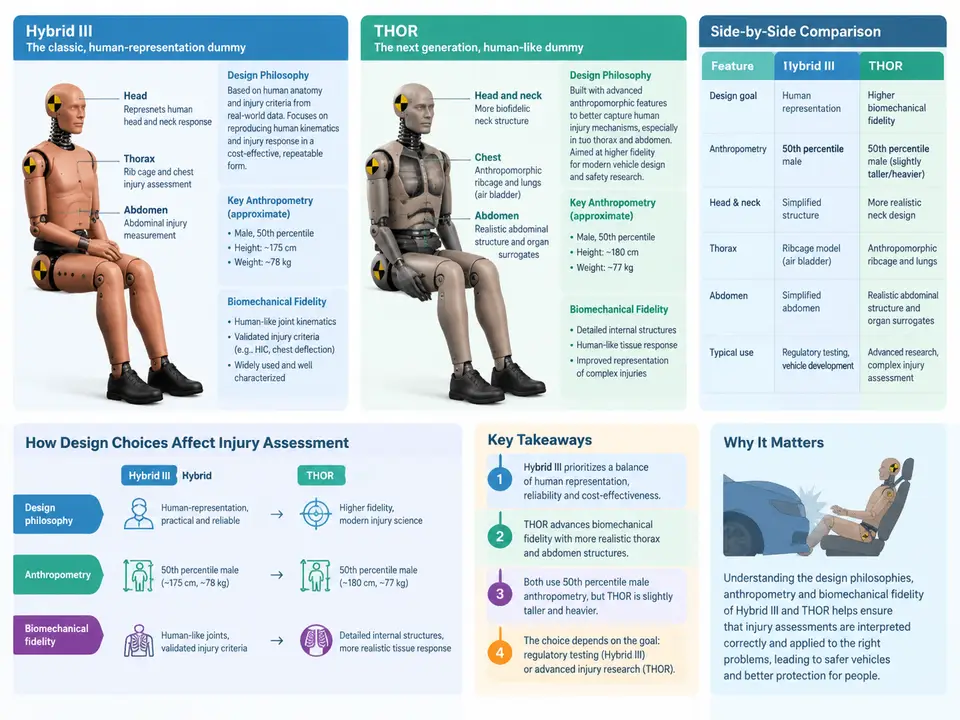
Every frontal impact injury assessment ultimately rests on a physical surrogate: a device that must sit in a seat, absorb energy, and report numbers that engineers translate into human injury risk. Two anthropomorphic test devices (ATDs) dominate this landscape — the Hybrid III, in service since the mid-1970s, and the THOR (Test Device for Human Occupant Restraint), developed from the late 1990s onward to address the Hybrid III's known blind spots. Understanding why both exist, and where their fidelity diverges, is the foundation for every subsequent decision about instrumentation, corridors, and injury criteria.
Design philosophies: durability-first versus biofidelity-first
The Hybrid III was engineered in an era when repeatability and ruggedness mattered more than anatomical realism. Its skeleton is a rigid steel and aluminum assembly, its joints are simple hinges and ball joints with adjustable friction, and its flesh is a set of molded PVC and urethane components. The design intent was a device that would survive hundreds of sled runs with minimal maintenance and produce stable, comparable signals. That philosophy succeeded: the Hybrid III is the most extensively validated and regulated ATD in history, and its 50th-percentile male variant remains the reference occupant in FMVSS 208, ECE R94, and most consumer rating protocols.
THOR was conceived after researchers documented systematic Hybrid III deficiencies: excessive chest stiffness, a lumbar spine that cannot replicate human flexion-extension, a rigidly coupled head-neck system, and no representation of thoracic deflection distribution. THOR's design philosophy inverts the priority — biofidelity first, with durability achieved through better materials and modular construction. Its spine is a multi-segment flexible column with rubber and polymer elements, its face and skull are deformable, its thorax uses four independently instrumented ribs, and its shoulder and clavicle assemblies permit realistic belt interaction. The trade-off is a device that is more complex, more expensive, and more sensitive to setup and environmental conditions.
Anthropometry and population coverage
Both families are built around a defined anthropometric reference. The Hybrid III 50th-percentile male represents a stature of approximately 175 cm and a mass of 78 kg, with segment masses and inertias derived from 1970s U.S. military anthropometry. The family extends to the 5th-percentile female (≈152 cm, 49 kg) and the 95th-percentile male (≈188 cm, 101 kg), plus the 6-year-old and 3-year-old child variants. THOR is currently mature primarily as a 50th-percentile male, with a smaller female variant under development; this narrower population coverage is a practical limitation that keeps the Hybrid III family in service for small-occupant and child assessments.
Anthropometry is not merely stature and mass. Segment mass distribution, center-of-gravity locations, and moments of inertia govern how the dummy rotates and loads the belt. A restraint tuned on the Hybrid III 50th male may behave differently on THOR because THOR's thoracic mass distribution and shoulder geometry differ, changing belt routing and chest loading paths. Engineers must therefore treat a change of ATD as a change of test condition, not a drop-in substitution.
Biomechanical fidelity: where the two devices diverge
The most consequential differences appear in the head-neck, thorax, and spine. The Hybrid III neck is a butyl-rubber column with a steel cable core, calibrated to flexion-extension corridors from cadaver tests; it is stiff in lateral bending and cannot reproduce the complex coupled response of the human cervical spine. THOR's neck uses a multi-element design with a flexible column and tuned damping, producing more human-like head kinematics under combined loading. In the thorax, the Hybrid III uses a single central deflection measurement (the chest potentiometer) that reports one scalar displacement; THOR's four-rib instrumentation reports deflection at multiple points, enabling detection of asymmetric loading from oblique or offset impacts — a scenario increasingly relevant as frontal protocols add oblique barriers.
The lumbar spine is another fault line. Hybrid III's lumbar is a curved rubber element that resists flexion but offers limited realism in extension and shear. THOR's multi-segment lumbar permits realistic coupled motion and includes a pelvis designed to interact with modern belt geometry, including lap-belt loading and submarining assessment. For submarining evaluation specifically, THOR's pelvic instrumentation and geometry make it the more informative device.
What this means in practice
Consider a concrete engineering scenario. A team is developing a restraint for a mid-size sedan and must decide which ATD to use for an oblique 56 km/h sled test with a 15° angled barrier. On the Hybrid III, the chest potentiometer will report a single deflection value, and the shoulder belt will likely load the rigid clavicle region in a way that under-represents real occupant shoulder roll-out. On THOR, the four-rib array will show higher deflection on the loaded side, and the flexible shoulder will allow the belt to migrate — producing a different, and generally more realistic, chest loading pattern. If the team validates only on Hybrid III, they may miss asymmetric rib loading that a THOR test would reveal.
The practical workflow is therefore not "pick one dummy" but "know what each dummy can and cannot tell you." A defensible approach: use the Hybrid III for regulatory certification and for comparability with historical data; use THOR for restraint concept development, oblique and offset screening, and submarining evaluation; and never compare injury numbers across the two devices without re-baselining. Injury criteria themselves differ — Hybrid III chest deflection is interpreted through the standard chest compression criterion, while THOR's multi-point deflection supports more granular rib-strain-based assessment, and THOR's neck and spine outputs feed criteria that have no direct Hybrid III equivalent.
Setup sensitivity: a practical caution
Because THOR is more articulated, its response is more sensitive to positioning and environment. Seat back angle, H-point location, belt anchor geometry, and even ambient temperature affect the flexible elements measurably. A common failure symptom in early THOR testing is a chest deflection trace that looks plausible but is offset from the expected corridor — often traced to a lumbar element that was not properly seated or a rib that was over-torqued during installation. Before trusting any THOR output, verify that the spine column is fully engaged, the ribs are at specified preload, and the head-neck assembly is centered. The Hybrid III tolerates sloppier setup; THOR does not.
The landscape in summary
The Hybrid III and THOR are complementary instruments born of different eras and priorities. The Hybrid III offers unmatched regulatory acceptance, durability, and historical continuity across a full anthropometric family. THOR offers superior biofidelity in the head-neck, thorax, spine, and pelvis, at the cost of complexity, cost, and narrower population coverage. A competent injury assessment engineer knows the design philosophy behind each device, understands which body regions each represents faithfully, and selects the ATD — and interprets its signals — accordingly. That judgment is the prerequisite for everything that follows in this course.