1. Course overview
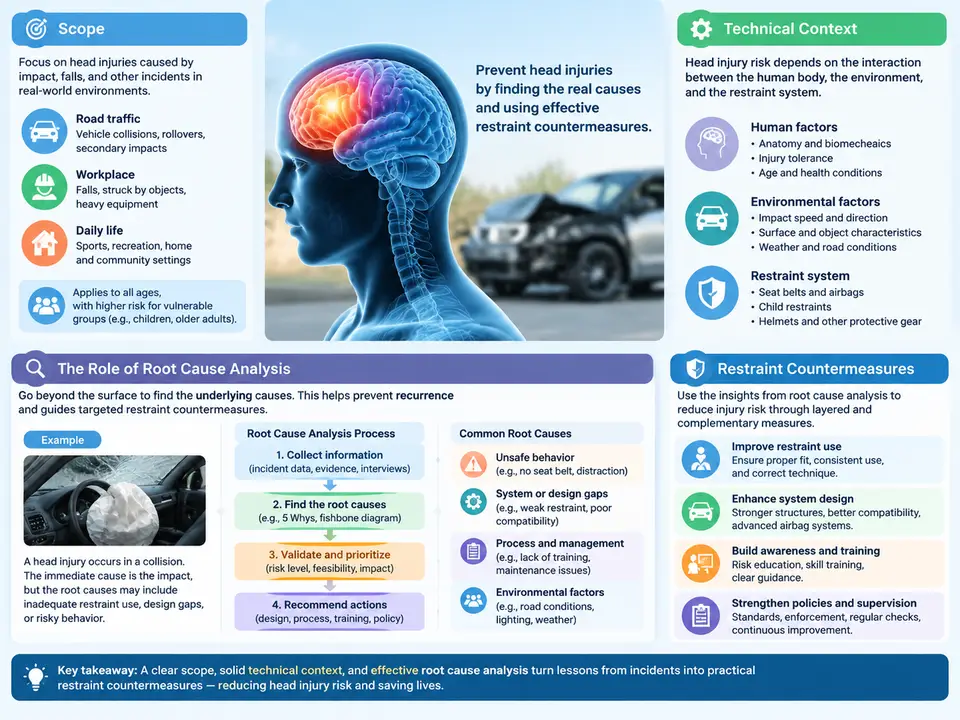
Head injuries in restraint situations are rarely the product of a single mistake. They emerge from the interaction of equipment design, human behavior, environmental conditions, and procedural gaps. This course examines that interaction systematically: it treats head injury as an outcome to be traced backward through a causal chain, and restraint countermeasures as the engineered and procedural controls that interrupt that chain before harm occurs. The scope spans the full lifecycle — from hazard identification and incident reconstruction through countermeasure selection, verification, and continuous improvement.
The technical context is deliberately cross-disciplinary. Restraint systems appear in vehicle occupant protection, patient handling in healthcare, law enforcement and custodial settings, and industrial fall-arrest and machine-guarding applications. In each domain, the head is the most vulnerable body region: it combines high mass relative to its supporting structures, limited tolerance to acceleration, and a geometry that concentrates impact force on small contact areas. A restraint that controls the torso but permits uncontrolled head excursion can convert a survivable event into a fatal one. Understanding this asymmetry is the foundation for everything that follows.
Why Root Cause Analysis Belongs at the Center
Corrective action without causal understanding produces what practitioners call "symptom chasing": a pad is added, a strap is tightened, a training slide is updated — and the same injury recurs under a slightly different configuration. Root cause analysis (RCA) changes the question from what failed to why the system permitted that failure. In head injury prevention, this distinction matters because the proximate cause is almost always visible and almost never sufficient. A head strike against a door frame during a transport maneuver is the proximate event; the root causes may include a restraint anchor point positioned to permit lateral excursion, a staffing pattern that forced a single-operator transfer, and an intake assessment that failed to flag agitation risk.
RCA in this domain follows a structured logic. The analyst reconstructs the event sequence, identifies the energy transfer that produced the injury, and then tests each candidate cause against three criteria: it must be necessary (removing it would have prevented or mitigated the outcome), actionable (a realistic control exists), and systemic (it explains recurrence, not just this instance). Causes that fail the third test are recorded but not treated as root causes — they are contributing factors. This discipline prevents the common failure mode of blaming the nearest individual and closing the case.
The Causal Chain from Hazard to Head Injury
The diagram below maps the causal structure this course uses throughout. It separates the hazard environment, the restraint system's performance envelope, the human and procedural layer, and the injury outcome, showing where RCA interrogates the chain and where countermeasures are inserted.
The chain is read left to right as the forward path of an event, and bottom-up as the analytical path. RCA works upward from the outcome, asking at each layer what condition allowed the preceding layer's failure to propagate. Countermeasures work downward, and the strongest programs pair a hardware control with a procedural one — an excursion limiter alone will not help if staffing prevents its correct application.
What the Course Covers, and How It Is Organized
The curriculum is sequenced to build analytical capability before tooling. Early chapters establish injury mechanics and the physics of head acceleration, because a countermeasure cannot be evaluated without a tolerance criterion. The middle section develops the RCA method itself: evidence collection, timeline reconstruction, barrier analysis, and the distinction between active and latent failures. Later chapters move into countermeasure engineering — restraint geometry, load distribution, padding selection, and the verification testing that confirms a control performs as intended. The final section addresses program-level integration: incident reporting culture, data trending, and audit cycles that keep countermeasures effective over time.
Across all chapters, a consistent analytical vocabulary is used. Hazard is a condition with potential for harm. Barrier is any control that interrupts the path from hazard to harm. Latent failure is a pre-existing weakness that lies dormant until an active failure exposes it. Countermeasure is a barrier deliberately introduced or strengthened as a result of analysis. Keeping these terms precise prevents the common confusion in incident reports where "cause" and "contributing factor" are used interchangeably.
An Illustrative Reconstruction
Consider a representative scenario used in the course's worked examples. During a two-person transfer, a restrained individual sustains a forehead laceration against a door frame. The proximate event is contact. A superficial review concludes "operator error — insufficient clearance." An RCA, however, reconstructs the timeline and finds that the restraint's lateral anchor permitted approximately 180 mm of head excursion under a moderate lateral load, that the doorway clearance on the chosen route was 250 mm, and that the route was selected because the primary corridor was blocked by stored equipment. Three barriers were absent or degraded: excursion limitation, route clearance control, and housekeeping discipline. The corrective action set therefore includes an anchor repositioning, a route-clearance check added to the transfer checklist, and a storage audit — not a disciplinary note.
Learning Outcomes
By the end of the course, a participant should be able to: reconstruct a head-injury event into a defensible causal chain; classify causes as root, contributing, or proximate using the necessity–actionability–systemic test; select countermeasures that address the identified layer rather than the visible symptom; and design a verification step that would detect countermeasure degradation before the next injury. These outcomes are assessed through case-based exercises in which learners analyze incident narratives and defend their causal conclusions against alternative explanations.
The measure of success for this course is not the ability to recite a method, but the ability to look at a restraint system and a set of incident records and identify where the chain is weakest — and what specific, verifiable change would break it.