1. Global NCAP landscape
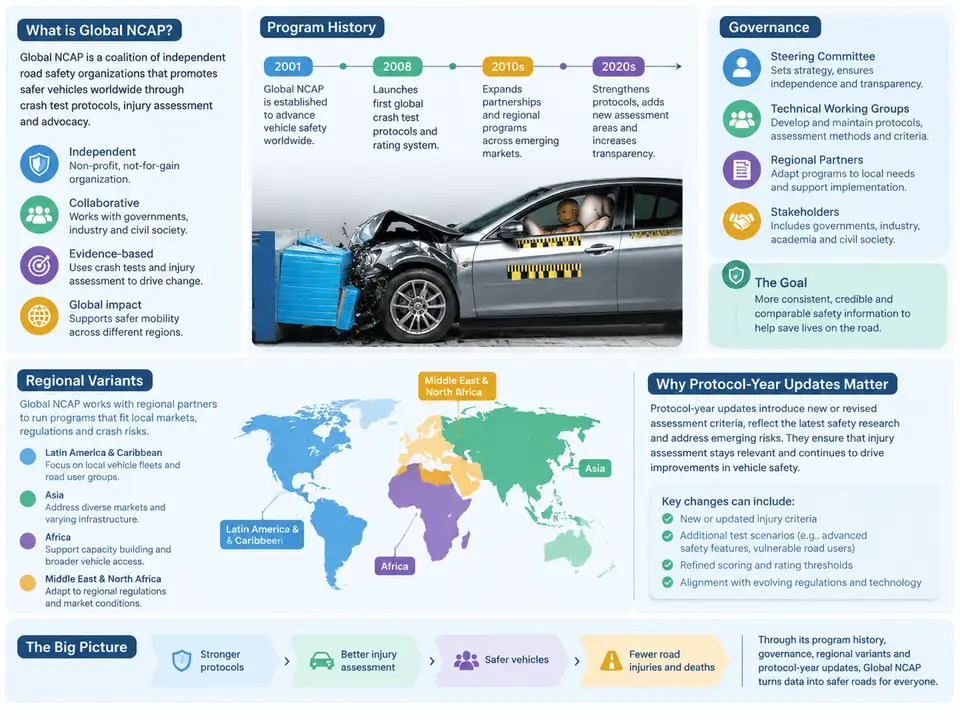
Global NCAP is not a single laboratory or a single regulation. It is a coordinating umbrella under which independent consumer-testing programmes apply comparable crash-test methods and publish star ratings for vehicles sold in their regions. For anyone working in injury assessment, the practical consequence is that a vehicle's safety performance is always reported relative to a specific protocol version. A five-star result from 2019 and a five-star result from 2024 are not interchangeable claims: the test matrix, dummy instrumentation, injury criteria, and scoring thresholds may all have changed in between. This chapter establishes the institutional map and the versioning logic that the rest of the course depends on.
Origins and the umbrella structure
The consumer-testing model began with US NCAP in 1979 and was reshaped by Euro NCAP in 1997, which introduced independent procurement of vehicles, published star ratings, and a progressively tougher test menu. Global NCAP was founded in 2011 as a UK-registered charity to extend that model to emerging markets and to harmonise where harmonisation is sensible. Its role is catalytic rather than regulatory: it sets a shared philosophy, publishes Roadmap documents that signal future requirements, and provides technical support and, in some cases, funding for new programmes. It does not type-approve vehicles and its results carry no legal force.
Latin NCAP (2010) and ASEAN NCAP (2013) were the first regional programmes; Bharat NCAP (launched 2023, with results from late 2023 onward) added a large market with its own protocol derived from Global NCAP's Safer Cars for India work. Each programme is governed by its own steering committee, typically comprising motoring organisations, insurers, government observers, and technical partners, and each maintains its own protocol documents, test-facility accreditation, and rating scheme. The umbrella matters because a manufacturer designing for one market can read another programme's roadmap and anticipate requirements, but it does not guarantee that a single test campaign satisfies every programme.
What actually varies between programmes
Regional variants diverge along four axes that directly affect injury assessment:
- Test matrix. Euro NCAP runs frontal offset (50 km/h, 50% overlap, mobile deformable barrier), full-width frontal, side barrier, side pole, and since 2020 a far-side occupant test; Latin NCAP and ASEAN NCAP historically emphasised frontal offset and side barrier with a lighter pole programme; Bharat NCAP's initial protocol combines offset deformable barrier, side movable deformable barrier, and pole tests with a pedestrian assessment.
- Dummy fleet and instrumentation. Hybrid III 50th percentile remains common in frontal tests, but THOR-50M appears in newer Euro NCAP frontal assessments, and WorldSID 50th is used for side impact. Injury criteria therefore differ: Hybrid III relies on HIC36, chest deflection, and femur loads; THOR adds lower-extremity and abdomen channels; WorldSID adds rib deflection and abdominal pressure sensing.
- Injury criteria and thresholds. The same physical loading can be scored differently. A chest deflection of 35 mm may sit near an "adequate" band in one protocol year and inside a "marginal" band in another after threshold tightening.
- Rating aggregation. Some programmes use a points-based system with sub-scores for adult occupant, child occupant, vulnerable road user, and safety assist; others weight body regions differently or apply a "star cap" if a critical body region falls below a minimum.
Why protocol-year updates dominate injury assessment
Protocols are revised on a roughly three-year cadence, with annual minor amendments. Each revision can change the physical test, the measurement chain, or the scoring logic — and any of the three changes the injury outcome. Consider a frontal offset test: if the protocol moves the barrier speed from 64 km/h to 50 km/h with a different overlap, the occupant's deceleration pulse changes, which changes chest deflection and hence the chest score. If the dummy is upgraded from Hybrid III to THOR, new channels become scoreable and previously invisible injuries (for example, to the abdomen) begin to count. If the threshold for a "good" chest deflection is tightened, an unchanged vehicle can lose points without any hardware change.
The practical workflow for a compliance engineer is therefore version-first: identify the protocol year that applies to the market and model year, retrieve the corresponding protocol document and its appendices (test procedures, injury criteria tables, rating guidelines), and only then plan the test campaign. The figure below maps the relationship between the umbrella, the regional programmes, and the versioning chain that feeds into a single injury-assessment outcome.
Reading a protocol update as an engineering change
Treat each protocol revision as a change request against your validation plan. A workable procedure is to diff the new protocol against the previous version in four passes. First, diff the test procedure: any change in impact speed, overlap, barrier mass or stiffness, or seat position alters the loading. Second, diff the dummy and instrumentation list: a new dummy type means new channels, new calibration tolerances, and possibly new positioning procedures. Third, diff the injury criteria table: record every threshold change and every newly scoreable channel. Fourth, diff the rating guidelines: check whether sub-score weights, star caps, or minimum body-region requirements changed.
As a concrete example, suppose a programme's 2024 revision raises the frontal offset impact speed from 64 km/h to 65 km/h and tightens the chest deflection threshold for a "good" rating from 42 mm to 38 mm. A vehicle previously scoring 3.8 points on chest may now score 3.2, and if the star cap requires a minimum chest score, the overall rating can drop by one star with no hardware change. The correct engineering response is not to re-tune the restraint blindly but to re-run the test with the new pulse, compare chest deflection traces against the new threshold, and decide whether the restraint tuning or the structure needs adjustment. The observable verification criterion is the measured peak chest deflection against the new threshold, not the star rating alone.
Governance implications for injury assessment work
Because Global NCAP has no regulatory authority, compliance is contractual and reputational rather than legal. Manufacturers submit vehicles voluntarily, and programmes reserve the right to select variants, purchase vehicles anonymously, and publish results. This means the injury-assessment engineer must be able to defend every number against the published protocol: the dummy serial number and calibration date, the channel list and filter class, the injury criteria calculation, and the scoring worksheet. A result that cannot be traced to a specific protocol clause is not defensible in a technical review, regardless of how good the star rating looks.
The governance structure also explains why regional variants persist. Each programme's steering committee balances local market conditions, vehicle fleet characteristics, and cost of testing against the desire for harmonisation. The result is a family of protocols that share philosophy and often share test facilities, but differ in detail. For the injury-assessment engineer, the discipline is simple and non-negotiable: identify the programme, pin the protocol year, and assess against that version only.