1. Course overview
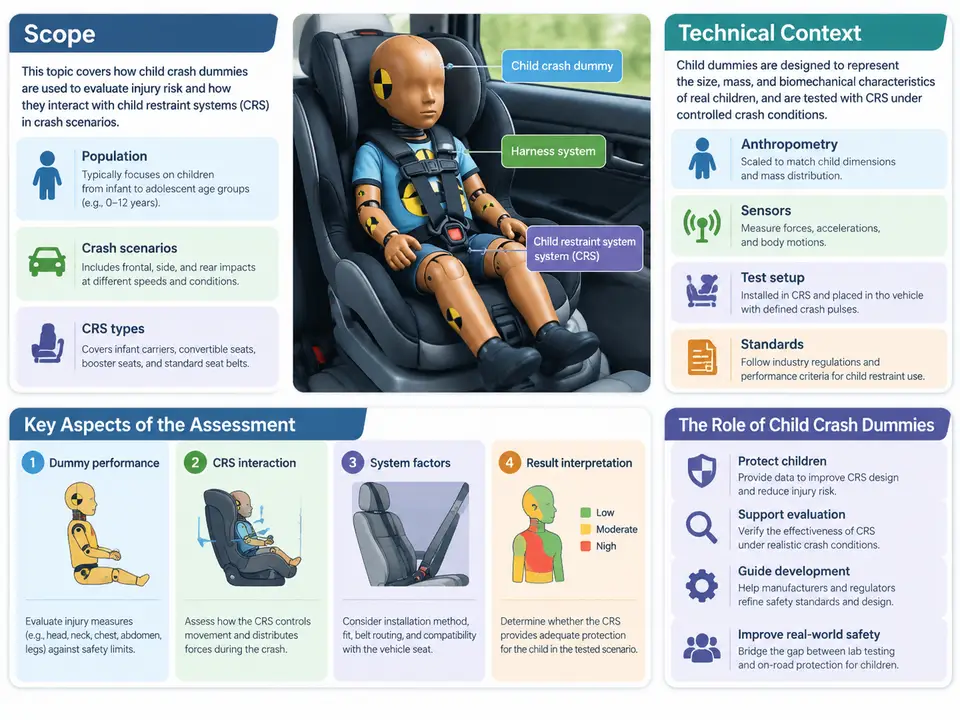
Child restraint systems (CRS) — infant carriers, convertible seats, booster cushions, and integrated child seats — are among the few safety products whose performance is judged almost entirely by surrogate testing. No regulatory or consumer-test protocol places a living child in a crash; instead, an anthropomorphic test device (ATD), commonly called a crash dummy, occupies the seat and records what a child of that size and mass would plausibly experience. This course is about that surrogate: how child dummies are built, instrumented, positioned, and interpreted, and how their measurements are converted into injury assessments that determine whether a CRS passes, fails, or earns a consumer rating.
The scope is deliberately end-to-end. It begins with the dummy as a physical and metrological object — mass distribution, joint stiffness, biofidelity corridors, sensor locations — and ends with the engineering decision: is the measured response acceptable, and what in the CRS design or installation caused it to be otherwise? Between those two ends sit the practical skills this course develops: selecting the correct dummy for a given regulation and child size, installing it reproducibly, running sled or full-vehicle tests, processing accelerometer and load-cell channels, and defending the resulting numbers against the tolerances that govern them.
Why the dummy, and not the child, defines the test
A CRS is a coupled system: the vehicle seat, the CRS shell, the harness or shield, the child's body, and the belt or ISOFIX attachments all interact within tens of milliseconds. The dummy is the element that makes this coupling measurable and repeatable. Its value lies in three properties that a real child cannot offer in testing: repeatability (the same dummy produces statistically similar responses across runs), instrumentability (accelerometers and load cells can be placed inside the head, chest, abdomen, and pelvis), and standardization (every laboratory worldwide uses the same geometry and mass so that results are comparable across facilities and regulatory regimes).
This is also the course's central caution. A dummy is a model, not a scaled child. Its biofidelity — how faithfully it reproduces human kinematics and injury tolerance — is validated only within defined corridors and loading regimes. When a test falls outside those regimes (very oblique impacts, prolonged rollover, nonstandard belt routing), the numbers remain precise but their injury interpretation weakens. Understanding where the surrogate is trustworthy, and where it is not, is a recurring theme throughout the course.
The regulatory and technical landscape
Child dummy practice is fragmented across jurisdictions, and the fragmentation is not cosmetic — it changes which dummy is used, which channels are recorded, and which criteria decide pass or fail. The principal families are worth fixing in mind from the outset:
| Dummy family | Nominal size / mass | Primary regulatory context | Characteristic instrumentation |
|---|---|---|---|
| Q-series (Q0, Q1, Q1.5, Q3, Q6, Q10) | Newborn to ~10-year-old; Q6 ≈ 22 kg, Q10 ≈ 32 kg | UN ECE R44/R129 (i-Size), Euro NCAP | Head accelerometers, chest deflection, abdominal pressure, pelvis and shoulder loads |
| Hybrid III 3-year-old and 6-year-old | ~15 kg and ~23 kg | FMVSS 213, FMVSS 225, US NCAP | Head and chest accelerometers, upper-neck load cell, chest deflection |
| CRABI 12-month and 18-month | ~10 kg and ~11 kg | FMVSS 208 (airbag interaction), FMVSS 213 | Head and chest acceleration, neck loads |
| Q10 / HIII 10-year-old | ~32–35 kg | Booster assessment, belt-fit studies | Head, chest, pelvis; belt-path load cells |
The Q-series dominates European practice and is the reference family for this course, but the assessment logic transfers: every family encodes a particular injury hypothesis in its sensor set. A dummy with abdominal pressure sensors is telling you that abdominal loading matters for that size class; a dummy with only head and chest channels is implicitly prioritizing head and thoracic injury. Reading the instrumentation is reading the injury theory.
From measurement to injury assessment
The chain from a sled pulse to a pass/fail decision has a consistent structure, and the figure below traces it. A crash pulse is applied to the sled or vehicle; the CRS and dummy respond; sensors record time histories; those histories are filtered and reduced to scalar criteria; the criteria are compared against limits that are size- and regulation-specific.
Two features of this chain deserve emphasis early. First, the filtering step is not clerical: the choice of channel frequency class (CFC 60 for chest deflection, CFC 600 for head acceleration, for example) changes the peak value and therefore the criterion. Second, the limits are not universal constants — a HIC15 of 600 may be acceptable for one size class under one regulation and marginal under another. The course treats criteria as regulatory constructs with defined derivation, not as physical truths.
What the course asks you to be able to do
By the end of the course, a competent participant should be able to take a CRS test request and carry it through without supervision. Concretely, that means:
- Select and justify a dummy for a given child size, CRS category, and regulatory market, including the differences between Q-series and Hybrid III responses at the same nominal size.
- Install the dummy reproducibly — H-point and seat-back angle setting, harness routing and tension, clothing and limb positioning — and recognize the installation errors that most often corrupt results.
- Acquire and process channels correctly, including sensor identification, polarity conventions, filtering, and the time-window rules that define each criterion.
- Compute and interpret criteria such as HIC, chest resultant acceleration over 3 ms, chest deflection, and neck Nij, and explain what each one does and does not capture.
- Diagnose failures by tracing a criterion exceedance back to a kinematic or design cause rather than treating the number as an endpoint.
A worked orientation example
To make the abstraction concrete, consider a representative frontal sled test used throughout the early chapters as a running example. A Q3 dummy (nominal mass 15 kg) is placed in a forward-facing CRS installed with ISOFIX and a top tether on a sled configured to a 50 km/h, 28 g frontal pulse. The head accelerometer is sampled at 20 kHz and filtered to CFC 600; the chest deflection channel is filtered to CFC 60. Suppose the processed head resultant acceleration yields HIC15 = 540 and the chest deflection peaks at 42 mm. Whether those values pass depends on the applicable limit set — and the course will show how to look that up, how to verify the processing was correct before trusting the number, and how a 42 mm deflection would be traced to harness slack, shell rotation, or tether geometry if it were marginal.
How the course is organized
The thirty chapters move from foundations to application. The opening block establishes dummy anatomy, biofidelity, and the regulatory map. A middle block covers test setup, instrumentation, data processing, and criterion computation in engineering detail. The closing block applies all of it to CRS categories — infant, convertible, booster, and integrated seats — and to the diagnostic work of explaining why a particular design or installation produced the response it did. Each chapter is self-contained but assumes the vocabulary introduced here: ATD, biofidelity corridor, CFC, HIC, Nij, and the distinction between a measured channel and a derived criterion.
The through-line is a single question that recurs in every chapter: what does this number mean for a real child, and how confident can we be in that interpretation? A child crash dummy is a powerful instrument precisely because it is standardized and repeatable, but it is an instrument with a defined operating envelope. Learning to work inside that envelope — and to recognize when a test has left it — is the core competence this course aims to build.