1. Occupant safety system overview
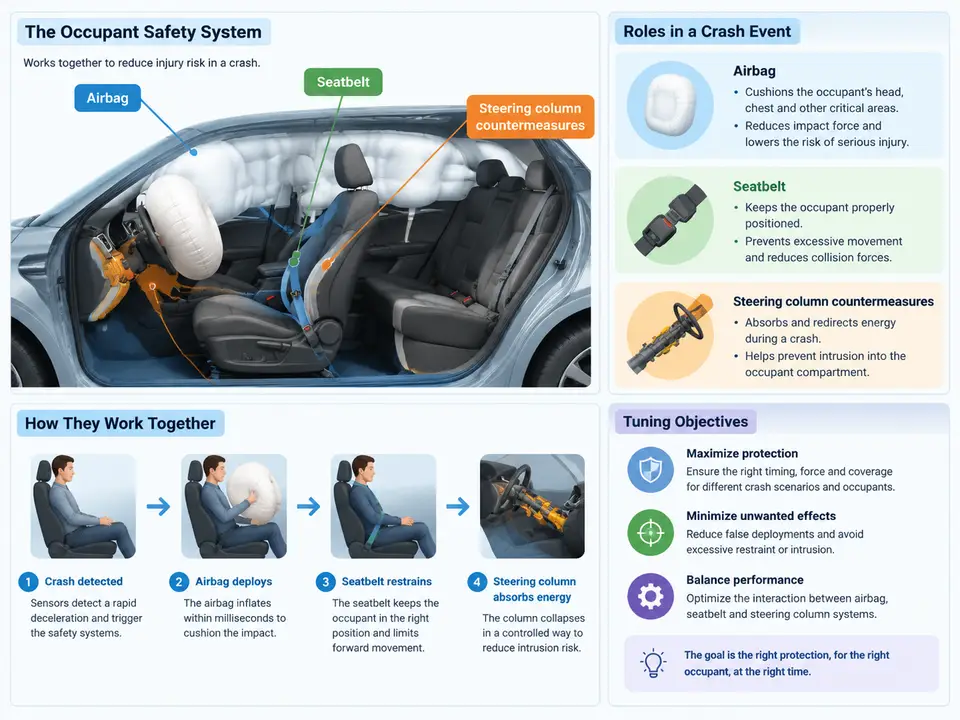
Every modern vehicle crash event is managed by a coordinated set of restraint and energy-absorption devices rather than by any single component. The airbag, the seatbelt, and the steering column form the three primary countermeasure families in frontal impact protection, and their tuning is deeply interdependent. This chapter establishes the shared mental model that the remaining 29 chapters build on: what each subsystem physically does during a crash, how the three interact in time and space, and what "tuning" actually means in engineering terms.
The three countermeasure families and their physical roles
Seatbelt systems are the primary restraint. A three-point belt with a retractor, load limiter, and pretensioner does three jobs: it couples the occupant to the vehicle so deceleration begins early, it limits peak belt force through controlled spool-out, and it positions the occupant for the airbag. The pretensioner removes slack within roughly 10–30 ms of a valid crash signal; the load limiter then caps shoulder-belt force, typically in the 3–6 kN range for a mid-size passenger car, by allowing the webbing to pay out through a torsion bar or similar element.
Airbags are supplemental restraints. A driver frontal airbag must inflate, vent, and deflate within roughly 100–150 ms so that it is a compliant cushion — not a rigid surface — when the occupant arrives. Its tuning levers include inflator output (mass flow and gas temperature), vent-hole area, cushion volume and geometry, and tether configuration. The airbag's job is to distribute occupant load over a large area and to absorb residual energy after the belt has done its primary work.
Steering column countermeasures address the driver specifically. A collapsible steering column uses shear capsules, sliding tubes, or crush elements to stroke axially when the driver loads the wheel through the airbag. This stroke absorbs energy and, critically, controls the wheel's rearward travel so the airbag module does not become a rigid impact surface. Column stroke is typically on the order of 50–150 mm depending on architecture, and its force–displacement characteristic must be tuned together with airbag venting.
How the three interact in a frontal crash
The crash timeline is the organizing principle. Consider a 50 km/h full-frontal rigid barrier impact, a standard tuning reference case. The vehicle's crash pulse — the deceleration history measured at the sill or tunnel — typically peaks between 30 and 45 g and lasts 80–120 ms. The restraint control module (RCM) must fire pretensioners and airbags within a decision window of roughly 10–20 ms after the pulse crosses its arming threshold, otherwise the occupant arrives at the airbag before it is fully deployed, or the airbag has already begun to vent.
The occupant's kinematics then unfold in sequence: belt pretensioning pulls the occupant rearward into the seat; the occupant's torso loads the belt and begins to decelerate; the head and chest move forward into the deploying airbag; the airbag compresses and vents, absorbing energy; the column strokes as driver load transfers through the wheel. The tuning objective is to shape this sequence so that occupant injury metrics — head injury criterion (HIC), chest deflection, and neck loads — stay below regulatory and internal targets while the airbag and column do not introduce their own loading peaks.
What "tuning" means in this course
Tuning is the deliberate adjustment of countermeasure characteristics so that the combined system meets occupant-protection targets across a defined matrix of crash modes, severities, and occupant sizes. It is not optimization of a single metric. A typical tuning matrix includes full-frontal rigid barrier at 50–56 km/h, offset deformable barrier (ODB) at 64 km/h, and a range of sled pulses representing vehicle classes; occupant variants include the 50th-percentile male, 5th-percentile female, and child restraint configurations.
The tuning levers fall into three groups. Deployment timing is set by the RCM's crash algorithm — arming threshold, discrimination time, and fire order. Energy management is set by belt load-limiter force level, airbag vent area and inflator output, and column crush force. Geometry and position is set by airbag cushion shape and tethering, seat position, and column tilt/stroke envelope. Each lever has a characteristic effect: increasing load-limiter force reduces chest deflection but raises belt loading and can increase head excursion; increasing vent area softens the airbag but may allow bottoming-out on the column; increasing column stroke reduces driver chest load but changes the airbag's effective contact surface.
A worked tuning example
Suppose a baseline 50 km/h frontal sled result shows chest deflection at 42 mm against a 40 mm internal target, while HIC is comfortably low at 480. The engineer has three candidate adjustments: raise the load-limiter force from 4.0 kN to 4.5 kN, increase airbag vent area by 15%, or add 20 mm of column stroke. Raising the limiter force directly reduces chest deflection but increases the risk of belt-induced rib loading and may push head excursion up. Increasing vent area softens the cushion and reduces chest load but may let the head approach the column. Adding column stroke reduces driver chest load without changing belt force, but only helps the driver, not the passenger.
A defensible first iteration is to raise the limiter to 4.3 kN and add 15 mm of column stroke, then re-run the sled. The expected observable is chest deflection dropping toward 38–39 mm with HIC remaining under 550 and head excursion within the 120 mm envelope. If chest deflection does not respond, the belt geometry or retractor locking behavior should be checked before further force increases. If HIC rises sharply, the airbag vent change should be revisited rather than the belt. This iterative, one-lever-at-a-time discipline — with a clear expected direction of change for each metric — is the core working method of the course.
Tuning objectives, stated precisely
The objectives that govern every later chapter can be summarized as follows. First, meet occupant injury criteria — HIC, chest deflection, chest acceleration, neck load, and femur load — with margin across the tuning matrix. Second, preserve out-of-position (OOP) robustness: the airbag must not injure occupants who are close to the module at deployment, which constrains inflator output and venting. Third, maintain deployment reliability: no fire in non-crash events, no failure to fire in valid crashes, and correct discrimination of severity. Fourth, keep the system robust to variation — occupant size, seat position, belt routing, temperature, and vehicle build variation. Fifth, satisfy regulatory and rating requirements (FMVSS 208, Euro NCAP, C-NCAP, and similar) without over-designing cost into the system.
These objectives conflict, and the conflicts are the substance of tuning. A stiffer belt helps chest deflection but hurts OOP and small-occupant performance. A more aggressive airbag helps large-occupant protection but raises OOP risk. A longer column stroke helps the driver but consumes packaging space and changes the airbag's contact geometry. The remaining chapters examine each countermeasure in depth, then bring them together into a coordinated calibration process.
| Countermeasure | Primary physical role | Key tuning levers | Typical tuning window |
|---|---|---|---|
| Seatbelt (pretensioner + load limiter) | Couple occupant early; cap belt force | Pretensioner stroke, limiter force level, retractor lock timing | Pretension 10–30 ms; limiter 3–6 kN |
| Driver frontal airbag | Distribute load; absorb residual energy | Inflator output, vent area, cushion volume, tethers | Full inflation 25–40 ms; deflation by ~120 ms |
| Steering column | Control driver forward excursion; absorb energy | Crush force, stroke length, shear-capsule release | Stroke 50–150 mm; crush force matched to airbag |
With this shared model in place — three countermeasure families, one crash timeline, a defined tuning matrix, and a disciplined one-lever-at-a-time iteration method — the course can now examine each subsystem's internal mechanics and calibration detail.