1. Course overview
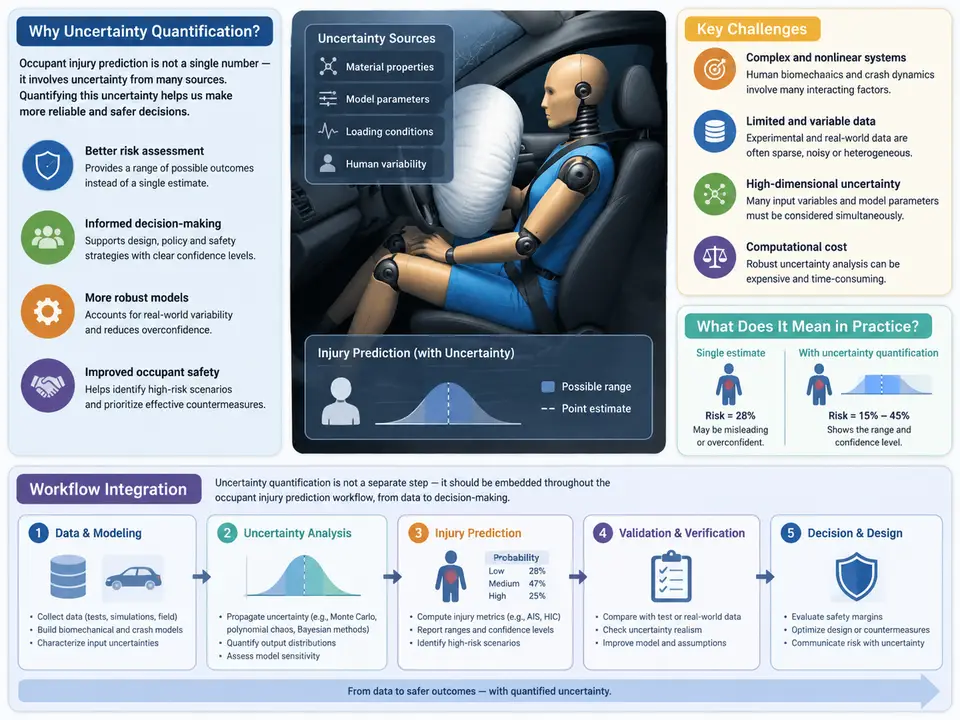
Occupant injury prediction sits at the intersection of crashworthiness engineering, biomechanics, and numerical simulation. A typical workflow takes a vehicle crash pulse and restraint configuration, runs a finite element (FE) occupant model such as a Hybrid III or THOR dummy, and produces injury metrics — HIC15, chest deflection, Nij, femur force, and so on. The output is then compared against regulatory or consumer-rating thresholds. The difficulty is that every stage of this chain carries uncertainty: material properties of the dummy and trim, friction coefficients, airbag inflator variability, belt routing, pulse shape, and the numerical discretization itself. Uncertainty quantification (UQ) is the discipline of characterizing those uncertainties, propagating them through the model, and expressing the prediction as a distribution rather than a single deterministic number.
This matters because a deterministic HIC15 of 680 against a 700 threshold looks like a pass, but if the 95th percentile of the underlying distribution is 810, the design is not robust. UQ converts a binary pass/fail statement into a probabilistic risk statement — for example, "probability of exceeding the HIC15 threshold is 12%" — which is what engineering decisions, safety margins, and regulatory discussions actually require.
Why Uncertainty Dominates Occupant Injury Prediction
Three properties make occupant injury prediction unusually uncertainty-heavy compared with other CAE domains. First, the response is highly nonlinear and threshold-driven. Injury criteria are defined by sharp cutoffs, and small changes in head contact timing or belt spool-out can move a metric across a threshold. Second, the input space is high-dimensional and correlated: dozens of parameters vary simultaneously, and some — such as belt friction and dummy joint stiffness — are physically coupled. Third, validation data are scarce and noisy. Cadaveric and PMHS tests are limited in number, and dummy certification tolerances themselves define a band of acceptable behavior rather than a single truth.
A practical consequence is that naive Monte Carlo with 10,000 FE runs is usually infeasible: a single occupant simulation may take 30 minutes to several hours. UQ for this domain therefore relies on surrogate modeling — Gaussian process regression, polynomial chaos expansion, or neural network surrogates trained on a few hundred Latin hypercube samples — followed by variance-based sensitivity analysis (Sobol indices) to identify which parameters actually drive the injury metric spread.
Key Challenges in Practice
- Input uncertainty specification. Distributions must be defensible. Dummy certification tolerances give bounded intervals (e.g., knee slider friction within a certified range), which are often modeled as uniform or truncated normal; material properties from supplier data may be lognormal.
- Model-form uncertainty. The FE model itself is an approximation. Comparing two dummy models (e.g., Hybrid III vs. THOR) or two solver formulations exposes discrepancy that parameter UQ alone cannot capture.
- Computational budget. Surrogate construction, cross-validation, and convergence checks must fit within program timing. Adaptive sampling and multi-fidelity approaches (coarse mesh + fine mesh) are common mitigations.
- Interpretation and communication. A probability of injury is only useful if it is tied to a clear decision rule and communicated with its assumptions — distribution choices, correlation structure, and surrogate error.
Where UQ Fits in the Workflow
UQ is not a post-processing step bolted onto the end of a crash simulation. It integrates at four points: (1) upfront, when the parameter space and distributions are defined alongside the CAE model; (2) during sampling, when the design of experiments (DoE) is generated and runs are dispatched; (3) at surrogate construction, when the response surface is fitted and validated; and (4) at decision, when probabilistic margins feed restraint tuning or sign-off. The diagram below shows this integration, including the feedback loop from sensitivity results back to parameter definition.
Reading the Workflow in Practice
Consider a concrete example. A frontal 56 km/h pulse is applied to a Hybrid III 50th-percentile occupant model with a three-point belt and driver airbag. The analyst defines six uncertain inputs: belt friction coefficient (uniform 0.25–0.35), inflator mass flow scaling (normal, μ = 1.0, σ = 0.05), pulse scaling factor (normal, μ = 1.0, σ = 0.03), knee-bolster stiffness (uniform ±10%), seat cushion stiffness (uniform ±8%), and dummy neck-pivot friction (certified range). A 200-point Latin hypercube sample is generated, and each point is run through the FE solver. The resulting HIC15 values are fitted with a Gaussian process surrogate; leave-one-out cross-validation gives R² = 0.93 and a normalized RMSE of 0.06, which is acceptable for screening.
Monte Carlo on the surrogate (10⁵ draws, seconds rather than hours) yields a mean HIC15 of 640 and a 95th percentile of 810. The probability of exceeding 700 is approximately 12%. Sobol analysis ranks belt friction first (0.42), inflator mass flow second (0.27), and pulse scaling third (0.16). The engineering response is therefore targeted: tighten the belt friction specification or add a pretensioner calibration study, rather than re-running the entire model with more samples. This is the practical value of UQ — it converts a large, opaque simulation campaign into a ranked, decision-ready set of levers.
What This Course Covers
The remaining chapters build this workflow from the ground up: formalizing input uncertainty from certification and test data, designing DoE campaigns under computational budget, constructing and validating surrogates, computing Sobol indices and probabilistic margins, and integrating the results into restraint tuning and sign-off. Each stage is treated as an engineering task with concrete inputs, observable intermediate results, and explicit acceptance criteria, so that the methods can be reproduced on a real occupant model rather than remaining abstract.