1. Crash response prediction landscape
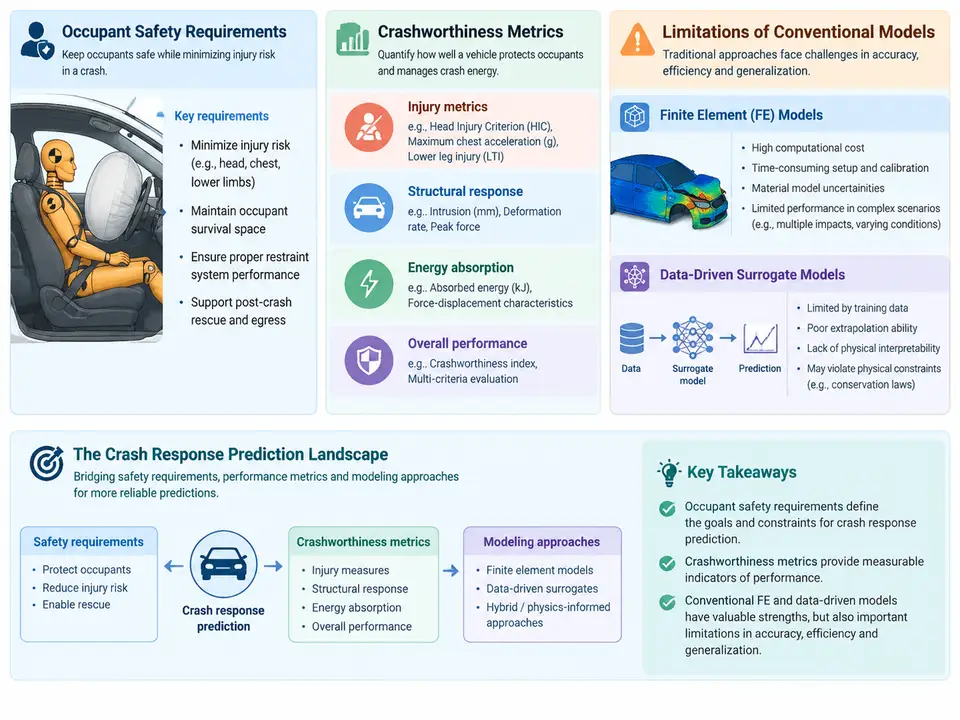
Crash response prediction sits at the intersection of structural mechanics, occupant biomechanics, and computational engineering. Before any neural network is trained, it is essential to understand what the prediction is actually for: protecting occupants during a collision event. This chapter maps the problem space — the safety requirements that define success, the crashworthiness metrics used to quantify it, and the structural limitations of the two dominant modeling paradigms: conventional finite element (FE) simulation and purely data-driven surrogate models. That landscape motivates the physics-informed approach developed throughout the rest of the course.
What Occupant Safety Requirements Demand
Vehicle crash safety is governed by regulatory standards and consumer rating programs that translate real-world injury risk into measurable test criteria. In the US, FMVSS 208 specifies frontal barrier and offset deformable barrier tests with instrumented Anthropomorphic Test Devices (ATDs, or "crash dummies"); FMVSS 214 covers side impact; FMVSS 216a addresses roof crush. In Europe, UN Regulation No. 94/95 and the Euro NCAP protocol impose comparable but not identical load cases. Each test defines a prescribed impact velocity, barrier geometry, and occupant restraint configuration, and each produces a set of injury criteria that must fall below threshold values.
These criteria are not arbitrary. They derive from biomechanical tolerance limits: the Head Injury Criterion (HIC), typically capped at 700 for a 15 ms window in frontal tests; chest deflection limits (e.g., 50–63 mm depending on the ATD and regulation); neck injury metrics such as Nij; and femur axial force limits around 10 kN. A prediction model is only useful if it can resolve these quantities accurately at the occupant level, which means the structural response — deceleration pulses, intrusion, restraint forces — must be captured with sufficient fidelity.
Crashworthiness Metrics: From Structure to Occupant
Crashworthiness is conventionally decomposed into three functions: energy absorption, occupant compartment integrity, and restraint system performance. The front-end structure must crush progressively, converting kinetic energy into plastic deformation rather than transmitting it to the occupant. Key structural metrics include the crash pulse (the acceleration–time history at the occupant compartment), peak deceleration, mean crush force, and the amount of intrusion into the occupant survival space.
The crash pulse is the critical coupling variable. A well-designed front structure produces a pulse that is high enough to absorb energy but shaped to keep occupant deceleration within tolerance — typically a rise to a plateau rather than a sharp spike. Restraint systems (airbags, seat belts, load limiters) are tuned against this pulse. Consequently, a surrogate model that predicts only peak acceleration or total intrusion is insufficient; it must reproduce the pulse shape and its timing, because occupant injury criteria are computed by integrating acceleration over time.
| Metric | Physical meaning | Typical target (example) |
|---|---|---|
| HIC15 | Head injury risk from resultant head acceleration | < 700 |
| Chest deflection | Rib cage compression under belt/airbag load | < 50 mm (varies by ATD) |
| Peak occupant deceleration | Severity of the crash pulse at the compartment | Pulse-shape dependent |
| Intrusion | Loss of survival space (toe pan, dash, door) | Design-specific limit |
| Energy absorbed | Kinetic energy converted by crush members | Match impact energy |
Conventional Finite Element Simulation
The industry workhorse is explicit nonlinear FE analysis, typically in LS-DYNA, Radioss, or Abaqus/Explicit. A full-vehicle frontal model contains millions of shell and solid elements, contact definitions, material models with strain-rate dependence, and a detailed restraint model including airbag gas dynamics. A single 150 ms frontal impact simulation on a high-performance cluster can take several hours to over a day, and a design-of-experiments study may require hundreds of runs.
The strengths are well known: FE captures large deformation, contact, buckling, and material failure from first principles, and it is the basis on which regulatory compliance is demonstrated. The limitations are equally well known and are the reason surrogates exist:
- Computational cost. High-fidelity runs are too slow for interactive design exploration, optimization loops, or real-time occupant risk assessment.
- Modeling burden. Mesh quality, contact parameters, and material calibration dominate engineering effort and introduce analyst-to-analyst variability.
- Numerical sensitivity. Explicit time-step stability, hourglassing, and contact instabilities can produce non-physical results that require expert judgment to detect.
- Parametric rigidity. Each geometry or material change generally requires a new mesh and a new run; the model does not generalize across configurations.
Data-Driven Surrogate Models and Their Limits
Surrogate models — response surfaces, Gaussian processes, and increasingly deep neural networks — learn the mapping from design parameters (sheet thickness, material grade, geometry variables, impact velocity) to response quantities (intrusion, pulse, injury metrics) from a set of FE simulations. Once trained, evaluation is milliseconds, enabling optimization and Monte Carlo uncertainty studies that would be infeasible with FE alone.
However, purely data-driven surrogates have structural weaknesses that become acute in crash problems. Crash response is highly nonlinear and discontinuous: buckling transitions, fracture initiation, and contact switching create sharp changes in output as inputs vary. A network trained on sparse samples can interpolate smoothly across a discontinuity and produce a physically impossible response. Extrapolation beyond the training envelope is unreliable. Worse, a surrogate may fit the training data well yet violate conservation laws — predicting, for example, more energy absorbed than the impact energy available, or a pulse that implies occupant deceleration inconsistent with the structural crush. These are not statistical errors but physics violations, and they are precisely what physics-informed neural networks (PINNs) are designed to prevent by embedding governing equations and constraints into the learning objective.
Why the Gap Matters for This Course
The landscape above defines the central tension. FE simulation is physically trustworthy but computationally prohibitive for the many-query workflows that modern safety engineering demands — design optimization, robustness studies, and rapid what-if analysis. Data-driven surrogates are fast but can silently violate physics, which is unacceptable when the output feeds an injury-risk decision. A model that predicts a HIC of 650 when the true value is 780 is not merely inaccurate; it is a safety hazard.
Physics-informed neural networks address this by combining the speed of learned models with the consistency of governing equations. Rather than treating the FE solver and the surrogate as separate worlds, PINNs use simulation data as one source of supervision and embed the conservation laws, boundary conditions, and constitutive constraints of crash mechanics as additional loss terms. The result is a model that can be evaluated in milliseconds yet respects the energy balance and kinematic relationships that any physically admissible crash response must satisfy.
With this landscape established — the occupant-level targets, the structural metrics that connect them, and the complementary weaknesses of FE and pure data-driven models — the course can now turn to the mechanics and mathematics that a physics-informed formulation must encode.