1. Crash load and contact modeling landscap
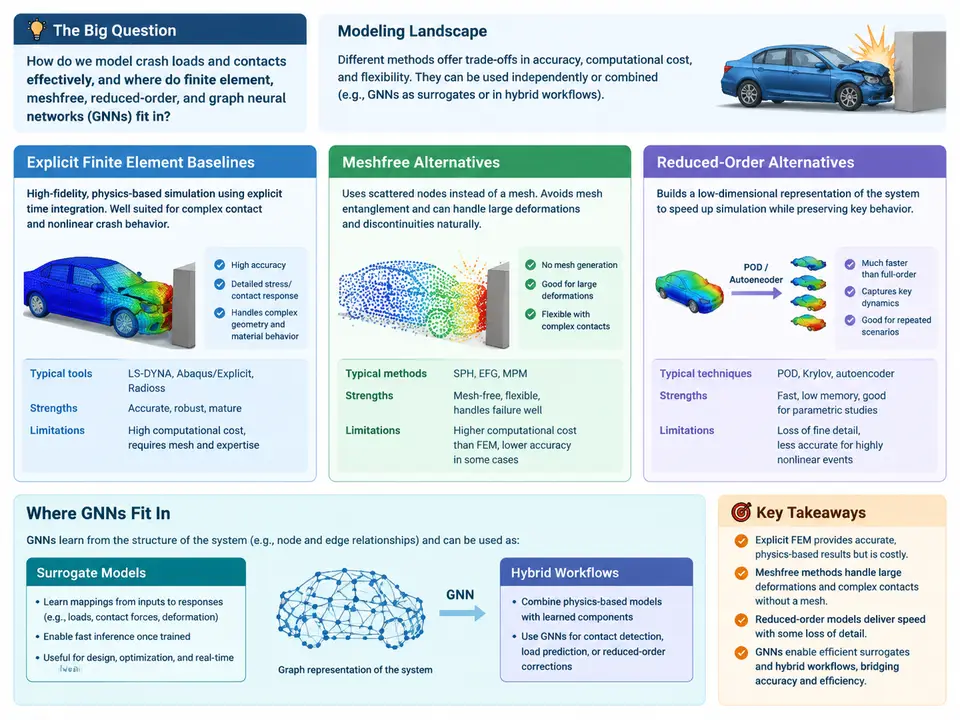
Crashworthiness simulation sits at the intersection of structural mechanics, contact mechanics, and numerical time integration. Before any graph neural network (GNN) enters the picture, it is worth being precise about what the incumbent toolchain actually does, where it strains, and which quantities a surrogate model would even be asked to reproduce. This chapter maps that landscape: explicit finite element (FE) baselines, meshfree and reduced-order alternatives, and the specific niches where GNNs operate as pure surrogates or as components inside hybrid workflows.
Explicit FE as the reference baseline
The dominant method for crash load and contact prediction is the explicit nonlinear finite element method. The central update is the central-difference scheme applied to the semi-discrete equation of motion:
M a_n + C v_n + f_int(u_n) = f_ext(t_n) + f_contact(u_n)
u_{n+1} = u_n + Δt · v_{n+1/2}
v_{n+1/2} = v_{n-1/2} + Δt · M^{-1} (f_ext + f_contact − f_int)
Two properties define the method's character. First, stability is conditional: the time step must satisfy the Courant–Friedrichs–Lewy (CFL) condition, Δt ≤ 2/ω_max, where ω_max is the highest eigenfrequency of the discretized system. Because ω_max scales with the smallest element size and the material wave speed, a single 3 mm solid element in a steel rail can force Δt into the 0.1–0.5 µs range, and a 150 ms crash event then requires on the order of 10⁵–10⁶ increments. Second, the mass matrix is lumped and inverted once, so each increment is cheap but the increment count is enormous. This is the cost structure that motivates every alternative discussed below.
Contact treatment is where explicit crash models become genuinely intricate. Penalty-based contact adds a stiffness-proportional force when penetration is detected; soft-constrained penalty (as in LS-DYNA's *CONTACT with SOFT=1) reduces spurious high-frequency contact noise at the cost of allowing small penetrations. Kinematic or Lagrange-multiplier formulations enforce non-penetration exactly but introduce constraint equations that complicate the explicit update. Friction is typically regularized with a Coulomb model and a static-to-kinetic transition velocity, and the choice of friction coefficient, penalty scale factor, and contact thickness directly changes peak force and intrusion predictions. A surrogate trained on FE outputs inherits all of these modeling decisions as part of its target distribution.
Meshfree and reduced-order alternatives
Meshfree methods — smoothed particle hydrodynamics (SPH), element-free Galerkin, reproducing kernel particle methods, and the material-point method (MPM) — avoid element distortion by carrying state at particles or material points and reconstructing gradients from a moving support domain. They handle extreme deformation, fragmentation, and fluid–structure interaction (fuel sloshing, airbag inflation) more gracefully than Lagrangian solids, but they are not cheap: neighbor search and support-domain reconstruction add per-step cost, and boundary conditions are harder to impose accurately. In crash workflows they typically appear as localized substitutes — an SPH patch for a fluid reservoir, an MPM region for soil or foam crush — rather than as a full-vehicle replacement.
Reduced-order models take a different route. Proper orthogonal decomposition (POD) or modal truncation projects the displacement field onto a small basis, and the projected equations are integrated at a fraction of the full cost. The limitation is well known: crash response is dominated by localization, buckling, and contact, whose solution manifolds are strongly nonlinear and low-dimensional only piecewise. A POD basis built from a frontal impact will not represent a pole impact. Hybrid approaches — hyper-reduction with empirical interpolation, or piecewise-local reduced models switched by an event detector — extend the range but require careful bookkeeping of the validity domain.
Where GNNs fit
Graph neural networks treat a discretized body as a graph: nodes carry nodal state (position, velocity, stress tensor components, material id), edges encode adjacency or spatial proximity, and message passing aggregates neighbor information. This maps naturally onto unstructured FE meshes and onto particle sets, which is why GNNs have become the default architecture for learned physics surrogates on irregular domains. Two deployment patterns matter for crash modeling.
Pure surrogate. The GNN replaces the solver entirely: given an initial mesh, boundary conditions, and material parameters, it rolls out nodal positions and internal forces over time. This is attractive for design-space exploration and for real-time occupant or pedestrian protection studies, but autoregressive rollout accumulates error, and contact events — where the graph topology effectively changes as bodies touch — are the hardest part to learn. A pure surrogate is best trusted inside a validated envelope: same topology family, same material set, same impact angle range.
Hybrid workflow. The GNN supplies a component the FE solver would otherwise compute expensively. Three concrete patterns recur. (i) Contact-law surrogate: a GNN predicts contact pressure distribution or contact force time history for a subassembly (battery module, door latch, seat recliner), and the FE model consumes it as a user-defined contact or force boundary. (ii) Substructure surrogate: a detailed submodel is replaced by a learned super-element whose force–displacement response is queried each increment. (iii) Accelerator: the GNN predicts a correction to the internal force vector, and the explicit integrator uses it to take larger effective steps or to skip expensive constitutive evaluations in regions flagged as low-risk.
The figure below summarizes how these paths relate: the explicit FE baseline defines the reference physics, meshfree and reduced-order methods trade generality for cost in specific regimes, and GNNs attach either as a full replacement or as a learned component inside the FE loop.
A worked framing: what a surrogate must reproduce
Consider a representative subproblem used throughout this course: a simplified B-pillar-to-rocker joint under a 30° oblique pole impact at 32 km/h, modeled with shell elements, an elastoplastic steel material card, and a soft-constrained penalty contact between the pole and the outer panel. The FE baseline produces, at minimum, a contact force–time curve, a peak force, a maximum intrusion at a monitored node, and a set of nodal displacement histories. A GNN surrogate for this subproblem is asked to map (mesh geometry, material parameters, impact angle, velocity) to those outputs.
The practical lesson is that the target must be specified before the architecture. Predicting the full nodal displacement field over 150 ms is a much harder task than predicting peak force and intrusion, and the two require different loss functions, different rollout strategies, and different validation protocols. A contact-law surrogate, by contrast, only needs to map local indentation and relative velocity to contact pressure — a far narrower function that can be learned from a few hundred high-fidelity submodel runs.
Choosing a path
The decision is driven by three questions. How much of the physics must be resolved? If the answer is "the full vehicle, all events," the explicit FE baseline remains the only defensible reference and GNNs enter as accelerators or component surrogates. How repetitive is the query? If a design loop needs thousands of evaluations of the same subassembly, a pure surrogate trained on a well-sampled design space pays for itself quickly. How localized is the nonlinearity? If the expensive physics is confined to a contact interface or a crush zone, a hybrid contact-law or substructure surrogate captures most of the value at a fraction of the data cost.
The remainder of this course builds the machinery for these choices: graph construction from crash meshes, physics-aware message passing that respects equilibrium and material symmetry, contact-event handling in learned rollouts, and validation protocols that keep a surrogate honest against the explicit FE reference.