1. Multi-output injury prediction landscape
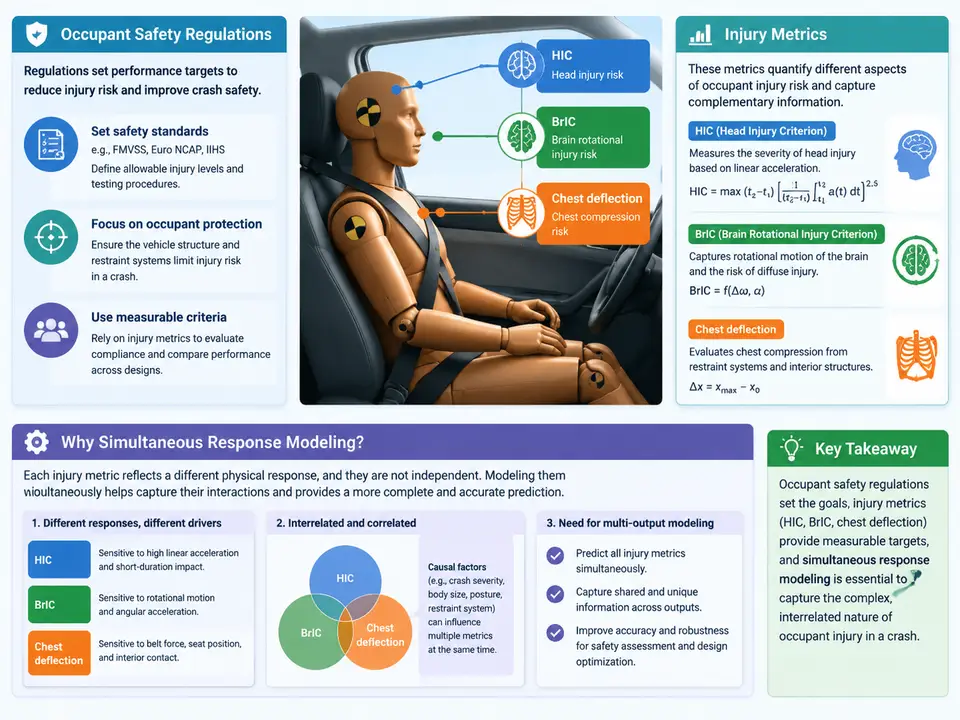
Occupant safety engineering has always been a measurement discipline before it became a modeling discipline. Long before anyone trained a neural network on crash data, engineers were already reducing the chaotic, millisecond-scale violence of a collision into a small set of scalar numbers that regulators, test labs, and vehicle programs could compare, threshold, and litigate. Understanding multi-output injury prediction therefore begins not with architectures or loss functions, but with the question: what exactly are we predicting, and why must several of those things be predicted at once?
This chapter maps that landscape. It establishes the regulatory context that defines which injury metrics matter, explains the physical meaning and computation of the three canonical metrics — HIC, BrIC, and chest deflection — and then argues why a single-output model is structurally inadequate for the problem, motivating the multi-output formulation that the rest of the course develops.
Regulations define the output space
Injury criteria are not academic constructs; they are codified in regulation and consumer test protocols, and those documents effectively specify the target variables of any injury model. The most widely referenced frameworks are FMVSS 208 (occupant crash protection, US), UN Regulation No. 94 and No. 95 (frontal and lateral impact, Europe), and the consumer programs Euro NCAP and US NCAP, whose protocols are frequently stricter and updated faster than the legal minimum. China's GB 11551 and C-NCAP play an analogous role in that market.
Each framework prescribes crash configurations (full frontal rigid barrier at 56 km/h, offset deformable barrier at 64 km/h, side movable deformable barrier, pole impact), dummy types (Hybrid III 50th percentile male, THOR, WorldSID, and increasingly the THOR-50M and BioRID for rear impact), and — critically — the pass/fail thresholds applied to specific channels recorded by those dummies. A frontal protocol will reference head injury criterion, neck axial force and moment, chest deflection and compression rate, and femur loads. A side protocol references head injury criterion, chest deflection (often via rib deflection), and abdominal forces. The output space is therefore heterogeneous: it mixes accelerations, forces, moments, displacements, and derived indices, measured at different body regions, under different loading directions.
Two consequences follow. First, the number of outputs is large — a modern frontal sled test can produce dozens of injury-relevant channels. Second, the outputs are physically coupled: restraint system design that reduces head excursion may increase chest loading; a stiffer seat structure may lower chest deflection while raising neck tension. This coupling is the engineering reason multi-output modeling is not merely convenient but necessary.
The three canonical metrics
HIC (Head Injury Criterion) quantifies the likelihood of head injury from translational acceleration. It is computed from the resultant translational acceleration at the head center of gravity, a(t), expressed in units of g:
HIC = max over (t1, t2) of [ (t2 - t1) * ( (1/(t2-t1)) * ∫ a(t) dt from t1 to t2 )^2.5 ]

subject to: t2 - t1 ≤ 15 ms
typical regulatory window: HIC15 (35 ms window used in some older criteria)
The 2.5 exponent makes HIC strongly sensitive to short, high-amplitude acceleration spikes, which is why it rewards smooth deceleration profiles. A common regulatory limit is HIC15 ≤ 700 for the driver in frontal impact, with consumer protocols often targeting lower values. Note the practical subtlety: HIC is a maximum over all windows, so it is a non-smooth, order-statistic-like functional of the acceleration trace — a property that matters greatly when it becomes a training target.
BrIC (Brain Injury Criterion) addresses rotational loading, which HIC ignores. It uses the angular velocity components about the head's anatomical axes:
BrIC = ( (ω_x / ω_xc)^2 + (ω_y / ω_yc)^2 + (ω_z / ω_zc)^2 )^0.5

critical angular velocities (rad/s):
  ω_xc = 66.25   (about the x / sagittal axis)
  ω_yc = 56.45   (about the y / coronal axis)
  ω_zc = 42.87   (about the z / horizontal axis)
BrIC is evaluated over a 15 ms window and a value of 1.0 corresponds to a 50% risk of a diffuse axonal injury–type outcome. Because it is a normalized vector magnitude, it is dimensionless and directly comparable across loading directions — a useful property for a model output.
Chest deflection measures the inward displacement of the sternum relative to the spine (frontal) or of the ribs (lateral), typically in millimetres, and is the primary predictor of rib fracture and thoracic organ injury. In frontal Hybrid III testing, chest deflection is often limited to roughly 63 mm (with compression rate limits), while side impact protocols use rib deflection criteria with limits in the 40–50 mm range depending on dummy and protocol. Chest deflection is a displacement, not an acceleration, and it is strongly rate-dependent in biological response — a reminder that the metric's meaning depends on the loading regime.
Why simultaneous modeling is required
A naive approach is to train one model per metric. In practice this fails for three reasons that are worth stating precisely, because they shape every design decision later in the course.
Shared input, correlated outputs. All metrics are driven by the same underlying crash pulse, restraint configuration, and occupant anthropometry. If a model predicts HIC well but ignores that the same restraint force that lowered HIC raised chest deflection, it has learned a spurious mapping. Multi-output training exposes the model to the joint distribution and forces it to represent the trade-off explicitly.
Data scarcity. Instrumented sled and vehicle tests are expensive; a program may have hundreds, not millions, of records. Sharing a representation across outputs multiplies the effective signal per parameter and regularizes each head. This is the same argument that made multi-task learning standard in vision and NLP, transplanted to crashworthiness.
Design optimization needs gradients across outputs. Restraint design is a constrained optimization: minimize chest deflection subject to HIC ≤ limit, or find the Pareto front between head and chest outcomes. A surrogate that predicts all outputs from one input vector can be differentiated or searched jointly; independent surrogates cannot express the coupling and will mislead the optimizer.
The figure below summarizes the landscape: regulatory configurations feed a shared occupant/restraint input space, which drives coupled physical responses, which are reduced to the three metric families and their thresholds. The arrows between metric blocks are the couplings that a multi-output model must capture.
From metrics to model targets: practical consequences
Treating these three metrics as model outputs is not as simple as copying three columns from a test database. Each has properties that affect how it should be handled in a learning pipeline, and these properties are the bridge to the modeling chapters that follow.
HIC is a maximum over windows. It is not a pointwise function of the input signal but a functional of the entire acceleration trace. A model that predicts HIC directly must implicitly learn the window search. An alternative, often preferable, is to predict the acceleration trace and compute HIC deterministically afterward — but that shifts the burden to waveform fidelity. Both strategies appear in the literature, and the choice depends on whether the downstream use needs the metric alone or the full time history.
BrIC is a normalized magnitude. Because it is dimensionless and direction-normalized, it is well-behaved as a regression target, but it is sensitive to the sign and axis convention of the angular velocity channels. A model trained on data where ωx follows one anatomical convention and applied to data following another will silently produce wrong BrIC values. Axis conventions must be documented and enforced at the data layer, not left to the model.
Chest deflection is a displacement with rate dependence. Its magnitude depends on the dummy's chest stiffness and on the loading rate, so a model trained predominantly on frontal Hybrid III data will not transfer cleanly to WorldSID lateral data without explicit conditioning on dummy type and loading direction. This is a covariate shift problem, and it argues for including dummy type and impact direction as input features rather than hoping the network infers them.
What "simultaneous" actually demands
The word simultaneous in the course title carries a specific technical meaning. It does not merely mean "predict several numbers from one model." It means the model must represent the joint conditional distribution p(HIC, BrIC, deflection | input) well enough that trade-offs are preserved. Three requirements follow, and they recur throughout the course:
- Shared representation with output-specific heads. A common trunk encodes the crash pulse and restraint configuration; separate heads decode each metric. The trunk is where coupling is learned; the heads allow different output scales and loss weightings.
- Loss balancing across heterogeneous targets. HIC ranges into the hundreds, BrIC is order unity, deflection is tens of millimetres. Naive summed MSE lets HIC dominate. Normalization, uncertainty weighting, or gradient-balancing schemes are needed — and the choice affects whether the model actually learns the chest trade-off.
- Evaluation on the joint, not the marginals. Reporting per-metric RMSE is necessary but insufficient. A model can have low marginal error and still misrank restraint designs because it gets the correlation between HIC and deflection wrong. Rank correlation and Pareto-front agreement are the metrics that matter for design use.
With the output space defined and the coupling argument established, the remaining chapters can treat the multi-output architecture, data pipeline, and validation strategy as engineering choices rather than open questions. The landscape is set: regulations fix the targets, physics couples them, and data scarcity makes joint learning the pragmatic path.