1. Course overview
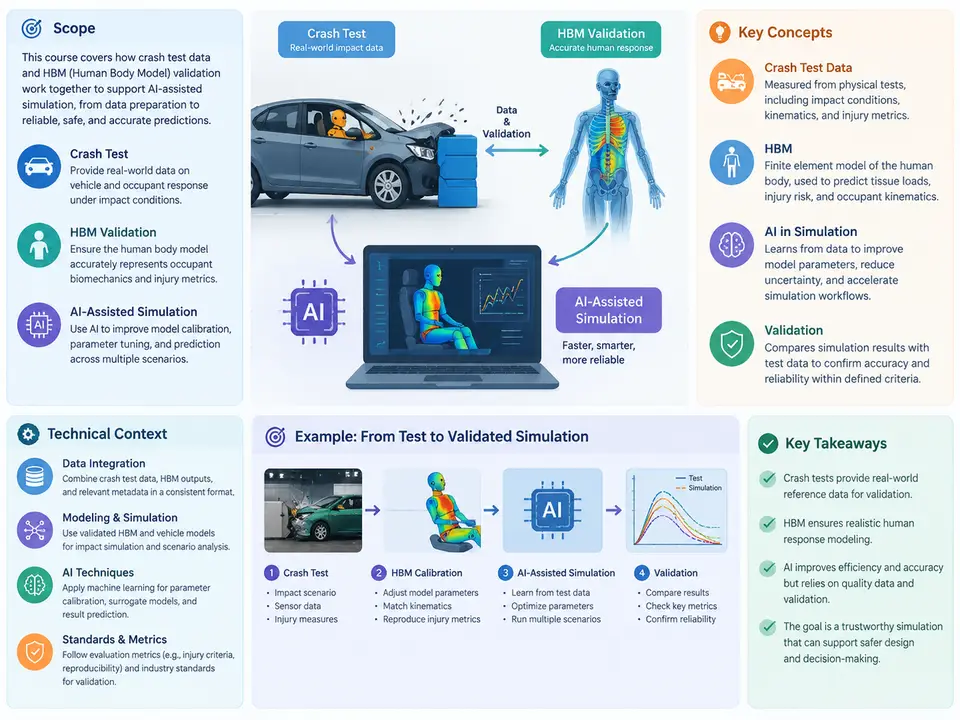
Crash testing has always been a discipline where physical evidence and numerical prediction meet. A vehicle body is instrumented, accelerated into a barrier, and the resulting deceleration pulses, structural deformations, and occupant responses are recorded. In parallel, CAE teams build explicit finite-element models of the same event and attempt to reproduce those measurements. The gap between the two — model correlation error — has historically been closed by engineering judgement, iteration, and a great deal of manual tuning. This course is about closing that gap with a disciplined, AI-assisted workflow, and about validating the human body model (HBM) that sits at the centre of every occupant-safety prediction.
Two objects of study run through all 30 chapters. The first is the physical crash test: sled tests, full-scale barrier impacts, and component-level drop or impact rigs, together with their instrumentation chains — accelerometers, load cells, string potentiometers, high-speed cameras, and the data-acquisition systems that synchronise them. The second is the human body model: a finite-element representation of the occupant, typically a 50th-percentile male (THOR-M or Hybrid III FE), a small female, or a detailed CORA/THUMS-class model, whose biofidelity must be demonstrated against cadaveric and volunteer test data before it can be trusted in a design decision. AI enters not as a replacement for either, but as an accelerator: surrogate models that replace expensive solver runs, machine-learning-based signal alignment, parameter-identification networks that fit material cards to test data, and anomaly detection that flags a suspect channel before it contaminates a correlation study.
Why the two halves must be taught together
A common failure mode in industry is to treat crash-test correlation and HBM validation as separate specialisms. They are not. The boundary conditions applied to an HBM — seat belt geometry, airbag deployment timing, seat cushion stiffness, floor pan intrusion — come from the vehicle test. If the sled pulse is mis-synchronised by 5 ms, or the belt force limiter is characterised at the wrong pay-out length, the HBM will be "validated" against a physically inconsistent input and the resulting occupant injury metrics (HIC, chest deflection, Nij, femur force) will carry an error that no amount of model tuning can remove. Conversely, an HBM whose biofidelity is unproven will produce confident-looking but meaningless injury numbers regardless of how well the vehicle model correlates. The course therefore treats the test article, the instrumentation, the occupant model, and the AI surrogate as one connected signal chain, and every chapter returns to the question: what is the evidence, and what is its uncertainty?
Core concepts and vocabulary
Four terms recur throughout the course and are worth fixing precisely at the outset. Biofidelity is the ability of an HBM to reproduce the biomechanical response of the human it represents — measured against post-mortem human subject (PMHS) tests and volunteer data, not against a vehicle. Correlation is the quantitative comparison of a simulation signal against a test signal, usually expressed through the CORA rating or the ISO 18571 objective rating, which decomposes error into phase, magnitude, and shape components and returns a score between 0 and 1. Validation is the formal judgement that a model is fit for a stated purpose within a stated envelope; it is a decision, not a number. Verification, often confused with it, asks only whether the equations were solved correctly — a mesh-convergence study, for example.
A useful working distinction for the whole course: a correlation score of 0.85 on a belt-force curve tells you the shapes agree reasonably well; it does not tell you whether the model will predict a chest deflection 4 mm too high at 60 ms, which may be the difference between a pass and a fail in a regulatory assessment. AI-assisted workflows are powerful precisely because they let you run thousands of parameter combinations to explore that sensitivity, but they also make it easy to over-fit a model to a single test. The discipline this course teaches is to keep the evidence chain visible at every step.
What the technical context looks like in practice
Consider a representative sled test used as the running example through the early chapters. A body-in-white with seat and restraint system is mounted on a deceleration sled and subjected to a 50 km/h frontal pulse with approximately 28 g peak deceleration. Instrumentation includes a sled-mounted accelerometer, belt load cells at the retractor and buckle, a chest-band potentiometer on the Hybrid III, and two high-speed cameras at 1000 fps. The measured belt force peaks at roughly 4.2 kN at 62 ms in this illustrative case. The corresponding CAE model must reproduce that pulse as a boundary condition, not as a tuning target — the pulse is input, the belt force is output. Confusing the two is one of the most common errors in junior correlation work, and Chapter 4 addresses it directly.
On the HBM side, the same logic applies at a different scale. A THOR-M model's chest deflection response to a 40 km/h frontal sled is compared against the PMHS corridor for that loading condition. If the model's deflection peaks 8 mm above the corridor mean at 55 ms, the question is not "how do I tune the chest stiffness to fix it" but "which material parameter, contact definition, or geometry is responsible, and is the discrepancy within the biofidelity tolerance for this model class?" AI-assisted sensitivity analysis — a Sobol index sweep over chest material parameters, for instance — answers the first half of that question in hours rather than weeks, but the second half remains an engineering judgement.
Scope boundaries and what this course is not
The course covers frontal and side impact occupant protection for automotive applications. It does not attempt to teach explicit FE solver theory from first principles, nor does it cover pedestrian protection, rear impact whiplash, or child restraint systems in depth, although the same evidence-chain logic applies to all of them. On the AI side, the course assumes familiarity with basic regression and neural-network concepts; it does not teach deep-learning fundamentals, but it does show how surrogate models are trained, validated, and — critically — how their prediction uncertainty is propagated into the correlation decision. A surrogate that predicts belt force with a 3% mean error but a 12% error at the peak is not useful for peak-force correlation, and recognising that requires the uncertainty-quantification methods in Chapter 25.
Finally, a note on regulatory and ethical context. HBMs are validated against PMHS data collected under ethical-review-approved protocols, and the use of AI in safety-critical prediction carries its own documentation burden: traceability of training data, version control of surrogate models, and explicit statement of the applicability domain. These are not bureaucratic afterthoughts; they are part of what makes an AI-assisted result defensible in a type-approval submission. The course treats them as first-class engineering requirements from Chapter 1 onward.