1. Global NCAP overview
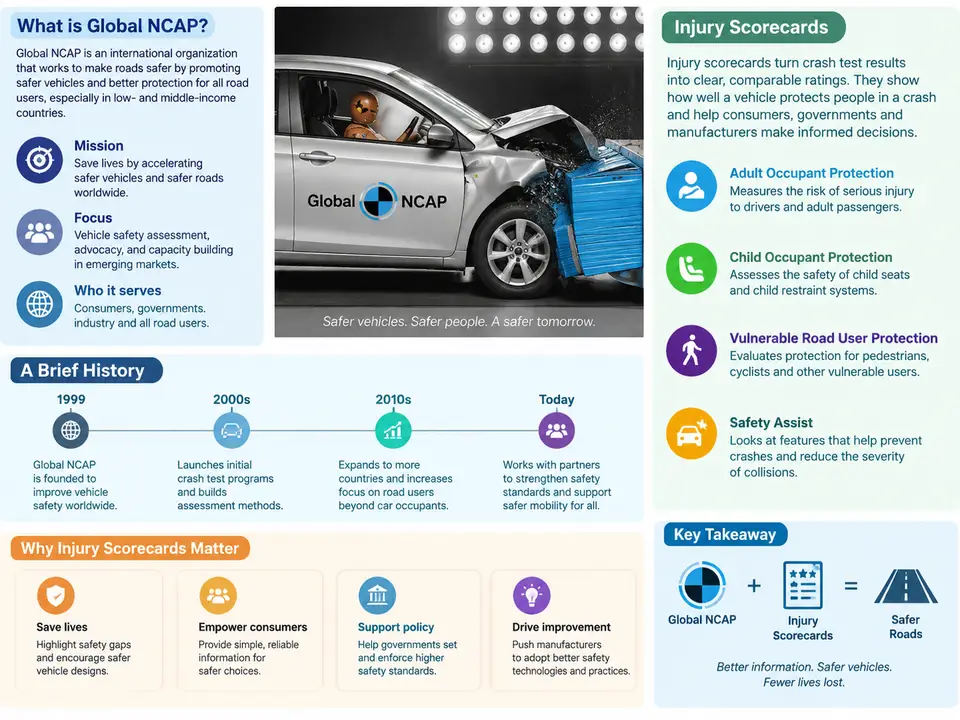
Global NCAP is an international vehicle safety assessment programme whose central purpose is to make the safety performance of cars sold in emerging and developing markets visible, comparable, and difficult to ignore. It is not a regulator and it does not issue type approval. Instead, it operates as an independent consumer-information and advocacy programme: it buys vehicles anonymously from local dealerships, subjects them to standardised crash tests, and publishes star ratings and detailed technical reports that consumers, journalists, regulators, and manufacturers can all read. The programme is coordinated by the Towards Zero Foundation and works alongside a family of regional NCAP organisations — Latin NCAP, ASEAN NCAP, Bharat NCAP, and others — that share methodology and results formats while adapting test selection to regional vehicle fleets.
The mission has three interlocking parts. First, consumer empowerment: a buyer in a market where safety equipment is often optional needs a reliable, independent signal about what happens to occupants in a crash. Second, market pressure: published results create a competitive incentive for manufacturers to fit airbags, electronic stability control, and stronger body structures as standard rather than as premium extras. Third, regulatory catalysis: Global NCAP results have repeatedly preceded and supported national legislation on crashworthiness and equipment mandates. The programme's slogan, "Safer Cars for India" and its regional analogues, captures the underlying logic — the rating is a means, and the reduction of real-world fatalities is the end.
How the programme developed
Global NCAP grew out of the earlier NCAP programmes — the original US NCAP launched in 1979 and Euro NCAP in 1997 — but its distinctive contribution was to extend independent crash testing to markets that had no such consumer programme. Early campaigns in India and Latin America tested small, high-volume models and produced results that were, by design, uncomfortable: several popular cars scored zero stars. Those results were not accidents of methodology; they were the point. A zero-star result on a widely sold vehicle generates media coverage, parliamentary questions, and eventually design changes. Over successive assessment protocols, the programme tightened requirements — from a basic frontal offset test toward the current Global NCAP protocol, which combines frontal offset impact, side impact, and active-safety assessment, and which increasingly aligns with the UN regulations that underpin Euro NCAP and other mature-market schemes.
Two structural features distinguish Global NCAP from a simple test laboratory. The first is anonymity of purchase: vehicles are bought at retail, so the tested specification is the one a real customer receives, not a hand-prepared prototype. The second is specification sensitivity: because equipment varies by trim and market, the programme records the exact variant, its safety equipment, and its market availability, and it reports results in a way that ties the star rating to a defined specification. A five-star result for a top trim with six airbags does not automatically transfer to the base variant with two.
Where injury scorecards fit
A star rating is a summary. The injury scorecard is the evidence beneath it. After each crash test, the dummy's instrumentation — accelerometers in the head, chest, and pelvis, load cells in the femur and neck, and displacement sensors — produces time histories of acceleration, force, and deflection. These are filtered according to the relevant standard (for example, CFC 1000 for accelerations and CFC 600 for chest deflection under UN Regulation No. 94 and its equivalents) and then reduced to peak or cumulative values. Each value is compared against a biomechanical reference limit, and the ratio of measured value to limit becomes a normalised injury criterion. The scorecard is the structured presentation of those criteria, body region by body region, for each occupant and each test.
The critical concept is the injury risk curve. For a given body region, the relationship between a physical measurement and the probability of a real injury of a given severity (typically AIS 2+, "moderate" injury) is described by a statistical function derived from cadaver, animal, and field-accident data. The Head Injury Criterion (HIC), the chest deflection limit, the neck tension and compression limits, and the femur axial force limit are all anchors on such curves. The scorecard converts a measured value into a points deduction by evaluating where that value sits on the risk curve. A chest deflection of 42 mm against a 50 mm reference limit is not simply "84% of the limit"; it maps to a specific probability of chest injury, and that probability determines the points lost.
This is why the scorecard matters more than the headline star count for engineering work. Two vehicles can both achieve four stars while failing in completely different ways: one may lose points on chest deflection in the driver, the other on head contact with the steering wheel rim or on neck loading in the rear passenger. The star rating tells a consumer "this is broadly acceptable"; the scorecard tells an engineer "this is the structure, restraint, or airbag calibration that must change."
Reading a scorecard in practice
When you open a Global NCAP technical report, the scorecard appears as a table of body regions against points, usually split by occupant (driver, front passenger, rear passenger) and by test (frontal offset, side impact, sometimes pole impact). The practical reading order is: identify the limiting region first, because it caps the occupant score; then check whether the deduction is a single large loss or an accumulation of small ones; then cross-reference the region against the restraint system that controls it. A chest deduction points to belt force limiting, airbag venting, seat geometry, and steering column collapse. A head deduction points to airbag coverage, contact with the A-pillar or steering wheel rim, and head restraint geometry. A neck deduction in a rear-seat occupant often points to belt routing and the absence of a load limiter.
It is equally important to read the specification line attached to the result. Global NCAP reports state the variant tested, the number of airbags, whether ESC is fitted, and whether the result applies to the whole model range or only to a specific trim. A scorecard without that context is not actionable, because the same body structure can produce very different occupant readings with and without a side airbag or a belt pretensioner.
The remainder of this course builds directly on this foundation. Later chapters will take the individual injury criteria — HIC, chest deflection, neck Nij, femur force, and the side-impact criteria — and show how each is computed from raw sensor data, how the risk curves are applied, how points are aggregated into occupant and vehicle scores, and how the resulting scorecard can be used to diagnose and prioritise design changes. The scorecard is the unit of analysis throughout: it is the artefact that connects a physical crash test to a consumer-facing rating, and it is the document an engineer must be able to read, interpret, and act on.