1. Regulatory and biomechanical foundations
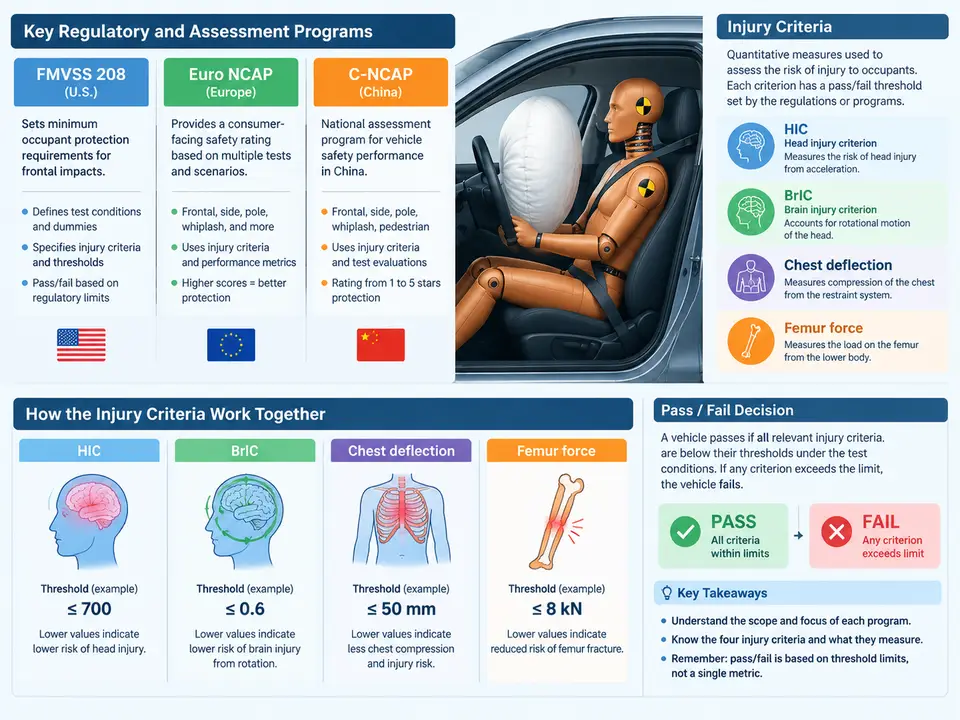
Every automated pass-fail decision in occupant safety ultimately reduces to a comparison: a measured or computed injury metric versus a regulated or consumer-protocol threshold. Before any automation logic can be trusted, the engineer must understand where those thresholds come from, what physical quantity each metric represents, and why the same dummy response can pass one protocol and fail another. This chapter establishes that foundation across the three regulatory and consumer frameworks most commonly encountered in global vehicle programs, and defines the four injury criteria that dominate frontal and side occupant assessment: HIC, BrIC, chest deflection, and femur force.
Three frameworks, three philosophies
FMVSS 208 (Federal Motor Vehicle Safety Standard 208, "Occupant Crash Protection") is a U.S. federal regulation. It is legally binding for vehicles sold in the United States and is enforced through self-certification: the manufacturer certifies compliance, and NHTSA audits through its New Car Assessment Program (NCAP) and compliance testing. FMVSS 208 defines rigid pass-fail limits under specified barrier and sled tests, including frontal rigid barrier impacts at 56 km/h (35 mph) and, for belted occupants, unbelted occupant protection requirements. Because it is a regulation, its thresholds are non-negotiable and carry legal consequence.
Euro NCAP is a consumer-testing program, not a regulation. It publishes star ratings and, since 2020, has progressively tightened its frontal offset and mobile progressive deformable barrier (MPDB) tests, adding a "compatibility" assessment and, in later protocols, a far-side occupant protection requirement. Euro NCAP thresholds are typically expressed as scoring bands rather than binary legal limits, but for automation purposes they are converted into pass-fail gates at defined point values.
C-NCAP (China New Car Assessment Program) follows a similar consumer-rating philosophy with its own test matrix, including a 50 km/h full-width rigid barrier and a 64 km/h offset deformable barrier test, plus side impact and whiplash assessments. Its thresholds and weighting differ from Euro NCAP, which is precisely why a single vehicle can score differently across markets.
The four core injury criteria
HIC (Head Injury Criterion) is defined over a time window and captures both acceleration magnitude and duration:
HIC = max over t1,t2 of [ (1/(t2-t1)) * ∫ a(t) dt ]^2.5 * (t2-t1)
where a(t) is the resultant head acceleration in g,
and (t2 - t1) is typically constrained to 15 ms (HIC15) or 36 ms (HIC36).
FMVSS 208 uses HIC36 with a limit of 1000 for the 50th-percentile male dummy in the frontal test; Euro NCAP and C-NCAP commonly use HIC15 with limits around 700 for a 5-star-equivalent score. The exponent 2.5 means HIC is highly sensitive to short, high-g spikes — a brief 150 g pulse can dominate a longer, gentler one. This is why the integration window must be stated explicitly in any automated check; a HIC value without its window is ambiguous.
BrIC (Brain Injury Criterion) addresses rotational head motion, which HIC ignores. It combines angular velocity components:
BrIC = ( |ωx| / ωxC )^2 + ( |ωy| / ωyC )^2 + ( |ωz| / ωzC )^2
with critical angular velocities ωxC = 66.25 rad/s,
ωyC = 56.45 rad/s, ωzC = 42.87 rad/s.
A BrIC of 1.0 corresponds to a 50% risk of a diffuse axonal injury (DAI) of AIS 4 or greater. Euro NCAP and C-NCAP increasingly score BrIC alongside HIC, particularly in far-side and oblique loading scenarios where head rotation dominates.
Chest deflection measures the inward displacement of the sternum relative to the spine, in millimetres, recorded by the dummy's chest potentiometer or IR-TRACC (Infra-Red Telescoping Rod for Assessment of Chest Compression). FMVSS 208 limits chest deflection to 63 mm for the 50th-percentile male in frontal impact; Euro NCAP and C-NCAP apply lower limits (often 42–50 mm depending on dummy and protocol) to reward better restraint tuning. Deflection is a direct proxy for rib fracture and internal organ injury risk.
Femur force is the axial compressive load transmitted through the femur, measured in kilonewtons by load cells in the dummy's upper legs. FMVSS 208 limits femur force to 10 kN per leg (for the 50th-percentile male); Euro NCAP and C-NCAP use similar or slightly lower values. Femur force indicates the risk of femoral shaft fracture and, indirectly, the effectiveness of knee bolsters and lower-extremity restraint.
Why the same dummy response passes one protocol and fails another
The table below summarizes representative thresholds. Values are illustrative of typical protocol limits and should be verified against the current published standard for any production program.
| Criterion | FMVSS 208 (typical) | Euro NCAP (typical) | C-NCAP (typical) |
|---|---|---|---|
| HIC | HIC36 ≤ 1000 | HIC15 ≤ 700 (5-star band) | HIC15 ≤ 700–1000 (score-dependent) |
| BrIC | Not primary (HIC-based) | BrIC ≤ 0.5–0.8 (protocol-dependent) | BrIC ≤ 0.7–1.0 (protocol-dependent) |
| Chest deflection | ≤ 63 mm (50th male) | ≤ 42–50 mm (dummy-dependent) | ≤ 50–63 mm (dummy-dependent) |
| Femur force | ≤ 10 kN per leg | ≤ 8–10 kN (score-dependent) | ≤ 10 kN per leg |
The practical consequence is that an automation system cannot carry a single global threshold table. It must be parameterized by protocol, dummy type (Hybrid III 50th male, THOR, WorldSID, etc.), impact mode, and occupant position. A HIC15 of 750, for example, may be a legal pass under FMVSS 208 but a scoring failure under Euro NCAP's 5-star band.
From metric to pass-fail gate: the evaluation chain
The SVG below traces how a raw dummy channel becomes a pass-fail verdict. It shows the signal chain from sensor acquisition through filtering and metric computation to protocol-specific threshold comparison, and highlights the two places where automation most often goes wrong: filter selection and threshold-set selection.
Practical example: computing and gating HIC15
Consider a frontal offset test with a Hybrid III 50th-percentile male. The head accelerometer records a resultant acceleration time history sampled at 10 kHz. The evaluation procedure is:
- Apply the SAE J211 CFC 1000 low-pass filter to the resultant acceleration channel. Using the wrong filter class (e.g., CFC 600) will under-report peak acceleration and produce an optimistic HIC.
- Compute the resultant acceleration a(t) = sqrt(ax² + ay² + az²) in g.
- For every pair (t1, t2) with t2 − t1 ≤ 15 ms, compute the mean acceleration and apply the 2.5 exponent, then multiply by the window duration. The maximum over all windows is HIC15.
- Compare against the selected threshold set. Under Euro NCAP's 5-star band, HIC15 ≤ 700 passes; a value of 720 fails the gate even though it would be legal under FMVSS 208's HIC36 ≤ 1000.
A common failure symptom in automated pipelines is a HIC value that is suspiciously low (e.g., 400 when the crash pulse clearly suggests higher). The usual causes are: filtering with too low a cutoff, integrating over a window longer than 15 ms, or using the vector magnitude of a single axis instead of the resultant. Conversely, a HIC that is implausibly high often traces to unfiltered raw data or a mis-scaled channel (g versus m/s²).
What the automation layer must encode
For pass-fail automation, the regulatory and biomechanical foundation translates into four configuration objects that must be explicit and version-controlled: the protocol identifier (FMVSS 208, Euro NCAP, C-NCAP, and protocol year), the dummy type (which determines channel scaling and applicable limits), the metric definition (window, filter class, axis convention), and the threshold set (the numeric limits and whether they are legal limits or scoring bands). Each verdict should carry a traceable reference to all four, so that a failed result can be audited against the exact standard revision in force at test time. This traceability is what separates a defensible automated decision from an opaque number.
With these foundations in place, subsequent chapters can build the signal-processing, threshold-management, and reporting layers on a stable definitional base — one where every pass-fail gate can be traced back to a published criterion and a specific protocol revision.