1. DOE fundamentals for restraint design
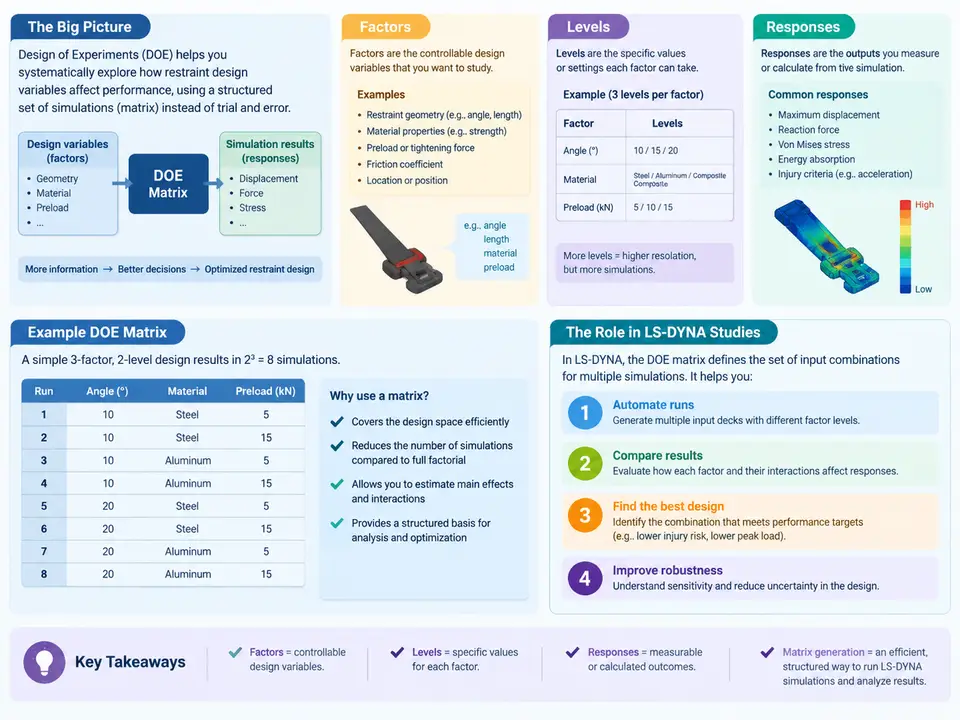
Restraint system design in LS-DYNA is rarely a single-run exercise. An occupant safety engineer must simultaneously satisfy FMVSS 208, Euro NCAP, and internal targets while balancing airbag pressure, venting, seat belt geometry, pretensioner timing, and material behavior. Each of these is a design variable, and each interacts with the others in ways that are not obvious from first principles. Design of Experiments (DOE) provides the structured framework for exploring this space efficiently, and matrix generation is the concrete artifact that turns a DOE plan into a set of LS-DYNA runs.
This chapter establishes the vocabulary and workflow that every subsequent chapter builds on: what factors and levels are in a restraint context, how responses are defined and extracted, and why the generated matrix — not the individual simulation — is the real unit of engineering work.
Factors: The Controllable Inputs of a Restraint Model
A factor is an input variable that the engineer can set before a run and that is expected to influence at least one response. In LS-DYNA restraint studies, factors fall into three practical classes:
- Geometric factors — seat belt anchor coordinates, D-ring position, airbag module location, steering wheel tilt. These typically map to
*NODEcoordinates or*DEFINE_TRANSFORMATIONparameters. - Material and constitutive factors — airbag fabric permeability, belt webbing stiffness, foam crush characteristics. These map to
*MAT_FABRIC,*MAT_SEATBELT, or*MAT_LOW_DENSITY_FOAMcard fields. - Control and timing factors — pretensioner firing time, airbag inflator mass flow rate, vent hole area, retractor locking threshold. These map to
*AIRBAG_SIMPLE_PRESSURE_VOLUMEor*ELEMENT_SEATBELT_PRETENSIONERparameters.
The critical discipline is to distinguish factors from noise variables. Manufacturing tolerance on belt stiffness, for example, is real but not controllable in the design; it belongs in a robustness study, not in the primary factor list. Mixing the two inflates the matrix and obscures the design signal.
Levels: Discretizing the Design Space
A level is a specific value assigned to a factor. Two-level designs are the workhorse of screening; three-level designs are needed when curvature or a nonlinear response is suspected. For restraint work, level selection should be anchored to physical plausibility, not arbitrary spacing:
| Factor | Low (−1) | Center (0) | High (+1) | LS-DYNA keyword |
|---|---|---|---|---|
| Airbag vent area | 1800 mm² | 2200 mm² | 2600 mm² | *AIRBAG_SIMPLE_PRESSURE_VOLUME |
| Pretensioner fire time | 12 ms | 16 ms | 20 ms | *ELEMENT_SEATBELT_PRETENSIONER |
| Belt webbing stiffness | 0.85× | 1.00× | 1.15× | *MAT_SEATBELT (LCID scaling) |
| D-ring X position | −15 mm | 0 mm | +15 mm | *NODE coordinate |
These values are illustrative and must be replaced with values from the actual program. The point is that each level corresponds to a real, editable field in the deck — a factor that cannot be traced to a keyword field cannot be swept reliably.
Responses: What the Matrix Must Measure
A response is the output metric extracted from each run. Restraint responses are typically time-history derived and require a defined extraction rule to be comparable across runs:
- HIC36 / HIC15 — head injury criterion, computed over the crash pulse window.
- Chest deflection and V·C — chest compression and viscous criterion from the chest band or accelerometer set.
- Nij, Nkm — neck injury indices.
- Peak belt force — maximum
*DATABASE_ASCIIseatbelt element force. - Airbag internal pressure peak — from the
*AIRBAGoutput block.
Each response must have a fixed extraction script, a fixed time window, and a fixed filter (e.g., SAE CFC 600 for chest acceleration). If the extraction rule changes between runs, the matrix is no longer a controlled experiment.
The Role of Matrix Generation
Matrix generation is the step that converts a factor-level specification into an explicit, ordered set of LS-DYNA input decks. It is not a formatting convenience — it is the mechanism that guarantees the statistical validity of the study. A well-generated matrix ensures orthogonality (factors vary independently), balance (each level appears equally often), and reproducibility (any run can be regenerated from the matrix row index).
The workflow is a closed loop: define factors and levels → choose a design type (full factorial, fractional factorial, Latin hypercube, or D-optimal) → generate the matrix → instantiate one deck per row → run → extract responses → fit a response surface or screen for significance. The matrix is the contract between the statistical plan and the simulation campaign.
Practical Considerations for the First Matrix
Before generating a matrix, verify three things. First, every factor must be traceable to a keyword field that can be modified without breaking the deck — a factor that requires manual node editing is a factor that will not survive automation. Second, every response must have a tested extraction script that runs on a single baseline deck; if the script fails on the baseline, it will fail on all 81 runs. Third, the design type must match the study goal: screening with many factors favors a fractional factorial (Resolution IV or higher), while response-surface optimization favors a central composite or D-optimal design.
With factors, levels, responses, and the matrix-generation step defined, the remaining chapters can treat the matrix as a given input and focus on design selection, deck parameterization, run management, and response-surface analysis. The foundation established here — traceable factors, fixed extraction rules, and a reproducible matrix — is what separates a defensible DOE study from a collection of simulations.