1. Course overview
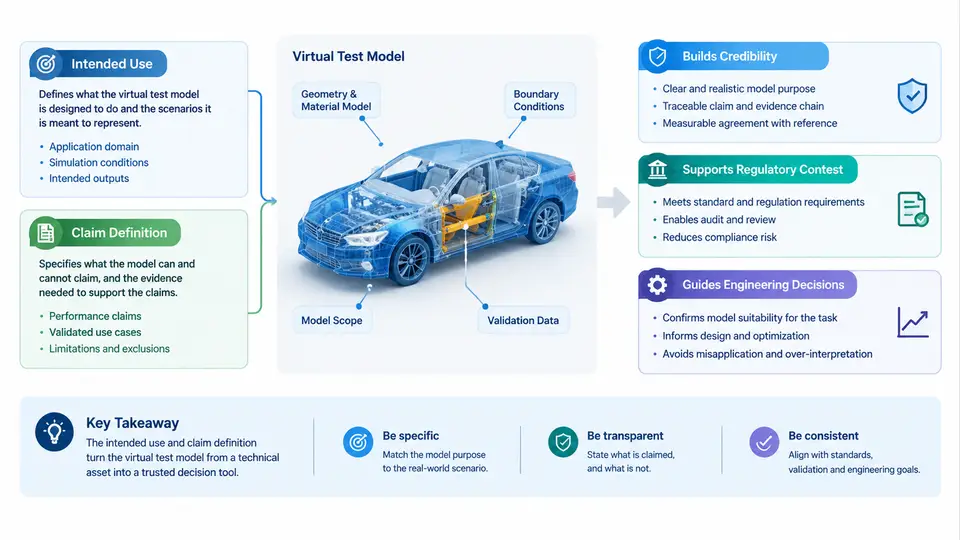
Virtual test models — reduced-order physics simulations, surrogate models, digital twins, hardware-in-the-loop plant models, and data-driven regressions — are increasingly used to replace, augment, or prioritize physical testing in product development. The central credibility question is not "Is this model accurate?" but rather "Is this model accurate enough for this specific decision?" Answering that question requires two tightly coupled artifacts defined before modeling begins: the intended use and the claim the model is expected to support.
This opening chapter establishes why these two artifacts govern every downstream credibility activity — verification, validation, uncertainty quantification, and regulatory submission — and how they convert an open-ended simulation exercise into a bounded, auditable engineering argument.
What Intended Use Actually Specifies
Intended use is a precise statement of the decision context in which a model's output will be consumed. A defensible intended-use statement answers five questions concretely:
- Decision being supported — e.g., "release a suspension control calibration to vehicle-level durability testing" rather than "evaluate suspension behavior."
- System and configuration boundary — which variant, trim, load case, and operating envelope the model represents.
- Output quantity of interest (QoI) — the specific scalar or field the decision consumes, such as peak vertical tire load at the wheel center, not "the whole simulation."
- Decision threshold and tolerance — the value band within which the decision flips, e.g., a 5% error in peak load is acceptable because the release margin is 15%.
- Consequence of a wrong decision — safety, cost, schedule, or regulatory exposure, which sets the rigor level.
Notice that accuracy is never absolute here. A model with 12% error on peak load may be entirely credible for a screening decision with a 30% margin and wholly inadequate for a certification claim with a 3% margin. Intended use is what makes that distinction explicit and reviewable.
Claim Definition: Turning Intent into a Testable Assertion
Where intended use describes the context, the claim states what the model asserts within that context. A well-formed claim is falsifiable and traceable. For example:
Intended use: Predict peak vertical tire load for the front-left wheel during a 40 km/h cleat impact, for the baseline suspension calibration, to support go/no-go on durability test entry.
Claim: For the defined load case and configuration, the model's predicted peak vertical load is within ±8% of the physical measurement mean across three repeat runs, with 90% confidence, over the operating envelope 30–50 km/h.
The claim fixes the QoI, the acceptance criterion, the statistical basis, and the envelope. It is the object that validation evidence will later confirm or refute. Without it, validation degenerates into "the curves look similar," which is neither auditable nor defensible.
Why This Matters: Regulatory and Engineering Context
Regulatory and standards frameworks increasingly require documented model credibility proportional to risk. ASME V&V 40 and its sub-standards for computational fluid dynamics and finite element analysis, FDA guidance on computational modeling in medical devices, and automotive functional-safety and simulation-credibility practices all share the same logic: credibility is context-dependent and must be established relative to intended use. A model cannot be "validated" in the abstract; it is validated for a use.
In engineering decision-making, the same principle governs resource allocation. Credibility activities — mesh convergence studies, code verification, calibration against test data, uncertainty propagation — are expensive. Intended use and claim definition tell the team where to spend that effort and, equally important, where not to. A low-consequence screening model may need only a documented sanity check; a safety-critical certification model may need a full validation hierarchy with quantified uncertainty.
How the Two Artifacts Interlock in Practice
The diagram above shows the causal chain: intended use and claim definition jointly set the rigor level, which selects the verification, validation, and uncertainty quantification activities, which produce evidence that either supports the decision or triggers revision. The dashed feedback path is essential — when validation shows the claim is not met, the team must decide whether to improve the model or to relax the claim (and thereby the intended use). Both are legitimate, but the choice must be documented, because relaxing a claim after seeing results is a credibility risk if left implicit.
Consider a concrete example. A team builds a lumped-parameter thermal model of a battery pack to support a fast-charge thermal-margin decision. The intended use fixes the pack variant, ambient range 15–35 °C, and the QoI as maximum cell-top temperature during a 10–80% SOC charge. The claim states the predicted peak cell-top temperature must be within ±3 °C of thermocouple measurements at three locations, with the model's 95% prediction interval covering the measured value. Because the consequence is a thermal-runaway safety margin, the rigor level is "certification-grade," which mandates a mesh/timestep convergence study, calibration on a subset of charge rates, and validation on held-out rates. Had the same model been used only to rank two cooling-plate designs, a screening-grade effort with a wider tolerance would have been defensible.
Common Failure Modes at the Definition Stage
Most credibility disputes trace back to weak definitions, not weak simulation. Watch for these symptoms:
- QoI drift — the model was built for peak load but the decision later consumes fatigue life; the claim no longer covers the use.
- Envelope creep — validation covered 30–50 km/h but the decision is applied at 70 km/h without re-validation.
- Unfalsifiable claims — "the model captures the trend" cannot be confirmed or refuted, so it provides no credibility.
- Tolerance without rationale — a ±5% criterion copied from a template rather than derived from the decision margin.
Derive the acceptance tolerance from the decision, not from model capability. If the release margin is 15% and the decision flips at 5% error, a ±5% claim is meaningful; a ±2% claim may be unachievable and a ±10% claim may be too loose to protect the decision. Document the derivation so reviewers can audit it.
What This Course Builds Toward
Across the following chapters, you will learn to write intended-use statements and claims that survive review, map them to appropriate verification and validation evidence, quantify uncertainty against the claim criterion, and assemble the resulting argument into a defensible credibility package for engineering and regulatory audiences. The discipline established in this chapter — define the decision and the assertion before touching the model — is the thread that keeps every later activity proportionate, traceable, and honest.