1. Framing virtual crash testing
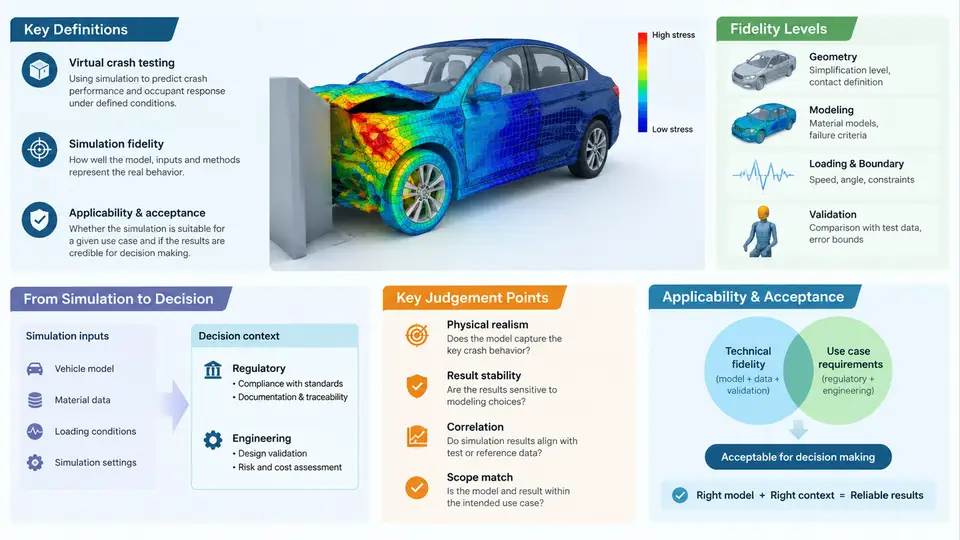
Virtual crash testing is the use of numerical simulation to predict how a vehicle structure, restraint system, or occupant responds to a crash event, and then to use those predictions as evidence in engineering and regulatory decisions. It is not simply "running a model." The discipline sits at the intersection of three distinct concerns: a physical definition of what is being simulated, a fidelity argument about how much the simulation can be trusted, and a decision context that determines whether a given level of trust is sufficient. Applicability and acceptance boundaries are the formal expression of that third concern — they answer the question "for this decision, is this model good enough, and how do we know?"
This chapter establishes the vocabulary and the reasoning framework that the rest of the course builds on. The goal is not to teach solver mechanics, but to make the reader able to look at any proposed virtual test and ask the right questions: What is the model representing? Against what evidence was it validated? What decision will it inform? What happens if it is wrong?
What "Virtual Crash Test" Actually Covers
The term spans a wide range of model types, and conflating them is a common source of misapplied acceptance criteria. At minimum, distinguish the following:
- Full-vehicle explicit finite element (FE) models — the body-in-white, closures, chassis, and subframes meshed at 5–10 mm characteristic length, solved with an explicit dynamics code (LS-DYNA, PAM-CRASH, Radioss, Abaqus/Explicit). These predict structural deformation, intrusion, and acceleration pulses.
- Occupant and restraint models — multibody or FE dummy models (Hybrid III 50th, THOR, WorldSID, Q-series) coupled to a seat and belt/airbag representation. These predict injury metrics such as HIC, chest deflection, and femur load.
- Pedestrian and two-wheeler subsystem models — headform and legform impactors against a bonnet or bumper representation, used for subsystem-level compliance.
- Barrier and sled representations — the boundary condition that transfers energy into the model; a poorly characterized barrier or pulse corrupts everything downstream.
A virtual test is only meaningful when the model type matches the decision. Using a full-vehicle FE model to argue occupant injury compliance without a validated occupant subsystem is a category error, not a fidelity shortfall.
Simulation Fidelity Is a Claim, Not a Property
Fidelity is often treated as a scalar — "this model is 90% accurate." That framing is misleading. Fidelity is a claim about a specific response quantity, over a specific range of conditions, supported by specific evidence. A model can be excellent for chest acceleration and poor for door intrusion; excellent at 50 km/h frontal impact and unvalidated at 64 km/h offset. Acceptance boundaries must therefore be expressed per response channel and per operating envelope, not as a single global grade.
Three evidence layers support a fidelity claim:
- Verification — does the model solve the equations correctly? Mesh convergence, energy balance (hourglass and internal energy ratios), time-step stability, and contact penetration checks. Verification says nothing about physical truth.
- Validation — does the model reproduce measured physical behavior? This requires test data from a comparable configuration, and a defined comparison metric (correlation score, peak error, phase error, or a composite such as ISO/TR 16250's objective rating).
- Uncertainty quantification — how much scatter exists in material properties, boundary conditions, and test repeatability, and how does that scatter propagate to the predicted response? A model that matches one test but sits inside a ±15% material scatter band has a different acceptance status than one that matches across the band.
The Decision Context: Why Boundaries Exist
Acceptance boundaries are not arbitrary thresholds imposed on simulation for its own sake. They exist because virtual results feed decisions with different consequence levels, and the tolerance for error scales with consequence. Consider the spectrum:
| Decision type | Typical use of simulation | Consequence of error | Evidence burden |
|---|---|---|---|
| Concept screening | Rank load paths, compare architectures | Low — reversible, cheap to correct | Trend-level agreement sufficient |
| Design release | Confirm intrusion and pulse targets | Medium — tooling and cost committed | Channel-specific validation required |
| Regulatory / homologation support | Substantiate compliance or reduce physical test count | High — legal and market access | Formal validation dossier, defined envelope |
| Safety-critical restraint logic | Airbag timing, belt load limiting, OOP | Very high — occupant outcome | Conservative bounds, UQ, physical confirmation |
The same model may be acceptable for concept screening and unacceptable for homologation support. This is the central insight of the course: acceptance is a property of the model-decision pair, not of the model alone.
How the Three Concerns Interlock
The figure below shows the relationship the chapter has been building: a physical definition feeds a model, the model's fidelity claim is bounded by verification, validation, and uncertainty evidence, and that bounded claim is then matched against the evidence burden demanded by the decision. Applicability is the match; acceptance is the verdict.
Reading the Framework in Practice
Suppose a team proposes to replace a 64 km/h offset deformable barrier (ODB) physical test with simulation for a design-release decision on occupant chest deflection. Applying the framework:
- Physical definition: full-vehicle FE model with a validated occupant subsystem, ODB barrier model, and the correct pulse. The occupant model must be the same dummy variant used in the physical test.
- Fidelity evidence: verification shows energy error below 5% and no significant hourglassing; validation shows chest deflection correlation against at least two prior physical ODB tests on comparable builds; UQ shows the material scatter band produces ±8% variation in chest deflection.
- Decision context: design release demands channel-specific validation — satisfied. But if the same result were to support homologation, the dossier would need to demonstrate the validated envelope covers the specific build and test configuration, not merely a similar one.
The verdict is not "the model is good." It is "this model, for chest deflection under 64 km/h ODB, is applicable to design release, with a stated uncertainty band." That sentence is the deliverable of the framing exercise, and every subsequent chapter refines how to construct and defend it.
What This Course Will Do With the Framework
The remaining chapters operationalize each element. Validation metrics and correlation methods are treated as engineering instruments with defined inputs and pass criteria, not as pass/fail rituals. Uncertainty quantification is presented as a way to convert scatter into a defensible tolerance band. The decision-context ladder is expanded into concrete acceptance criteria for specific regulatory and engineering scenarios, including where simulation may substitute for physical testing and where it may only supplement it. Throughout, the standard is the same: a virtual crash test is applicable when its bounded fidelity claim matches the evidence burden of the decision it informs, and acceptance is the documented judgment that this match holds.