1. Course overview
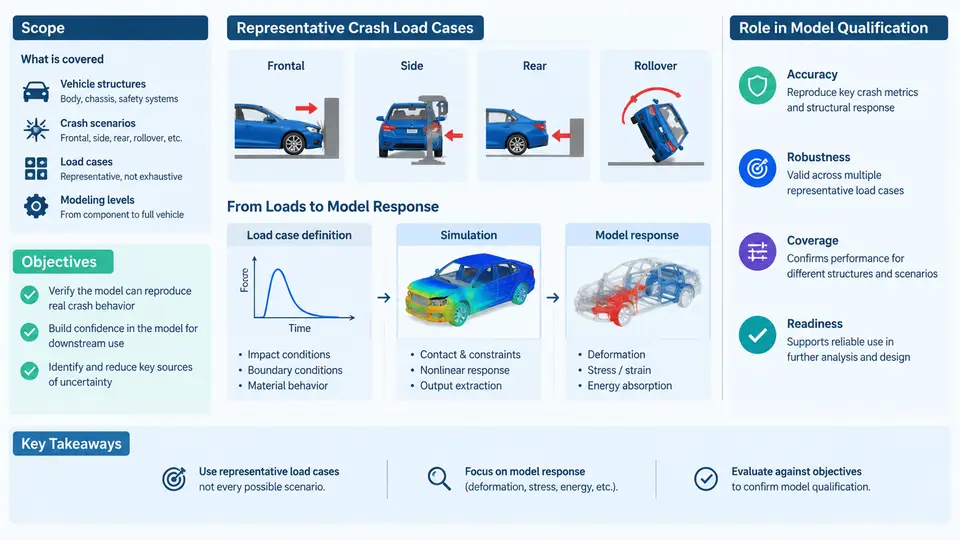
Crashworthiness simulation is only as trustworthy as the load cases used to qualify the model behind it. A finite element (FE) model can be meticulously meshed, correctly connected, and numerically stable, yet still fail to predict real-world occupant injury or structural collapse if it has been validated against load cases that do not represent the conditions the model will face in service. This course addresses that gap directly: it treats the selection, definition, and application of representative crash load cases as a deliberate engineering discipline rather than an afterthought in the CAE workflow.
The scope of the course spans the full qualification chain — from regulatory and consumer-rating requirements, through load-case derivation and boundary-condition specification, to correlation metrics and acceptance decisions. The objective is not to teach how to press buttons in a solver, but to build the judgment needed to answer a harder question: given this model, these test data, and this intended application, which load cases actually qualify it, and how do we know when qualification has succeeded?
What "Representative" Actually Means
A load case is representative when it exercises the same physical mechanisms, at comparable severity, with comparable boundary conditions, as the real event the model must predict. Representativeness has several independent dimensions, and a case can be strong in one and weak in another:
- Kinematic representativeness — the impact direction, obliquity, and yaw of the striking and struck bodies match the target event. A 100% frontal rigid-barrier test is a poor proxy for a 40% offset deformable-barrier event because the deformation path through the front structure differs fundamentally.
- Severity representativeness — the delta-v, peak deceleration, and pulse duration bracket the range the model must cover. Qualifying only at 50 km/h leaves the model unproven at the 64 km/h used in many offset protocols.
- Boundary representativeness — constraints, contact definitions, and fixture compliance reflect the physical test setup. A model qualified with a rigidly constrained rocker panel may behave very differently when the rocker is allowed to deform.
- Material and rate representativeness — strain-rate sensitivity, failure strain, and joining behavior are exercised in the regime the case produces. A quasi-static material card can pass a low-speed case and fail badly in a high-rate one.
These dimensions are not independent in practice. Increasing obliquity changes both the kinematic path and the local strain rate, so a single case can stress several dimensions at once. The qualification strategy must therefore be built as a set of cases whose combined coverage closes the gaps that any single case leaves open.
Where Load Cases Sit in the Qualification Workflow
Model qualification is a chain of evidence, and load cases are the links that connect simulation to physical reality. The figure below shows the relationship between the requirement source, the derived load cases, the model under test, and the correlation decision that closes the loop.
The diagram makes one point explicit: qualification is a closed loop, not a one-way pipeline. When correlation fails, the response is not simply to "fix the model" — it may be that the load case itself was mis-specified, that the physical test fixture introduced compliance not present in the simulation, or that the case is not representative of the intended application. Distinguishing among these causes is a core skill this course develops.
Objectives and Learning Outcomes
By the end of the course, you should be able to perform the following tasks with defensible engineering reasoning:
- Derive a load-case set from regulatory, rating, and internal requirements, and justify each case by the mechanism it exercises.
- Specify boundary conditions, initial velocities, contact definitions, and output channels so that the simulation case is comparable to its physical counterpart.
- Select and compute correlation metrics appropriate to the channel type — pulse-shape metrics for acceleration, deformation-mode comparison for structural intrusion, and force-displacement comparison for component-level cases.
- Judge qualification status against pre-agreed acceptance criteria, and document the evidence trail.
- Diagnose common failure modes: rate-dependent material mismatch, fixture compliance, contact penetration, and hourglassing that masquerades as physical deformation.
A Worked Framing Example
Consider a body-in-white (BIW) model intended to support frontal occupant-restraint design. The requirement sources include a 56 km/h full-frontal rigid-barrier protocol and a 64 km/h 40% offset deformable-barrier protocol. A naive qualification might run only the full-frontal case because it is simpler to set up. That choice is not representative: the offset case loads the longitudinal rails asymmetrically, drives bending rather than pure axial collapse, and produces a different intrusion pattern into the footwell. A defensible load-case set would include both, plus a lower-severity case to check that the model does not over-predict deformation at moderate speeds.
For each case, the specification must pin down the initial velocity (e.g. 15.56 m/s for 56 km/h), the barrier mass and stiffness (rigid wall versus deformable honeycomb with a defined force-displacement curve), the ground friction, and the output channels (B-pillar acceleration, toe-pan intrusion, steering-column displacement). These are not arbitrary choices; each one determines whether the simulated event is comparable to the test it will be correlated against.
Common Pitfalls at the Outset
Three mistakes recur in early qualification work and are worth naming explicitly. First, treating the load case as a solver input rather than an engineering specification — the case must be documented with enough precision that another engineer can reproduce it exactly. Second, confusing correlation with validation — a high correlation score against one test does not validate the model for a different impact direction or severity. Third, ignoring the physical test's own uncertainty — fixture compliance, sensor placement, and trigger timing all introduce variance that must be accounted for when setting acceptance bands.
The remainder of the course builds outward from this foundation: individual load-case families, their derivation and specification, the metrics used to correlate them, and the decision logic that turns correlation evidence into a qualification statement. The organizing principle throughout is the same one introduced here — a load case earns its place in the qualification set only by closing a coverage gap that the other cases leave open.