1. Physical test coverage planning fundamen
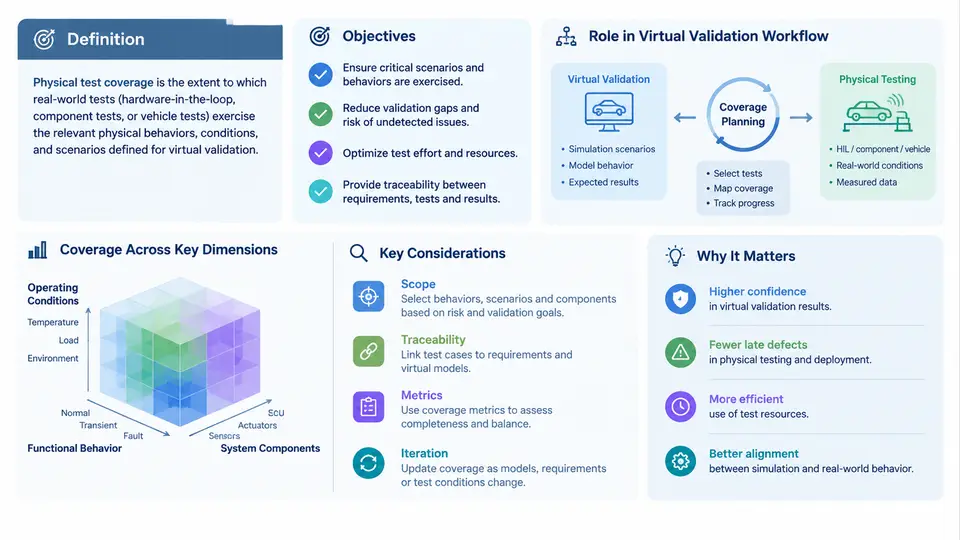
Virtual validation has become the default first line of defense in modern product development: simulation models, hardware-in-the-loop (HIL) benches, and software-in-the-loop (SIL) environments can execute thousands of scenarios before a single physical prototype exists. Yet virtual validation is only as trustworthy as the evidence that it represents reality. Physical test coverage planning is the discipline that decides which real-world tests must be performed, on which physical specimens, under which conditions, and with what acceptance criteria, so that the residual gap between simulated behavior and physical behavior is measured rather than assumed. It is the bridge between the virtual campaign and the physical campaign, and it is planned deliberately, not inherited from a test request list.
This chapter establishes the vocabulary and the planning logic used throughout the course: what coverage means in a physical test context, what objectives a coverage plan serves, and how coverage artifacts plug into a virtual validation workflow.
Definitions: Coverage, Physical Coverage, and Coverage Planning
In verification literature, coverage is a measure of how thoroughly a defined space of interest has been exercised. In software testing the space is usually code or requirements; in physical testing the space is a set of operating conditions, load cases, configurations, and failure modes that the product will encounter in its lifecycle. A coverage item is one distinguishable element of that space — for example, "ambient temperature −20 °C", "battery state of charge 15 %", or "single-channel sensor fault during braking". A coverage item is covered when a physical test has exercised it and produced a valid, traceable result.
Three terms must be kept distinct:
- Test coverage — the fraction (or set) of planned coverage items actually exercised by executed physical tests.
- Model confidence — the degree to which simulation results are trusted for a given region of the operating space, usually established by correlation against physical measurements.
- Coverage plan — the controlled document that defines the coverage space, the items, the physical test allocation, the acceptance criteria, and the traceability links to requirements and simulation scenarios.
A common misconception is that coverage is a percentage to be maximized. In physical testing, each covered item consumes specimen time, instrumentation, and budget, so coverage planning is fundamentally an allocation problem under constraints: maximize evidential value per test hour, not the raw count of tests.
Objectives of a Physical Coverage Plan
A well-formed coverage plan serves four objectives simultaneously, and the plan's structure should make each one auditable:
- Evidence sufficiency. Provide physical evidence for every requirement or risk item that cannot be closed by analysis or simulation alone — typically safety-critical functions, novel materials, and interfaces with uncontrolled environments.
- Model validation. Supply measurement data at carefully chosen points so that simulation models can be correlated and their validity domain declared explicitly.
- Risk retirement. Target the failure modes with the highest severity × occurrence score first, so that late discovery is avoided.
- Efficiency and reuse. Avoid duplicate tests; one well-instrumented test can cover several items and feed several correlation activities.
Where Coverage Sits in the Virtual Validation Workflow
Coverage planning is not a downstream activity that begins after simulation ends. It runs concurrently and iteratively with the virtual campaign. The figure below shows the information flow: requirements and risk analysis define the coverage space; the virtual campaign explores that space cheaply and identifies where model confidence is weak; the coverage plan allocates physical tests precisely to those weak regions and to items that simulation cannot close; physical results then feed back as correlation data, which updates model confidence and may reopen the coverage space.
The loop matters more than any single box. Coverage planning is revisited whenever correlation reveals that a model is weaker than assumed, or whenever a physical test produces an unexpected result that invalidates part of the coverage space. Treating the plan as a living, versioned artifact — not a one-time test list — is the single strongest predictor of a defensible validation argument.
From Coverage Space to a Worked Allocation Example
Consider an illustrative example: an electric drive unit with a declared operating envelope of ambient temperature −20 °C to +45 °C and DC bus voltage 240–420 V. The coverage space is the cross-product of these two continuous dimensions plus discrete items such as "coolant flow below minimum" and "single-phase loss". A naive plan might test the four corner points of the envelope. A coverage-driven plan instead asks which regions the simulation model cannot be trusted in — typically the extremes and the boundaries where protection functions intervene — and allocates physical tests there, while using simulation to cover the benign interior.
A practical allocation table for such a plan might look like this (values are illustrative, not measured):
| Coverage item | Why physical | Specimen / setup | Acceptance criterion |
|---|---|---|---|
| −20 °C cold start, 240 V | Model uncertainty in low-temperature viscosity and heater logic | Unit A, climatic chamber, torque transducer | Start within 2 s; no protection trip; correlation error ≤ 8 % |
| +45 °C, 420 V, continuous load | Thermal model extrapolation beyond validated range | Unit B, dyno, thermocouples on stator and inverter | Winding temp ≤ 155 °C steady state; derating onset as predicted ±5 °C |
| Coolant flow below minimum | Safety function; simulation cannot reproduce sensor lag | Unit A, flow restrictor, fault injection harness | Derating within 500 ms; no thermal runaway |
| Single-phase loss at mid-load | Failure mode with high severity; model lacks validated fault path | Unit C, switchable phase disconnect | Safe shutdown; no overcurrent beyond 1.2 × rated |
Note what the table forces you to state: the reason each item needs physical evidence, the resource it consumes, and the criterion that decides whether the item is covered. Without the third column, coverage becomes an unbounded wish list; without the fourth, a test can run and still leave the item open.
Common Planning Failure Modes
- Coverage by test count. Reporting "120 tests executed" says nothing about which items were exercised. Track items, not runs.
- Simulation-shaped plans. Copying the simulation scenario list into the physical plan ignores that physical tests are expensive and should be placed where models are weakest.
- Missing acceptance criteria. An item without a pass/fail threshold cannot be closed and will silently migrate to the next milestone.
- No traceability. If a coverage item cannot be linked to a requirement, hazard, or model-confidence claim, its result cannot be used in the validation argument.
- Frozen plans. A plan that is never revised after correlation results is a plan that has stopped learning.
What a Coverage Plan Must Contain
Although formats vary by organization, a complete physical coverage plan contains: the coverage space definition with explicit boundaries and reference conventions (for example, all temperatures are ambient unless stated otherwise); the enumerated coverage items with unique identifiers; the allocation rationale for each item (why physical rather than virtual); the specimen and instrumentation matrix; acceptance criteria and measurement methods; traceability links to requirements, hazards, and simulation scenarios; and a revision history tied to correlation results. These elements are the minimum for the plan to function as evidence rather than as a schedule.
With these fundamentals in place, subsequent chapters can move into the mechanics: how to enumerate coverage items systematically, how to size the physical campaign against model confidence, and how to maintain the plan as correlation data accumulates.