1. Crash evidence and simulation credibilit
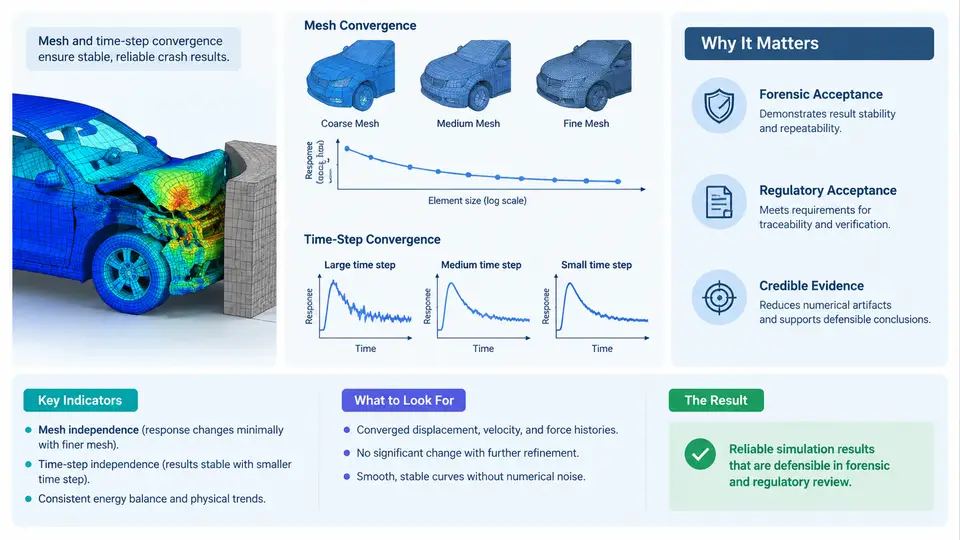
In crash forensics and regulatory compliance, a finite element (FE) simulation is rarely an end in itself. It is an evidentiary instrument. Whether the question is why an occupant sustained a particular injury, whether a restraint system met a certification threshold, or how a vehicle structure behaved in a specific collision, the simulation must withstand scrutiny from parties who did not build it: opposing experts, regulators, insurers, and courts. That scrutiny almost always converges on one question — is the numerical result a property of the physics, or a property of the discretization? Mesh and time-step convergence is the discipline that answers this question, and it is the single most common technical basis on which crash simulations are accepted or rejected.
Why Discretization, Not Just Physics, Determines Credibility
An explicit crash solver advances a discretized approximation of the governing equations. Two numerical controls dominate the error budget: the spatial discretization (element size, element formulation, hourglass control, contact thickness) and the temporal discretization (the stable time step and any mass scaling used to achieve it). Both introduce error that is systematic, not random. A coarse mesh can under-predict peak acceleration while over-predicting intrusion; aggressive mass scaling can artificially stiffen or soften the response and shift energy absorption between components. Because these errors are reproducible, they can be exposed — and that is precisely what a convergence study does.
The forensic consequence is direct. If a simulation's key outputs change materially when the mesh is refined or the time step is reduced, the original result cannot be presented as a unique prediction of the event. It is one point on an unconverged numerical trajectory. Regulators and courts do not require infinite resolution; they require that the analyst has demonstrated the result is insensitive to further refinement within a stated tolerance, and that the tolerance is justified relative to the decision being made.
Defining the Quantities of Interest Before Refining
Convergence studies fail most often because they are run against the wrong target. Refining a mesh while watching global kinetic energy will show near-perfect convergence almost immediately, because energy is conserved by construction and is insensitive to local discretization. The QoI must be the quantity the forensic or regulatory decision actually depends on. Typical choices in crash work include:
- Occupant response: resultant head acceleration peak and 3 ms clip, HIC36, chest deflection, femur force.
- Structural response: maximum intrusion at a named location, peak longitudinal deceleration of the occupant compartment, door latch separation.
- System response: total internal energy, hourglass energy as a fraction of internal energy, contact energy, and the ratio of added kinetic energy from mass scaling to physical kinetic energy.
Each QoI should be tied to a location and a time window, not just a global maximum. "Peak intrusion at the driver footwell rear bulkhead, 0–120 ms" is a defensible QoI; "maximum displacement" is not, because it can migrate to a different component as the mesh changes.
Running a Defensible Mesh and Time-Step Convergence Study
A practical study refines the two controls independently, then together. The following example uses representative values for a full-frontal rigid-barrier occupant-compartment model; the numbers are illustrative and must be replaced with values appropriate to the actual model and solver.
# Illustrative convergence matrix (example values, not measured results)
# Refinement level | nominal element size | target dt | mass scaling
L0 (baseline)      | 10 mm               | 1.0 us    | 0.0 %
L1                 |  7 mm               | 0.7 us    | 0.0 %
L2                 |  5 mm               | 0.5 us    | 0.0 %
T1 (time only)     | 10 mm               | 0.5 us    | 0.0 %
T2 (time only)     | 10 mm               | 0.25 us   | 0.0 %
Run L0–L2 with the time step held at the stable value for each mesh (no mass scaling), and run T1–T2 on the baseline mesh with a reduced time step to isolate temporal error. Record each QoI at every level. Then compute the relative change between successive levels:
delta_i = |QoI_i - QoI_(i-1)| / |QoI_(i-1)| * 100 %
A result is considered converged for a given QoI when delta falls below the acceptance tolerance and the trend is monotonic or oscillatory-but-bounded. A common forensic tolerance is 5 % for occupant injury metrics and 2–3 % for structural intrusion, but the tolerance must be justified against the regulatory threshold or the injury criterion being evaluated — a 5 % band around a HIC value sitting exactly at a pass/fail limit is not sufficient evidence.
Reading the Convergence Behavior
The pattern of change carries as much evidentiary weight as the final number. Three behaviors matter in forensic review:
- Monotonic convergence — successive refinements move the QoI toward a stable value. This is the strongest position: the analyst can state the converged value and its uncertainty band.
- Oscillatory convergence — the QoI alternates around a mean as the mesh refines. Acceptable only if the oscillation amplitude is bounded and below tolerance; otherwise the QoI is sensitive to element alignment and the mesh must be redesigned, not merely refined.
- Divergence or drift — the QoI keeps moving with refinement. This indicates a modeling issue (contact definition, element formulation, material instability, or a stress concentration that is physically real but numerically unresolved) and must be resolved before any result is presented.
Time-step convergence is often overlooked because explicit solvers are conditionally stable and analysts assume the stable step is "correct." It is stable, but stability is not accuracy. Reducing the time step below the stable value isolates temporal error; if the QoI shifts materially, the original step was too coarse for the loading rate, and the result must be re-run. Mass scaling deserves particular forensic attention: it is a legitimate technique, but it changes the mass distribution and therefore the dynamics, and any scaling must be documented, bounded, and shown not to alter the QoI beyond tolerance.
Documenting the Evidence for Forensic and Regulatory Review
The convergence study is only as persuasive as its documentation. A defensible submission records, for each refinement level: the nominal element size and the actual minimum element size in the QoI region, the time step and any mass scaling factor, the QoI value with its location and time window, the relative change from the previous level, and the hourglass and mass-scaling energy ratios. It also states the acceptance tolerance and the basis for choosing it — for example, "5 % of HIC, chosen because the regulatory threshold is 1000 and the converged value is 720, leaving a margin far larger than the numerical band."
This documentation converts a numerical exercise into an auditable argument. When an opposing expert challenges the mesh, the analyst can point to the refinement sequence and show that the QoI moved by less than the stated tolerance between the two finest levels. When a regulator asks whether mass scaling compromised the dynamics, the analyst can show the added kinetic energy fraction and the time-step sensitivity run. The credibility of the crash simulation is then grounded not in the sophistication of the model but in the demonstrated insensitivity of its conclusions to the discretization choices — which is exactly the standard forensic and regulatory acceptance demands.
In practice, mesh and time-step convergence is the bridge between simulation output and evidentiary weight. It is the mechanism by which an analyst demonstrates that a predicted intrusion, deceleration, or injury metric is a property of the crash physics rather than an artifact of how the continuum was chopped into elements and advanced in time. Establishing that bridge rigorously — with defined QoIs, independent spatial and temporal refinement, explicit discretization gates, and transparent documentation — is what allows a crash simulation to be defended in a forensic report or accepted in a regulatory submission.