1. Applicability domain fundamentals
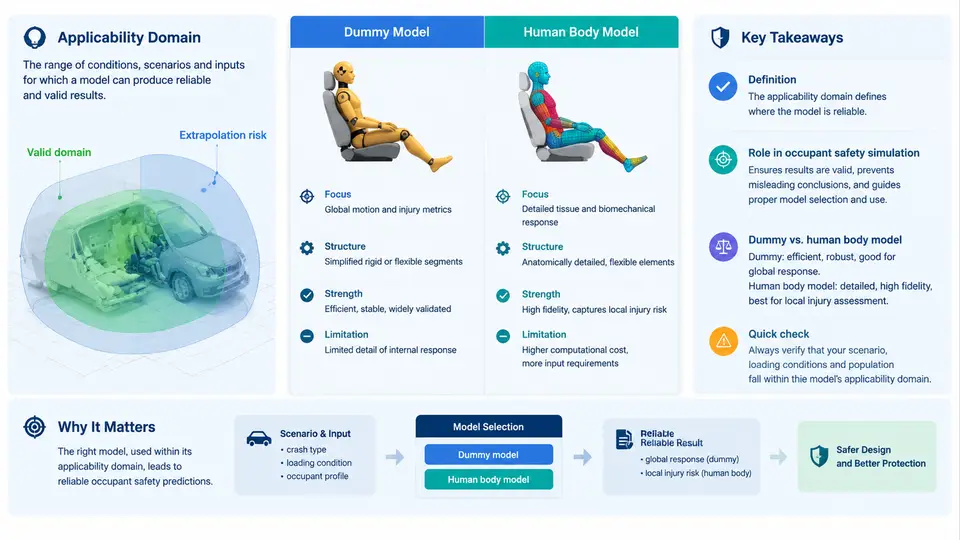
In occupant safety simulation, a model is never universally valid. Every finite element (FE) dummy and every human body model (HBM) is developed, tuned, and validated against a bounded set of loading conditions, anthropometries, and injury criteria. The applicability domain is the formal envelope within which a model's predictions can be trusted. Treating it as an afterthought is one of the most common sources of silent error in restraint-system development: the simulation runs, the solver converges, the animation looks plausible, and the conclusion is nonetheless wrong because the model was used outside the conditions it was built for.
What the Applicability Domain Actually Is
The applicability domain is the set of input conditions — impact direction, severity, boundary conditions, occupant anthropometry, posture, restraint configuration, and the output quantities of interest — for which a model has demonstrated, through validation against physical tests, that its response is representative within a stated tolerance. It is not a single number or a single pass/fail flag. It is a multi-dimensional region, and a model can be inside its domain on one axis while outside it on another.
Four dimensions dominate in practice:
- Loading conditions — impact type (frontal, side, rear, oblique, rollover), pulse shape, and severity (e.g., Δv in km/h, or barrier impact speed).
- Boundary and contact environment — seat geometry and stiffness, belt routing and pretensioner/load-limiter behaviour, airbag deployment timing and venting, steering-wheel or side-trim contact surfaces.
- Occupant description — anthropometry (stature, mass, BMI), posture, material properties of soft tissue, and skeletal geometry.
- Output quantities — the injury metrics the model is expected to predict (head acceleration, HIC, chest deflection, rib strain, pelvis force, etc.), each with its own validated range.
A model may be well validated for chest deflection in 40 km/h frontal impacts yet have no validated basis for predicting rib fracture location under a 64 km/h oblique load. The domain is therefore always assessed per output quantity, not per model as a whole.
Why the Domain Matters in Occupant Safety Simulation
Occupant safety simulation supports restraint tuning, packaging studies, and certification pre-assessment. In each case the simulation substitutes for a physical test, and the substitution is only legitimate inside the validated envelope. Three practical consequences follow.
First, design decisions inherit the model's uncertainty. If a restraint parameter is optimised using a dummy outside its validated severity range, the optimum may not transfer to the physical sled test. Second, regulatory and consumer-rating assessments (FMVSS 208, Euro NCAP, C-NCAP, etc.) are defined around specific Anthropomorphic Test Devices (ATDs) and specific pulses; using a model beyond those conditions produces numbers that cannot be compared to the rating thresholds. Third, extrapolation must be declared. When a study deliberately explores beyond the domain — for example, a future, more severe crash scenario — the result should be reported as a trend indicator, not as a quantitative prediction.
Dummy Models and Human Body Models: A Structural Distinction
The two model families answer different questions, and their applicability domains are shaped by fundamentally different construction principles.
Dummy models (e.g., Hybrid III 50th percentile male, THOR, WorldSID, EuroSID-2re, BioRID) are numerical representations of physical ATDs. Their geometry, mass distribution, joint stiffness, and instrumentation are fixed by the hardware they mimic. They are calibrated to reproduce the ATD's own biofidelity corridors, which were themselves derived from cadaver and volunteer tests decades ago. Their strength is comparability: a dummy model predicts what the corresponding physical dummy would measure, so simulation and sled test are directly comparable. Their limitation is that they represent a single, fixed anthropometry and a simplified, lumped-mass biomechanical response; they cannot resolve local tissue injury such as individual rib fractures or strain in a specific brain region.
Human body models (e.g., THUMS, GHBMC, SAFER HBM) are detailed FE representations of human anatomy: deformable brain, individual ribs with cortical and trabecular bone, organs, muscles, and ligaments. They can predict local injury metrics — rib strain, brain strain, organ pressure — and can be morphed to represent a range of anthropometries (small female, obese, elderly). Their strength is biofidelity and anatomical resolution. Their limitation is that they are far more sensitive to material-property uncertainty, mesh quality, and boundary conditions, and their validation basis is narrower and more condition-specific than a dummy's. A dummy model validated across a family of pulses may be usable across that family; an HBM validated for one impact direction and one anthropometry may not be.
| Attribute | Dummy model (ATD) | Human body model (HBM) |
|---|---|---|
| Reference object | Physical ATD hardware | Human anatomy (cadaver/volunteer data) |
| Anthropometry | Fixed per ATD size (5th, 50th, 95th) | Morphable across population |
| Output resolution | Instrumented channels (accel, load, deflection) | Local strain, stress, organ-level metrics |
| Primary strength | Direct comparability with sled tests and regulations | Biofidelity and anatomical detail |
| Domain sensitivity | Moderate; tied to ATD calibration corridors | High; tied to material properties and specific validation cases |
| Typical use | Restraint tuning, certification pre-assessment | Injury mechanism study, population variability, novel restraint concepts |
The practical implication is that the applicability domain of a dummy model is largely inherited from the ATD's certification and biofidelity history, whereas the domain of an HBM must be assembled case by case from its validation matrix. A dummy model's domain statement might read "validated for frontal impact, 25–64 km/h, Hybrid III 50th, chest deflection and head acceleration." An HBM's domain statement is typically a table of validation cases, each with its own loading condition, anthropometry, and output metric.
Reading the Domain in Practice: A Worked Example
Consider a frontal restraint study at 50 km/h using a Hybrid III 50th percentile dummy model, with the objective of predicting chest deflection (maximum compression) and head acceleration. The domain check proceeds as follows. The loading condition (frontal, 50 km/h, standard pulse) sits inside the ATD's validated frontal range. The occupant (50th male) matches the ATD's fixed anthropometry. The restraint environment (belt with load limiter, driver airbag) is within the range of configurations used in the ATD's calibration. The output metrics (chest deflection, head acceleration) are instrumented channels the ATD was designed to measure. The study is inside the domain, and the predicted values can be compared directly to sled-test data and to regulatory thresholds.
Now change one variable: the study is repeated at 80 km/h, or with a 5th percentile female occupant, or with an oblique 30° impact. Each change moves the study along a different axis. The 80 km/h case exceeds the validated severity range; the 5th percentile case requires a different ATD (or an HBM morphed to that anthropometry); the oblique case requires a model validated for oblique loading. In each case the correct response is not to run the simulation and hope, but to identify which axis has been exceeded, whether a validated model exists for that axis, and — if not — to label the result as exploratory.
Establishing and Documenting the Domain
For a dummy model, the domain statement is usually derived from the ATD's qualification and biofidelity documentation plus the specific validation cases the model was tuned against. For an HBM, the domain must be built from a validation matrix: a table listing each validation case (loading condition, anthropometry, boundary conditions), the output metrics compared, and the achieved correlation or tolerance. The domain is then the union of the cases for which the model met its acceptance criteria — and, critically, the interpolation between those cases, not the extrapolation beyond them.
A practical documentation format records, for each output metric, the validated range on each axis and the source of validation. When a new study falls outside a range, the entry is flagged and the study is either re-scoped to a validated model or explicitly labelled exploratory. This discipline is what separates a defensible occupant-safety simulation from a plausible-looking animation.
The remainder of this course builds on this foundation: subsequent chapters examine how domains are established through validation, how they are queried in practice, and how dummy and HBM domains are combined or contrasted when a study spans both model families.