1. Introduction to crash simulation credibi
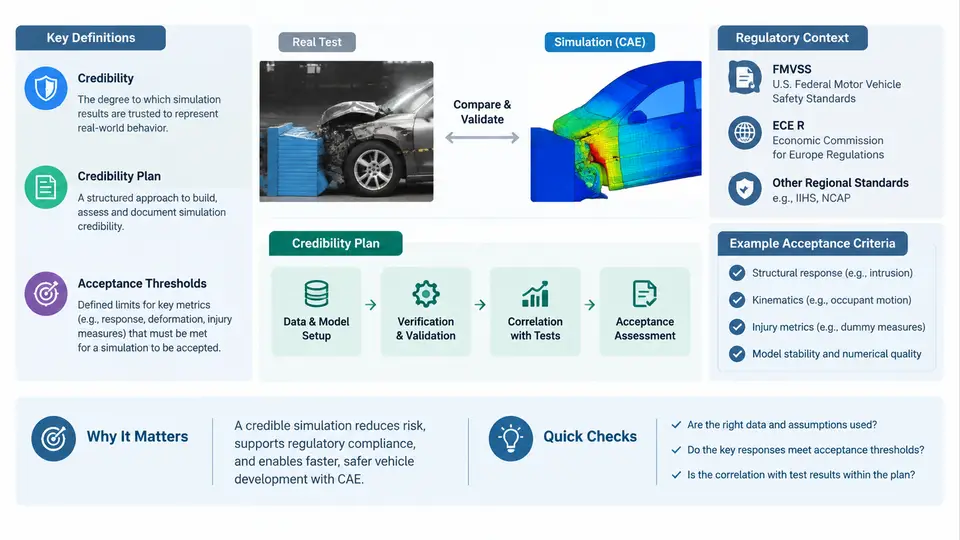
Crash simulation is one of the most consequential modeling activities in vehicle development. A full-vehicle frontal impact model may contain 5–15 million elements, dozens of material laws calibrated from coupon and component tests, contact definitions spanning hundreds of interfaces, and boundary conditions that must reproduce a physical barrier, sled, or moving deformable barrier (MDB) setup. The output of such a model — occupant compartment intrusion, restraint loading, dummy injury metrics — feeds directly into design decisions and, increasingly, into type-approval and self-certification arguments. When a model is used this way, the central engineering question is no longer "does the simulation run?" but "how much confidence should a decision-maker place in this prediction, and why?" That question is the subject of crash simulation credibility.
This chapter establishes the vocabulary and the organizational logic that the rest of the course builds on: what credibility means in a CAE context, how the regulatory and standards landscape frames it, and why a written credibility plan — agreed before the model is used for a decision — has become a standard artifact in OEM and supplier safety development.
What "Credibility" Means for a Crash Model
Credibility is not a synonym for accuracy. Accuracy is a property of a single prediction compared with a single reference; credibility is a defensible judgment that a model, in a stated context of use, is adequate to support a specific decision. Three ideas are embedded in that definition and each has practical consequences.
- Context of use (CoU). A model validated for 56 km/h full-frontal rigid-barrier occupant response is not thereby credible for 32 km/h oblique pole side impact or for a 90 km/h rear-seat case. The CoU must state the load case, the vehicle configuration (trim, powertrain, restraint variant), the output quantities of interest (QoIs), and the decision the model supports — for example, "compare two B-pillar reinforcement gauges for IIHS side-impact rib deflection" rather than "validate the body structure."
- Evidence. Credibility rests on a body of evidence: verification (does the code solve the equations correctly?), validation (does the model reproduce physical tests?), sensitivity and uncertainty quantification, and documented expert review. Evidence is accumulated, not asserted.
- Proportionality. The rigor required scales with the consequence of a wrong decision. A model used to rank early-phase concepts tolerates more uncertainty than one used to sign off a restraint calibration that will appear in a certification report.
The Regulatory and Standards Context
Crash simulation credibility did not emerge from simulation groups alone; it was pulled into formal practice by regulators and standards bodies responding to the growing use of CAE in safety demonstration.
ASME V&V 10 and 20 provide the general framework: V&V 10 defines verification and validation terminology and the concept of validation comparison with experimental uncertainty, while V&V 20 addresses credibility assessment and, importantly, the credibility factors — phenomena, coupling, boundary conditions, materials, and code verification — that must be rated for a given CoU. ASME V&V 40 extends this to medical devices but is frequently cited for its structured credibility matrix approach. In the automotive domain, SAE J2945-family and industry consortia guidance, together with OEM-internal CAE standards, translate these general principles into crash-specific practice: which tests constitute a validation set, how to treat dummy biofidelity separately from structural correlation, and how to document model changes after correlation.
Regulatory frameworks add a second layer. UN R94/R95, FMVSS 208/214, and the newer UN R127/R152 pedestrian and ADAS-adjacent regulations define the physical test procedures; they do not, in general, prescribe how a simulation must be validated. However, when CAE is used to support certification by simulation, virtual testing, or a design decision that reduces physical test count, the burden shifts to the manufacturer to demonstrate that the model is fit for that purpose. Euro NCAP and other consumer-rating programs have moved in the same direction, accepting simulation evidence for some development and pre-test activities while requiring documented correlation. The practical consequence: the credibility argument must be written down, reviewable, and tied to the specific regulatory or rating decision it supports.
Where the Credibility Plan Sits in the Development Flow
A credibility plan is a short, controlled document (typically 5–15 pages plus appendices) created before the model is used for its decision, and updated as evidence arrives. It is not a validation report written after the fact; its value comes from committing to the CoU, the QoIs, the acceptance thresholds, and the evidence sources up front, so that correlation work is aimed at the right targets and disagreements are surfaced early.
The figure below shows the relationship between the plan, the model lifecycle, and the decision gate it protects.
The plan is deliberately placed above the lifecycle rather than at its end: it defines what "correlated" will mean before correlation begins, and it is the artifact a reviewer reads when deciding whether the model may be used. The decision gate at the bottom is the point of the whole exercise — the plan exists to make that gate auditable.
What a Credibility Plan Contains in Practice
Although formats vary by OEM, a workable plan answers five questions in order. First, what decision does this model support, and what is the consequence of being wrong? This sets the rigor level. Second, which quantities of interest will be compared, and against which physical tests? A typical frontal-impact plan might list occupant compartment intrusion at the toe pan, steering-wheel rearward displacement, seat-belt force at the retractor, and dummy Head Injury Criterion (HIC) and chest deflection, each mapped to a specific sled or full-vehicle test. Third, what acceptance thresholds apply to each QoI, and why those values? Thresholds should be justified — for example, a peak-force tolerance of ±10% derived from test-to-test repeatability observed across three repeat tests, not an arbitrary round number. Fourth, what evidence already exists and what is still missing? This is the evidence matrix, and it is where most plans earn their keep: it exposes that, say, the knee-bolster material has coupon data but no component-level validation. Fifth, who reviews and signs, and how are changes to the model after correlation handled? Any post-correlation change to geometry, material, or contact must be logged and its effect on the evidence re-assessed; otherwise the validation silently expires.
Why This Matters for CAE-Driven Safety Development
Modern vehicle programs run hundreds of crash simulations per architecture, and the ratio of simulations to physical tests continues to rise as virtual testing is accepted for more decisions. That leverage is only safe if each simulation used for a decision carries a proportionate, documented credibility argument. The credibility plan is the mechanism that makes this scalable: it forces the CoU and thresholds to be agreed by simulation, test, and safety teams before results are available, it makes correlation work target the QoIs that matter, and it leaves an audit trail that survives staff turnover and program carryover. The remaining chapters of this course develop each element — CoU definition, verification, validation test design, correlation metrics, threshold derivation, uncertainty quantification, and review governance — in engineering detail, using the plan structure introduced here as the organizing frame.