1. Introduction to CORA rating
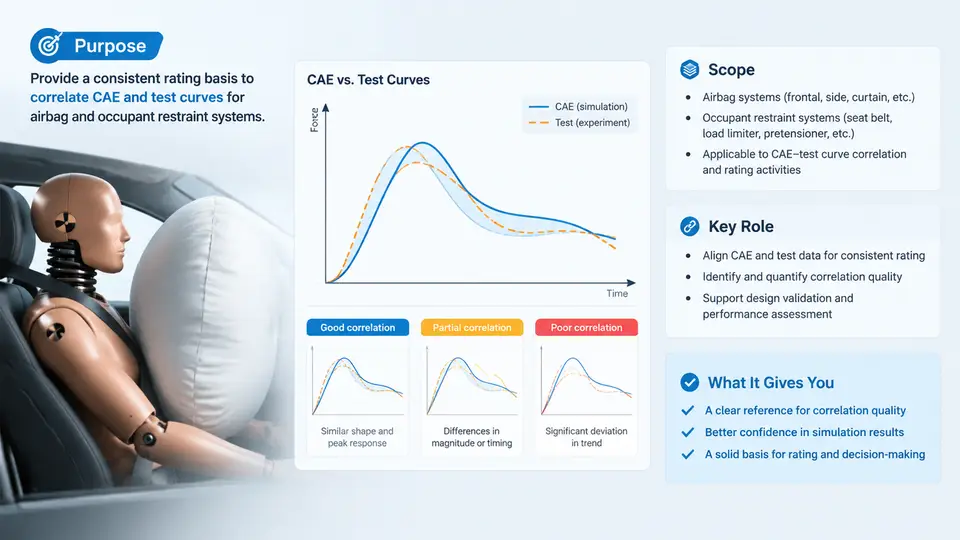
In occupant safety engineering, a CAE model is only as trustworthy as the evidence that it reproduces physical reality. The CORA rating (Correlation and Rating) is a standardized, quantitative method for measuring how closely a simulated curve matches its corresponding test curve. Originally developed within the German automotive industry and now maintained as an open standard, CORA has become the de facto language for communicating correlation quality between CAE engineers, test engineers, and OEM safety departments. This chapter establishes what CORA measures, where it applies, and how it fits into the broader validation workflow for airbag and occupant restraint systems.
Why a Standardized Rating Is Needed
Before CORA, correlation was often judged by eye: an engineer overlaid two curves, declared the match "good," and moved on. This approach fails for three reasons. First, it is subjective — two reviewers can reach opposite conclusions from the same plot. Second, it is not scalable — a full frontal restraint system may involve dozens of channels (head acceleration, chest deflection, belt force, airbag pressure), and visual inspection of each is slow and inconsistent. Third, it is not actionable — "looks close" does not tell a modeler whether the discrepancy lies in timing, amplitude, or phase.
CORA addresses all three by decomposing the comparison into two independent, physically meaningful metrics and combining them into a single score. The result is a number that can be tracked across builds, compared between departments, and used as an objective acceptance criterion.
The Two Core Metrics: Corridor and Cross-Correlation
CORA evaluates a pair of curves — a reference curve (typically the test measurement) and a comparison curve (the CAE result) — using two complementary measures:
- Corridor rating assesses amplitude agreement. A tolerance band is constructed around the reference curve, with the inner and outer corridor widths defined as a percentage of the reference signal's range (commonly ±5% inner and ±10% outer, configurable per channel). The comparison curve is evaluated at each time step: full credit inside the inner corridor, partial credit between inner and outer, and zero outside. The corridor rating is the weighted average of these per-step scores.
- Cross-correlation rating assesses phase and shape agreement. The two curves are cross-correlated over a defined time window, and the maximum normalized correlation coefficient is reported together with the time lag at which it occurs. A high coefficient with near-zero lag indicates the simulation captures both the shape and the timing of the event.
The two ratings are then combined — typically as a weighted average, with weights set by the evaluation protocol — into an overall CORA score between 0 and 1. A score of 1.0 means perfect agreement; in practice, well-correlated restraint models target overall scores above roughly 0.7–0.8, with channel-specific thresholds agreed between CAE and test teams.
Where CORA Applies in Restraint System Validation
CORA is channel-agnostic: it operates on any time-history pair sampled on a common time base. In airbag and occupant restraint work, typical channels include:
| Domain | Example channels | What correlation reveals |
|---|---|---|
| Occupant kinematics | Head resultant acceleration, chest acceleration, chest deflection, pelvis acceleration | Whether the dummy loading path and restraint engagement timing are captured |
| Restraint hardware | Seat belt force (shoulder/lap), retractor pull-out, buckle load | Whether belt routing, slip, and load limiting behave as in test |
| Airbag performance | In-bag pressure, vent pressure, module reaction force | Whether inflation timing, venting, and bag–occupant interaction are modeled correctly |
| Vehicle response | Sled pulse, B-pillar acceleration, steering column displacement | Whether the boundary conditions driving the occupant model are faithful |
The scope of a CORA evaluation is therefore defined by the channel set and the time window. A common mistake is to rate only the "headline" channel (e.g., head acceleration) while ignoring the underlying belt-force and pressure channels. Because CORA scores are per-channel, a model can score well on the headline channel for the wrong reasons — compensating errors in belt force and bag pressure can cancel out in the occupant response. A defensible correlation study rates the full causal chain, from boundary condition through restraint hardware to occupant response.
How CORA Fits the CAE–Test Workflow
CORA is not a modeling tool; it is a judgment layer applied after simulation and test data are both available. The figure below shows where it sits in the workflow and how its outputs feed back into model improvement.
What CORA Does Not Do
Understanding the boundaries of the method is as important as understanding its mechanics. CORA quantifies agreement; it does not explain it. A low corridor rating tells you the amplitude deviates, but not whether the cause is an incorrect vent area, a mis-specified belt friction coefficient, or a boundary condition that does not match the sled pulse. Similarly, a high cross-correlation coefficient with a large time lag is a specific, diagnosable signature — often pointing to an inflation onset offset or a contact initialization delay — but CORA itself will not name the parameter to change.
CORA also does not replace engineering judgment about which channels matter. A model that scores 0.85 overall but 0.45 on chest deflection has not passed, regardless of the aggregate number. The rating is an input to a decision, not the decision itself.
Practical Setup Considerations
Three setup choices materially affect the score and must be documented alongside it:
- Time alignment. Both curves must share a defined time-zero. For restraint channels, t=0 is typically the sled pulse onset or a specified event trigger. A systematic offset of even a few milliseconds will depress the cross-correlation rating and should be resolved before rating, not absorbed into the score.
- Evaluation window. The window should cover the physically meaningful event — from restraint engagement through occupant rebound — and exclude pre-trigger noise and post-event settling. Windows that are too wide dilute the rating; windows that are too narrow can exclude the phase information the cross-correlation needs.
- Corridor definition. Inner and outer corridor widths are protocol parameters. They should be set per channel type (a belt force channel and a head acceleration channel have very different acceptable tolerances) and frozen before evaluation begins, so that scores remain comparable across model iterations.
Summary
CORA provides an objective, two-dimensional rating of CAE–test correlation by separating amplitude agreement (corridor rating) from shape and phase agreement (cross-correlation rating) and combining them into a single score. In airbag and occupant restraint engineering, it applies to any time-history channel pair and is most defensible when applied across the full causal chain — boundary condition, restraint hardware, and occupant response — rather than to headline channels alone. Its outputs feed a model-update loop: diagnose the sub-score that is low, identify the responsible physical parameter, adjust, re-simulate, and re-rate. The remaining chapters build on this foundation, covering corridor construction in detail, cross-correlation mechanics, weighting and aggregation schemes, channel-specific protocols, and the diagnostic workflow for turning a low score into a targeted model improvement.