1. Q-Series child dummy overview
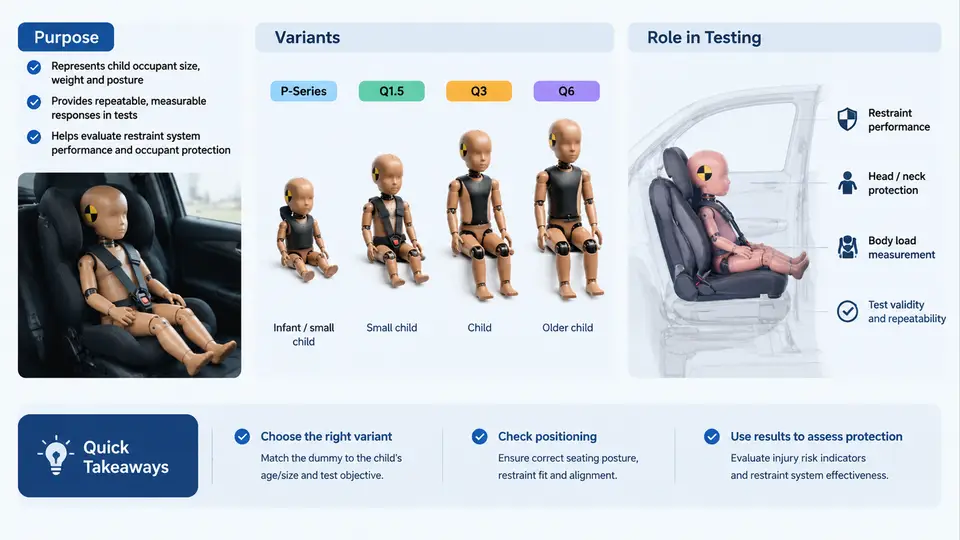
The Q-Series is a family of anthropomorphic test devices (ATDs) developed to represent children of different ages and sizes in vehicle crash testing. Unlike the older P-Series dummies, which were derived from scaled adult designs, the Q-Series was engineered from the ground up around pediatric anthropometry and biomechanics. For anyone installing and positioning these dummies, understanding what each variant represents, how it is built, and what it is meant to measure is not background reading — it directly determines whether a test result is valid. A Q3 positioned with the wrong pelvis angle, or a Q6 fitted with the wrong jacket, produces data that looks plausible but is not comparable to certification or regulatory baselines.
This chapter establishes the foundation for the installation and positioning work that follows: the purpose of the Q-Series, the variants and their physical distinctions, and the role these dummies play in child occupant protection (COP) testing programs such as ECE R129 and consumer rating protocols.
Why a Dedicated Child Dummy Family Exists
Children are not small adults. Their head-to-body mass ratio is far higher, their cervical spine is immature, their rib cage is more compliant, and their pelvis is not fully ossified. A dummy scaled down from an adult Hybrid III cannot reproduce these proportions or injury mechanisms. The Q-Series addresses this by using child-specific geometry, mass distribution, and joint stiffness, and by instrumenting locations that matter for child injury criteria — notably the head, neck, chest, and abdomen.
The family was developed under the auspices of the European Enhanced Vehicle-safety Committee (EEVC) and is specified in UN Regulation No. 129 (ECE R129), which made Q-Series dummies the reference ATDs for child restraint system (CRS) approval in Europe. Their use extends well beyond regulation: consumer test programs, OEM development testing, and CRS manufacturer validation all rely on Q-Series hardware because it provides repeatable, biofidelic response and a documented certification chain.
The Variants and What Distinguishes Them
The Q-Series covers a range of child sizes. The most commonly encountered variants in installation and positioning work are Q0, Q1, Q1.5, Q3, Q6, and Q10, where the number denotes the approximate age in years. Each variant has its own mass, stature, and segment geometry, and each is certified as a complete assembly. The table below summarizes the principal variants and their typical test roles.
| Variant | Nominal Age | Approx. Mass | Typical Test Role |
|---|---|---|---|
| Q0 | Newborn | ~3.4 kg | Rearward-facing infant carriers; newborn CRS approval |
| Q1 | 1 year | ~10 kg | Rearward-facing CRS; transition to forward-facing |
| Q1.5 | 1.5 years | ~11 kg | Rearward-facing CRS in larger shells |
| Q3 | 3 years | ~15 kg | Forward-facing CRS with harness; booster development |
| Q6 | 6 years | ~22 kg | Booster seats; belt-positioning assessment |
| Q10 | 10 years | ~32 kg | Booster seats; adult belt fit for older children |
Mass and stature values above are nominal reference figures; always use the certified mass stated on the dummy's calibration certificate for the specific unit in use, since ballast and instrumentation can shift the total. The Q0 and Q1 are rearward-facing designs with a distinctive reclined posture and a head support that differs structurally from the forward-facing variants. The Q3, Q6, and Q10 share a common architectural philosophy — articulated pelvis, instrumented chest, and a neck assembly tuned to the age group — but differ in segment length and joint stiffness.
Construction and Instrumentation Relevant to Positioning
A Q-Series dummy is a segmented assembly: head with accelerometers, a deformable neck, a chest with rib deflection measurement, an abdomen with pressure or deflection sensing, and a pelvis that provides the primary mounting and reference datum. The pelvis is the anchor for positioning — its angle relative to the seat cushion and backrest defines the dummy's posture, and every downstream measurement (head excursion, chest deflection, belt fit) depends on it. This is why installation procedures specify pelvis angle targets and why a positioning check always begins at the pelvis.
The dummy also carries a certification status: each unit is certified as a complete assembly, and mixing components across units or variants invalidates the certification. During installation, the serial numbers on the head, torso, and pelvis should be checked against the certificate. A common failure in practice is using a Q3 torso with a Q6 pelvis after a repair — the assembly fits mechanically but the mass distribution and geometry are wrong, and the resulting data cannot be traced to a certified configuration.
Role in Child Occupant Protection Testing
In a COP test, the Q-Series dummy serves three functions simultaneously. First, it loads the CRS and vehicle seat the way a child would, so the restraint system's structural response is realistic. Second, it measures the occupant response — head acceleration, neck loads, chest deflection, abdominal pressure — which are converted into injury criteria used for pass/fail decisions. Third, it provides a repeatable reference: because the dummy is certified and its geometry is fixed, results from different labs and different test series can be compared.
The choice of variant is driven by the CRS category under test. A rearward-facing infant carrier is evaluated with Q0 or Q1; a forward-facing harnessed seat with Q3; a booster with Q6 or Q10. Using the wrong variant is not a minor deviation — it changes the mass, the center of gravity, and the belt routing, and it invalidates any comparison to the approval baseline. The figure below maps the relationship between CRS category, dummy variant, and the primary measurement focus.
What This Means for Installation and Positioning
Because the Q-Series is a certified, segmented assembly with a pelvis-referenced posture, installation is not simply "place the dummy in the seat." The procedure must respect the dummy's design: the pelvis is set to a specified angle, the torso is brought into contact with the backrest under a defined load, the head is positioned within a tolerance, and the limbs are arranged so they do not preload the CRS. Each of these steps exists because the dummy's instrumentation and geometry were certified in that configuration.
A practical example makes the dependency concrete. Suppose a Q3 is being installed in a forward-facing harnessed CRS for a frontal impact test. The test plan specifies a pelvis angle of 20° ± 2° relative to the seat cushion and a head-to-headrest clearance of 20–40 mm. If the installer sets the pelvis at 26°, the torso reclines further, the head moves rearward, and the chest deflection sensor's orientation relative to the belt changes. The test may still run and produce numbers, but the head excursion and chest deflection will not be comparable to the approval baseline, and the result may be wrongly attributed to the CRS rather than to the setup. The positioning check exists precisely to catch this before the sled fires.
Key Takeaways for the Chapters Ahead
- The Q-Series is a child-specific ATD family, not a scaled adult; its geometry and instrumentation reflect pediatric biomechanics.
- Variants Q0 through Q10 map to CRS categories and test roles; selecting the correct variant is a prerequisite for valid comparison.
- Each dummy is certified as a complete assembly; component mixing or uncertified repair invalidates the data.
- The pelvis is the positioning datum; pelvis angle and seat contact determine torso posture, head position, belt routing, and every measured response.
- Installation targets are measured values, not visual judgments; the positioning check is the gate between setup and test execution.
With this foundation, the next stage of the course moves into the concrete installation sequence: preparing the dummy and seat, establishing the pelvis reference, setting torso and head position, and verifying each target before the test is released.