1. Certification record fundamentals
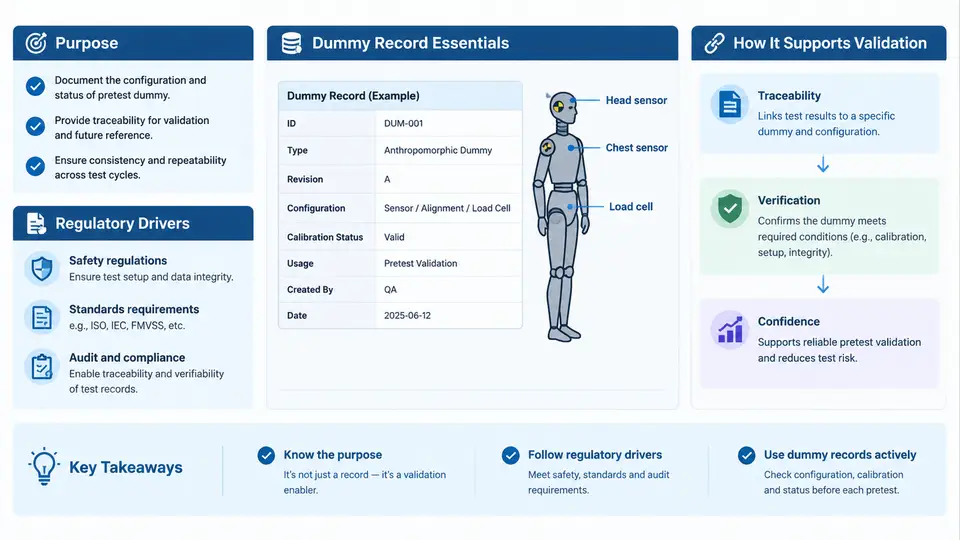
Before a single measurement is taken on a device under test (DUT), the test laboratory must be able to demonstrate that its measurement system, personnel, and procedures are in a known, controlled, and traceable state. The certification record is the documentary evidence of that state. In pretest validation, a dummy record — a deliberately constructed, non-production certification record used to exercise the record-keeping and traceability chain — is the instrument that proves the system works before real data is committed to it. This chapter establishes what certification records are, why regulators and accreditation bodies demand them, and how dummy records function as a validation tool rather than as a formality.
What a Certification Record Actually Is
A certification record is a controlled, retrievable set of documents and data that links a specific test result to the conditions under which it was produced. It is not a single form. In a typical electromagnetic compatibility (EMC) or safety laboratory, the record for one test campaign includes the test request and DUT identification, the applicable standard and clause list, the test plan, instrument identification with calibration status, the raw measurement data and plots, the environmental conditions log, the operator and reviewer signatures, and the final report with its unique report number. Each element is a link in a chain: the report cites the raw data, the raw data cites the instrument, the instrument cites its calibration certificate, and the calibration certificate cites a national metrology institute.
The defining property of a certification record is traceability — the ability to reconstruct, from the record alone, who did what, with which equipment, under which conditions, against which requirement, and with what result. A record that cannot answer those five questions is not a certification record; it is a collection of files.
Regulatory and Accreditation Drivers
The obligation to maintain certification records comes from several overlapping sources, and understanding which one applies shapes how the record must be structured.
- ISO/IEC 17025 requires accredited laboratories to retain records of original observations, derived data, and sufficient information to facilitate re-testing, and to ensure records are legible, retrievable, and protected against alteration. Clause 7.5 and Clause 7.11 are the operative anchors for most record-keeping audits.
- Product regulation — for example the EU EMC Directive, the Radio Equipment Directive, or FCC Part 15 — requires that a manufacturer hold a technical file supporting the declaration of conformity, and that test reports be traceable to the tested sample.
- Scheme rules — CB Scheme, NRTL programs, and notified-body procedures impose their own record retention periods and content requirements, often stricter than the base standard.
- Customer and contractual requirements frequently add data-package formats, witness-test documentation, or sample-retention rules.
These drivers converge on one practical consequence: the record must be designed before testing begins, because a record assembled after the fact almost always has gaps — a missing calibration interval, an unsigned raw-data sheet, an unrecorded ambient temperature — that cannot be retroactively created without falsification.
Why Dummy Records Exist in Pretest Validation
A dummy record is a complete certification record built around a known, non-critical test object — often a reference load, a golden sample, or a deliberately simple DUT — for the explicit purpose of validating the record-generation process. It is sometimes called a dry-run record, a record rehearsal, or a traceability mock-up. Its value lies in the fact that it is disposable: errors found in a dummy record cost nothing, while errors found in a production record during an accreditation audit can invalidate a certification.
Dummy records serve four distinct validation functions:
- Chain completeness testing. The dummy record is walked end-to-end to confirm that every required link exists — that the report number resolves to raw data, that raw data resolves to an instrument ID, and that the instrument ID resolves to a valid calibration certificate within its interval.
- Template and field validation. It exposes missing mandatory fields, ambiguous units, inconsistent date formats, and signature blocks that cannot accommodate the actual number of reviewers.
- Workflow and role testing. It verifies that the handoff from operator to reviewer to approver is recorded with timestamps and identities, and that no role can silently overwrite another's entry.
- Retention and retrieval testing. It confirms that the record can be located by report number, by DUT serial number, and by date range within the required retrieval time, and that it survives the archive migration cycle.
VALIDATION-DUMMY prefix in the report number and a watermark on every page — so that it can never be mistaken for, or cited as, evidence of conformity for a real product.The Traceability Chain Visualized
The diagram below shows the certification record as a traceability chain, with the dummy record overlaid as a validation probe that tests each link before production data enters the chain.
Building a Dummy Record: A Worked Example
Consider a laboratory preparing for an ISO/IEC 17025 surveillance audit of its radiated-emissions test bench. The quality manager decides to build a dummy record for a reference comb generator used as a stable, known emission source. The following steps are representative and use illustrative parameters, not measured results.
- Define the dummy object. Assign the reference source a validation serial, e.g.
REF-CG-0042, and record it in the asset register with a flagvalidation_use = trueso it is excluded from production reporting. - Create the record header. Use report number
VALIDATION-DUMMY-2024-001, cite the applicable standard clause (for example CISPR 32 radiated emissions, 30 MHz–1 GHz), and list the test plan revision. - Populate the instrument chain. Enter the receiver asset number, its calibration certificate number, the certificate's validity window, and the calibration uncertainty. Confirm the test date falls inside the validity window.
- Capture raw data. Store the sweep trace, the antenna factor and cable loss tables used, and the ambient temperature and humidity log. Record the operator identity and the timestamp of data capture.
- Route for review. Send the record to a reviewer who did not perform the test, then to an approver. Confirm that each signature carries a distinct identity and timestamp.
- Test retrieval. Search the archive by report number, by
REF-CG-0042, and by the test date range. Record the retrieval time for each query.
Expected observable outcomes for a passing dummy record: every link resolves without manual intervention, no mandatory field is blank, the calibration validity window contains the test date, the three role signatures are distinct and time-ordered, and each retrieval query returns the record within the laboratory's stated retrieval target (commonly under five minutes for an electronic archive). Typical failure symptoms include a report number that does not resolve to raw data, a calibration certificate whose validity window ends before the test date, a reviewer signature identical to the operator's, or a retrieval query that returns nothing because the record was indexed only by report number.
Record Content Baseline
The table below summarizes the minimum content a certification record should carry, mapped to the traceability link it supports. It is a starting baseline; scheme rules may add fields.
| Record element | Traceability link supported | Typical failure if missing |
|---|---|---|
| Unique report number | Report → raw data | Record cannot be retrieved or cited |
| DUT / sample identification | Result → tested object | Result cannot be tied to a specific unit |
| Standard and clause list | Result → requirement | Conformity claim unsupported |
| Instrument asset ID and calibration cert. | Data → instrument → NMI | Measurement traceability broken |
| Raw data and environmental log | Report → original observations | Re-test or re-analysis impossible |
| Operator, reviewer, approver identities and timestamps | Result → responsible persons | Accountability and independence unproven |
| Retention and archive index entry | Record → retrieval | Record effectively lost |
Key Takeaways
A certification record is a traceability chain, not a document. Its purpose is to let an auditor or customer reconstruct the full measurement context from the record alone. Regulatory and accreditation drivers — ISO/IEC 17025, product directives, scheme rules, and contracts — all converge on the same requirement: the record must be designed before testing and must remain retrievable and unaltered for its retention period. The dummy record is the validation instrument that proves the chain holds before production data depends on it. Treat it as a controlled artifact, mark it unmistakably, and when it fails, fix the system rather than the artifact.