1. Posttest data plausibility review fundam
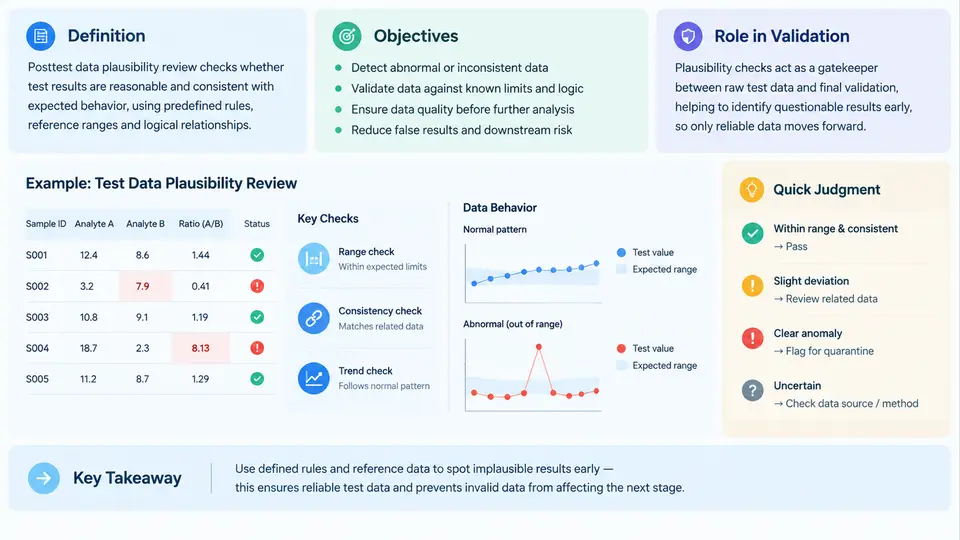
In any measurement campaign — environmental monitoring, structural load testing, power electronics validation, or production end-of-line testing — the raw data that leaves the acquisition system is not yet evidence. It is a set of numbers that may or may not reflect the physical behavior of the device under test (DUT). Posttest data plausibility review is the disciplined process of judging, before any engineering conclusion is drawn, whether each recorded channel is physically credible given the test setup, the sensor characteristics, and the expected behavior of the DUT. It sits between data acquisition and data analysis, and it is the gate that decides which channels are trustworthy enough to enter the analysis pipeline and which must be quarantined.
The distinction between plausibility and correctness matters. A plausibility review does not prove that a value is the true value; it establishes that the value is consistent with the physical world and the test configuration. A strain channel reading exactly 0.000 µε for the entire duration of a loaded test is not "correct" or "incorrect" in isolation — it is implausible, because a loaded specimen must deform. Conversely, a channel showing a smooth 50 Hz sinusoid on a vibration test may be perfectly plausible even if its amplitude is later found to be miscalibrated. Plausibility is a necessary but not sufficient condition for validity, and that asymmetry is exactly why it is such an efficient first filter.
Definitions and Scope
Three terms are used throughout this course and should be fixed early:
- Plausibility — the degree to which a recorded signal is consistent with physical laws, sensor physics, expected DUT behavior, and the documented test configuration. It is a per-channel, per-segment judgment.
- Plausibility check — a specific, repeatable test applied to a channel or channel group that produces a pass/fail (or scored) outcome. Checks are automated where possible and documented always.
- Channel quarantine — the controlled removal of a channel from the analysis dataset, with its raw data preserved, its exclusion reason recorded, and its downstream impact assessed. Quarantine is not deletion.
The scope of a plausibility review typically covers: signal presence and activity, range and saturation behavior, rate-of-change and frequency content, cross-channel consistency, timing and synchronization, and metadata coherence (gain, unit, sensor ID, calibration date). It deliberately does not cover calibration accuracy verification, which belongs to metrology, nor statistical outlier rejection within an otherwise valid signal, which belongs to analysis.
Objectives of the Review
A well-run plausibility review pursues four concrete objectives. First, protect the analysis: prevent a failed sensor, a disconnected lead, or a misconfigured gain from propagating into fatigue calculations, pass/fail decisions, or certification reports. Second, localize faults: distinguish whether an anomaly originates in the sensor, the cabling, the conditioning amplifier, the digitizer, or the DUT itself, because each has a different remedy. Third, preserve traceability: every exclusion must be justified with evidence so that a reviewer six months later can reconstruct why a channel was removed. Fourth, feed back into the test process: recurring plausibility failures point to fixture problems, connector wear, or configuration errors that should be corrected before the next campaign.
Where Plausibility Checks Sit in the Validation Chain
Test data validation is usually depicted as a sequence: acquisition → signal quality screening → plausibility review → calibration correction → engineering analysis → reporting. Plausibility review is the stage that reasons about physical meaning rather than signal statistics alone. A statistical screen might flag a channel as "noisy"; the plausibility review decides whether that noise is consistent with, say, a high-impedance piezoelectric sensor on a long cable, or whether it indicates a broken shield. The figure below shows this position and the decision flow that a reviewer follows for each channel.
What a Plausibility Check Actually Tests
Checks are most useful when they are tied to a physical expectation rather than a generic threshold. Consider a concrete example from a structural test: eight foil strain gauges (350 Ω, gauge factor 2.10) are bonded to a steel beam and connected in a quarter-bridge configuration to a conditioning amplifier with a 120 Hz low-pass filter, sampled at 1 kHz. The beam is loaded in four-point bending to a nominal 20 kN, and the expected peak surface strain at the mid-span is approximately 850 µε based on a hand calculation. The review then applies checks such as:
- Activity check — standard deviation of the channel over the loaded segment must exceed a floor derived from the amplifier noise specification (e.g., 2 µε RMS). A channel with σ = 0.3 µε across the entire load ramp is a flatline candidate.
- Range check — the recorded peak must lie within a physically bounded window, say 0.5× to 2.0× the predicted 850 µε. A reading of 12,000 µε on a beam that should see under 1,000 µε indicates a gain error, a wrong gauge factor, or a bridge wiring fault.
- Rate check — the maximum sample-to-sample change must be consistent with the 120 Hz filter and the loading rate. A step of 400 µε in one millisecond is not physically achievable through that filter and points to a digital glitch or a loose connection.
- Cross-channel check — gauges on the tension and compression faces of the same section should show opposite signs and comparable magnitudes. If all eight channels move in the same direction with identical amplitude, the bridge excitation or the reference channel is suspect.
Each check produces a result with a timestamp, the segment it applied to, the threshold used, and the observed value. That record is what makes the eventual quarantine defensible.
Common Failure Modes the Review Is Designed to Catch
| Observed symptom | Typical physical cause | Plausibility check that catches it |
|---|---|---|
| Perfectly flat channel during loading | Disconnected lead, dead gauge, disabled input | Activity / variance floor |
| Signal pinned at ±full scale | Over-range gain, open bridge, saturated amplifier | Range and saturation check |
| Strong 50/60 Hz component | Broken shield, ground loop, long unshielded run | Spectral check against expected bandwidth |
| Step discontinuities | Intermittent connector, slip-ring noise | Rate-of-change / slew check |
| One channel inverted relative to its pair | Reversed bridge wiring or sign convention error | Cross-channel sign and correlation check |
| All channels share an identical artifact | Common excitation droop or reference fault | Cross-channel common-mode check |
Judgment, Not Just Thresholds
The hardest part of plausibility review is that thresholds alone are insufficient. A channel may pass every numeric check and still be implausible because the test sequence was wrong — for example, the load was never actually applied, so a "quiet" strain channel is faithfully recording a beam that was never bent. This is why the review must always be conducted against the documented test configuration: the intended load schedule, sensor map, wiring list, and acquisition settings. The reviewer's question is not only "is this signal clean?" but "is this signal what this sensor, on this DUT, under this test, should have produced?"
Equally, a channel that fails a check is not automatically worthless. A strain channel that saturates briefly during a deliberate overload event may still be valid for the elastic portion of the record. The review therefore works at the level of channel segments, not whole channels, and the quarantine decision records the affected time window. This granularity is what allows a test to be partially salvaged rather than discarded wholesale.
Deliverable: Channel Plausibility Review Record
The review produces one record per channel, which becomes the audit trail for every downstream decision. A minimal but complete template is shown below; the fields are chosen because each one is needed to defend an admit/quarantine decision later.
Channel Plausibility Review Record
---------------------------------
Test ID:            ST-2024-017  (four-point bending, beam B3)
Channel:            SG-05  (mid-span, tension face, 350 ohm, GF 2.10)
Acquisition:        1 kHz, 120 Hz LPF, gain 100, bridge 2.0 V
Expected peak:      ~850 microstrain (hand calc, 20 kN nominal)

Check               Threshold            Observed        Result
------------------  -------------------  --------------  --------
Activity (sigma)    > 2 microstrain      41.6 ue         PASS
Range (peak)        425 - 1700 ue        902 ue          PASS
Slew (max d/sample) < 25 ue             6.1 ue          PASS
Cross-channel sign  opposite to SG-06    opposite        PASS
Spectral (50 Hz)    < 5% of RMS         1.2%            PASS

Decision:           ADMIT
Segment:            full record (0.0 - 42.5 s)
Reviewer:           [initials]   Date: [YYYY-MM-DD]
Notes:              none
When a check fails, the same record is completed with the observed value, the decision QUARANTINE or ESCALATE, the affected segment, and a short root-cause hypothesis. The raw file is never modified; the record points to it by channel name and time window. This separation of evidence from judgment is the core discipline of the entire course: plausibility review decides what may be used, quarantine records what may not, and both leave the original data intact for anyone who needs to re-examine the decision.
With these fundamentals in place — the definition of plausibility, the four objectives, the position of the review in the validation chain, and the structure of the review record — the remaining chapters can move into the specific check families, their parameterization, and the mechanics of channel quarantine.