1. Introduction to Hybrid III ATDs
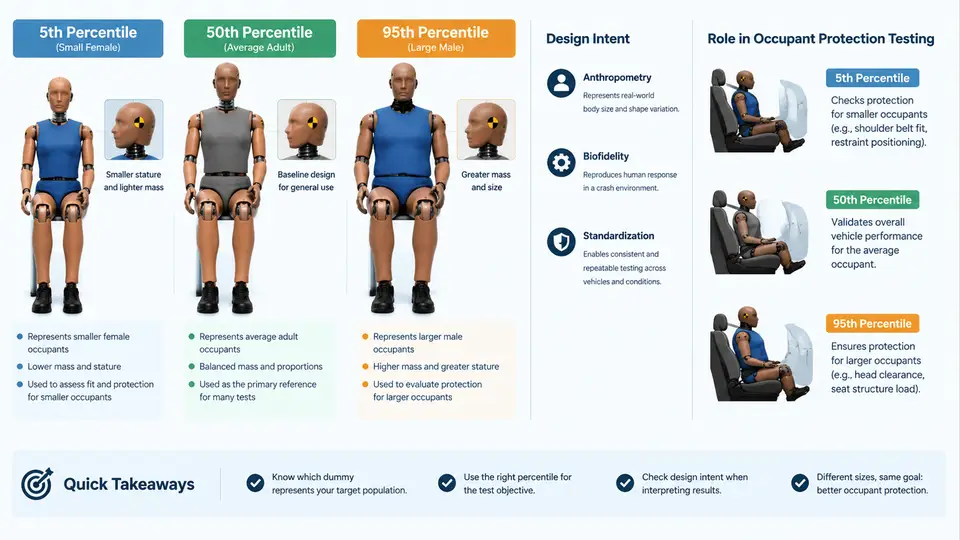
The Hybrid III Anthropomorphic Test Device (ATD) family is the backbone of automotive occupant protection testing in the United States and many other regulatory and consumer-testing regimes. Unlike a crash-test dummy in the colloquial sense, a Hybrid III is a calibrated measuring instrument: every segment, joint, and load cell exists to produce repeatable, biofidelic responses that can be compared against injury criteria. This chapter introduces the three principal adult Hybrid III variants — the 5th percentile female, the 50th percentile male, and the 95th percentile male — and explains why a single dummy size cannot represent the whole occupant population.
Design Intent and Lineage
The Hybrid III descends from the Hybrid II, which was developed in the 1970s for frontal-impact compliance testing. The Hybrid III, introduced in the mid-1980s, added a deformable, segmented face, a more human-like neck, improved lumbar spine response, and instrumented lower extremities. Its design intent is narrow and deliberate: it is a frontal-impact device, validated primarily against pendulum and sled tests representing belt-restrained and airbag-restrained occupants in frontal collisions. It is not a validated side-impact or rear-impact tool, and using it outside its validated envelope produces numbers that look precise but carry no established injury-correlation meaning.
Each percentile variant is a geometrically and mass-scaled member of the same family, sharing instrumentation philosophy, calibration procedures, and much of the hardware. That shared architecture is what makes the family practical: a test laboratory can run the same data-acquisition setup, the same calibration fixtures, and the same analysis pipeline across all three sizes.
The Three Adult Variants at a Glance
The percentile label refers to the stature and mass distribution of the U.S. adult population as characterized when the devices were defined. The 50th percentile male represents the median adult male; the 5th percentile female represents a small adult; the 95th percentile male represents a large adult. The table below summarizes the nominal design values that drive seating position, belt geometry, and injury-criterion thresholds.
| Attribute | 5th % Female | 50th % Male | 95th % Male |
|---|---|---|---|
| Nominal stature | ≈ 151 cm (59.5 in) | ≈ 175 cm (69 in) | ≈ 188 cm (74 in) |
| Nominal total mass | ≈ 49 kg (108 lb) | ≈ 78 kg (172 lb) | ≈ 101 kg (223 lb) |
| Primary use | Small-occupant / out-of-position risk | Baseline compliance and development | Large-occupant / belt-fit extremes |
| Head | Smaller skull geometry | Reference geometry | Larger skull geometry |
| Typical seating reference | Forward, upright | Mid-track | Rearward, reclined tendency |
These are nominal design values, not measured results from any particular build; individual devices carry serial-number-specific calibration data that must be used in place of catalog figures when computing injury criteria.
Why Three Sizes Matter: Occupant Protection Logic
Restraint systems are tuned around a design occupant, usually the 50th percentile male. But the failure modes at the extremes are different in kind, not just in magnitude. A small female occupant sits closer to the steering wheel and airbag module, so her chest and head are exposed to the airbag during deployment — the out-of-position (OOP) problem. Her lower mass also means the same belt force produces higher deceleration, and her shorter torso changes where the shoulder belt crosses the clavicle and sternum. A large male occupant, by contrast, loads the belt and airbag more heavily, may sit further rearward so the belt geometry wraps differently, and can bottom out the airbag before the torso is fully coupled.
Testing only the 50th percentile therefore leaves both extremes unexamined. Regulatory and consumer programs address this by requiring multiple sizes: for example, FMVSS 208 frontal-occupant protection specifies 50th percentile male driver and passenger tests, plus 5th percentile female and 95th percentile male configurations for unbelted and belted conditions. The intent is not to test every body type but to bracket the population so that a restraint design validated at the extremes is unlikely to fail in between.
Instrumentation and the Measurement Chain
All three variants carry a common instrumentation set: head accelerometers (triaxial at the head CG), upper-neck and lower-neck load cells, chest accelerometers and a chest deflection potentiometer, lumbar spine load cells, pelvis accelerometers, and femur/tibia load cells with knee-slider potentiometers. The measurement chain matters because injury criteria are computed from specific channels at specific locations. Head Injury Criterion (HIC) uses the resultant head CG acceleration; chest deflection uses the potentiometer stroke relative to the sternum; the Neck Injury Criterion (Nij) uses the upper-neck load cell forces and moments.
Because the three sizes share this architecture, a channel map written for the 50th percentile transfers directly to the 5th and 95th, with the caveat that sensor ranges and calibration coefficients differ. A 95th percentile femur load cell may see higher loads than a 5th percentile unit, and the data-acquisition gain settings must be chosen accordingly to avoid clipping.
Reading the Family Correctly in Practice
When a test request arrives, the first decision is which variant answers the question. A development engineer investigating an airbag-induced chest injury on a small occupant will run the 5th percentile female in an OOP configuration; a compliance engineer preparing a certification package will run the 50th percentile male in the specified belted and unbelted modes; a restraint supplier evaluating a large-occupant belt-fit concern will run the 95th percentile male. Mixing these up — for example, using the 50th percentile to argue that a small-occupant concern is resolved — is a common and serious error, because the 50th percentile simply does not exercise the geometry that creates the risk.
Two practical cautions follow from the family design. First, the percentile labels are population descriptors from the era of definition, not current anthropometric truth; they should be treated as fixed device identities, not as claims about today's drivers. Second, because the devices share architecture but not dimensions, calibration fixtures and positioning procedures are size-specific. A 5th percentile female head is positioned and oriented differently from a 95th percentile male head, and the H-point and seat-back angle setup must follow the size-specific procedure. Using a 50th percentile positioning template on a 5th percentile device will bias the very measurements the test is meant to produce.
What This Course Covers
The remaining chapters build from this foundation into handling procedures: receiving and inspecting each variant, size-specific positioning and H-point setup, instrumentation checks and channel verification, calibration intervals and pass/fail limits, sled and vehicle test execution, data reduction into injury criteria, and troubleshooting when channels behave unexpectedly. Throughout, the guiding principle is that the Hybrid III is a calibrated instrument whose numbers are only meaningful when the correct variant is used, positioned per its own procedure, and reduced with its own calibration data.