1. Crash test vehicle preparation fundament
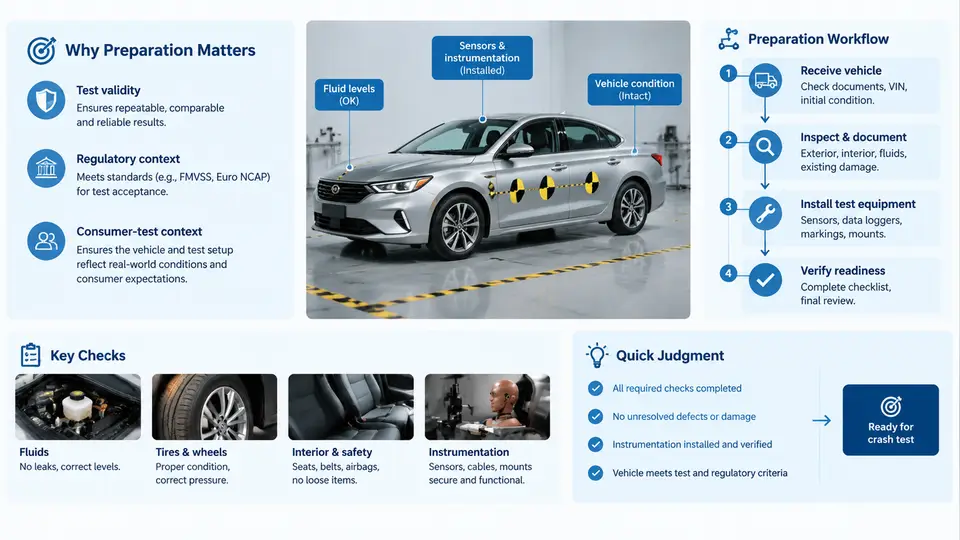
In a crash test, the vehicle itself is a measurement instrument. Every acceleration pulse, intrusion value, and injury criterion recorded during the event is only meaningful if the vehicle presented to the test facility matches the specification the test was designed around. Vehicle preparation is the discipline that guarantees this match. It sits between vehicle receipt and the moment the test engineer arms the propulsion system, and it determines whether the resulting data can be used to certify a restraint system, satisfy a regulatory requirement, or support a consumer-rating claim.
The stakes are easy to underestimate. A 20 g difference in a barrier impact pulse, a seat mounted 15 mm out of position, or a fuel system carrying 8 kg more than the declared test mass can shift occupant injury metrics enough to change a pass into a fail — or, worse, produce a pass that cannot be reproduced. Preparation is therefore not logistics; it is part of the measurement chain.
Why Preparation Governs Test Validity
Test validity rests on three properties: representativeness, repeatability, and traceability. Representativeness means the prepared vehicle reflects the production configuration being evaluated — same restraint hardware, same trim mass distribution, same structural content. Repeatability means a second vehicle prepared to the same procedure would produce a statistically comparable result. Traceability means every deviation, adjustment, and measurement is documented so that an auditor or a counterpart lab can reconstruct exactly what was tested.
Preparation protects all three. Mass properties are the clearest example. Regulatory frontal impact procedures typically require the vehicle to be at a specified test mass — often curb mass plus a defined occupant and cargo allowance — with the center of gravity within a tolerance band of the production position. If ballast is added carelessly, the longitudinal CG migrates rearward, the pitch behavior during braking and impact changes, and the occupant excursion relative to the restraint changes with it. A preparation team that weighs each wheel position individually and computes the CG before and after ballasting catches this before the test, not after.
Regulatory Versus Consumer-Test Contexts
The two contexts impose different preparation priorities, and confusing them is a common source of rework.
| Aspect | Regulatory (type-approval) testing | Consumer-rating testing |
|---|---|---|
| Configuration basis | Worst-case or specified variant defined in the regulation | Highest-volume or nominated variant, often with optional safety equipment |
| Mass condition | Prescribed test mass, often curb mass plus fixed allowances | Typically curb mass plus defined occupant/cargo load, sometimes with a tolerance window |
| Dummy selection | Specified by regulation (e.g., Hybrid III 50th percentile) | Multiple sizes and positions to score occupant protection across the range |
| Documentation | Formal conformity evidence, witnessed and sealed | Detailed configuration disclosure to the rating organization |
| Tolerance philosophy | Pass/fail against legal limits | Scoring, with preparation consistency affecting comparability across vehicles |
In regulatory work, the preparation engineer follows a specification that leaves little discretion: the regulation names the mass condition, the dummy, the impact speed, and the barrier. The job is conformity. In consumer testing, the preparation engineer often has more judgment — which trim level, which seat position, whether a sunroof is fitted — and that judgment must be defensible and disclosed. A vehicle prepared for a rating test with a configuration that differs from the one sold in volume will produce a score that misleads consumers, even if every measurement is technically correct.
The Preparation Workflow: From Receipt to Test Readiness
The workflow below is typical for a frontal or side impact program. It is presented as a sequence because the dependencies are real — mass properties cannot be finalized before the vehicle is in its test configuration, and instrumentation cannot be installed before the interior is stripped to the required degree.
Stage 1 — Receipt and inspection. The vehicle arrives with a shipping configuration that is rarely the test configuration. Record the VIN, odometer, and any transport damage with photographs before anything is removed. Damage that is later mistaken for test-induced deformation is a classic audit finding.
Stage 2 — Configuration build. Bring the vehicle to the declared test configuration: correct trim level, optional equipment present or absent as specified, fluids at the prescribed fill, tires of the specified size and make at the specified pressure. This stage is where regulatory and consumer programs diverge most, because the configuration basis differs.
Stage 3 — Mass properties. Weigh each wheel individually on calibrated scales, compute total mass and CG, then add ballast to reach the target test mass. Ballast must be mechanically secured so it cannot shift during the impact, and its location must be chosen to keep the CG within tolerance. Record the before-and-after values. This is the gate shown in the diagram: if the CG or test mass is out of tolerance, the vehicle returns to configuration or ballasting — it does not proceed.
Stage 4 — Instrumentation and dummy installation. Install accelerometers, load cells, and displacement sensors per the channel list, then install the dummy and verify the H-point and seat position against the specification. A seat back angle error of a few degrees changes the occupant kinematics measurably.
Stage 5 — Alignment and final checks. Confirm wheelbase, track, tire pressures, and the vehicle's position relative to the barrier or sled. Verify that all sensors are responding and that the data acquisition system is armed and recording.
Stage 6 — Test readiness sign-off. The preparation engineer signs the readiness record, the deviation log is closed or explicitly carried forward, and the data package is handed to the test conductor.
A Worked Mass-Property Example
Consider a mid-size sedan with a declared test mass of 1,650 kg and a target longitudinal CG within ±15 mm of the production position. Corner weights on arrival read 410, 405, 420, and 415 kg, giving a total of 1,650 kg — already at target. But the CG computed from the corner weights sits 22 mm rearward of the production position because the fuel tank is at the prescribed fill while the ballast allowance has not yet been placed. The preparation engineer adds 30 kg of ballast in the front footwell area, re-weighs, and finds the CG now 9 mm rearward — inside tolerance. The ballast is secured, its mass and location are logged, and the vehicle passes the gate. Had the engineer simply accepted the arrival weight because the total matched, the test would have run with a rearward-biased CG and a pitch response that does not represent the production vehicle.
Preparation is complete when the vehicle is not merely built but documented as built. The workflow above exists to make that documentation inevitable: each stage produces a record, each record supports the next, and the mass-property gate prevents a vehicle with the wrong inertial characteristics from ever reaching the barrier.