1. Course overview
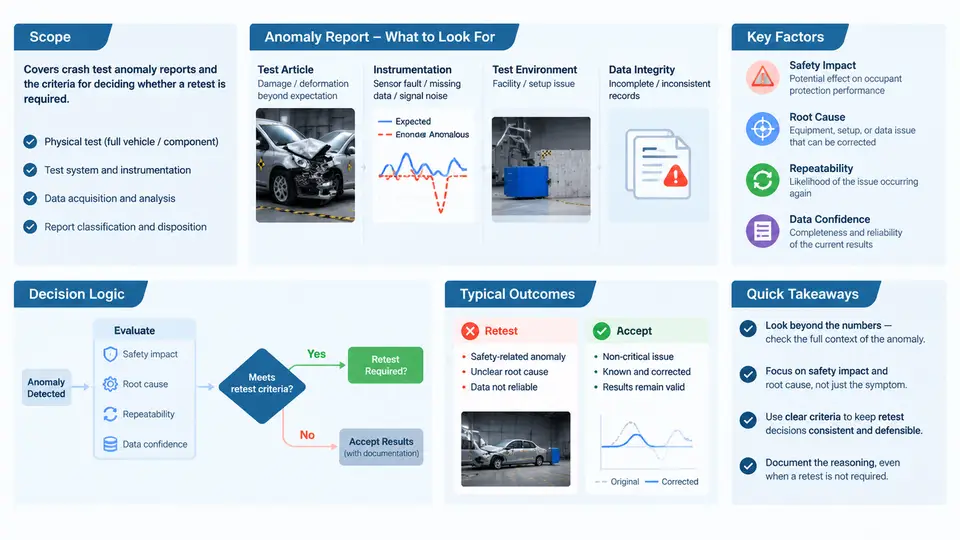
Crash testing produces some of the most consequential data in vehicle development. A single frontal offset test can generate thousands of channels of accelerometer, load-cell, and high-speed video data, and the difference between a valid test and an invalid one often determines whether a safety program proceeds to certification or repeats a multi-hundred-thousand-dollar event. This course addresses a specific and frequently underestimated discipline: recognizing when a crash test result is anomalous, documenting that anomaly rigorously, and deciding — on defensible technical grounds — whether a retest is required.
The scope of the course spans the full anomaly lifecycle. It begins with the physical and procedural sources of test anomalies, moves through detection and classification, and ends with formal retest decision criteria that can withstand internal design review, customer audit, and regulatory scrutiny. Throughout, the emphasis is on engineering judgment supported by evidence rather than on rigid pass/fail rules, because the standards themselves (FMVSS 208, ECE R94/R95, Euro NCAP protocols, C-NCAP, and equivalent national schemes) define test validity conditions but leave the retest decision to the test laboratory and the manufacturer in most cases.
What Counts as an Anomaly
An anomaly is any observed condition that deviates from the validated test setup, the expected physical response, or the accepted data quality envelope — and that could plausibly alter the measured outcome or its interpretation. This definition deliberately separates three families of anomaly, because each demands a different response:
- Setup and facility anomalies. Barrier alignment outside tolerance, tow-track speed error, dummy certification lapse, seat position drift, sensor range overload, or a camera sync failure. These are procedural: the test hardware or execution deviated from the validated configuration.
- Specimen anomalies. A body-in-white weld failure that is not representative of production, a restraint component installed with the wrong build-level part, or a pyrotechnic device that did not fire. These concern the article under test rather than the facility.
- Response anomalies. Occupant injury metrics or structural deformation that fall outside the expected correlation envelope even though setup and specimen appear nominal — for example, an unexpectedly high chest deflection with no corresponding setup deviation. These are the hardest to adjudicate, because the anomaly may be a genuine design finding rather than a test defect.
The distinction matters operationally. A setup anomaly generally invalidates the test outright and triggers a retest on procedural grounds. A specimen anomaly requires determining whether the deviation is build-specific or design-representative. A response anomaly requires correlation analysis before any retest decision can be justified — retesting without understanding the cause frequently reproduces the same result and wastes an event.
The Technical Context: Why Anomalies Are Inevitable
Crash tests are destructive, single-shot experiments conducted at the edge of sensor and structural limits. A 64 km/h offset deformable barrier test delivers peak vehicle decelerations well above 40 g within roughly 100 ms; accelerometers are typically selected with a ±500 g or ±2000 g range and a specified frequency response, and any channel that saturates or clips is immediately suspect. Dummy instrumentation is calibrated to tight tolerances but is sensitive to temperature, humidity, and prior history. The test article itself is a hand-built prototype whose weld quality, adhesive application, and trim fit can vary from the production intent.
Layered on top of the physics is a dense procedural framework. A typical frontal test requires documented verification of barrier face condition, vehicle mass and center-of-gravity within tolerance, tire pressure, fuel load or ballast, dummy positioning per the relevant positioning procedure, seat and head-restraint adjustment, and camera coverage with a verified frame-sync signal. Each of these is a potential anomaly source, and each has a defined tolerance in the applicable protocol. The course treats these tolerances as the first line of anomaly detection: a value inside tolerance is not automatically benign, and a value outside tolerance is not automatically disqualifying — context determines severity.
From Detection to Decision: The Course Architecture
The diagram below shows the logical structure of the discipline and how the course chapters map onto it. Detection feeds classification; classification determines the evidence required; the evidence feeds a decision gate that yields one of three outcomes — accept with documented justification, retest, or escalate to design review.
Core Concepts and Vocabulary
Several terms recur throughout the course and are worth fixing now. Test validity refers to whether the event was executed within the tolerances of the applicable protocol; it is a binary procedural judgment. Result validity is broader: whether the measured outcome can be attributed to the design intent rather than to an anomaly. A test can be procedurally valid yet yield an invalid result — for example, a correctly executed test on a prototype with a known non-representative weld. Correlation is the comparison of measured response against CAE prediction or against a historical baseline from comparable tests; it is the primary tool for adjudicating response anomalies. Retest justification is the written argument, supported by evidence, that a repeat event is necessary and that the repeat will differ meaningfully from the original.
A practical example illustrates the interplay. Suppose a 50 km/h frontal offset test returns a driver chest deflection of 42 mm against a predicted 34 mm, with all setup tolerances met and the dummy certified. The raw number alone does not justify a retest. The engineer first checks sensor validity (was the chest potentiometer within calibration and free of pre-test damage?), then reviews the high-speed video for restraint deployment timing, then compares the vehicle deceleration pulse against the CAE baseline. If the pulse matches but the chest deflection does not, the anomaly is likely specimen-specific — a restraint component or seat structure deviation — and the correct action is a build investigation, not an immediate retest. If the pulse itself deviates, the anomaly may be setup-related and a retest with corrected setup is justified. This reasoning chain, not the metric threshold, is what the course teaches.
Deliverable: Anomaly Report Header
Every anomaly report in this course begins with a structured header that forces the author to state the anomaly, its classification, and the evidence basis before any narrative. The following template is the working form used throughout the chapters; fields are intentionally minimal and all are technically load-bearing.
| Field | Content requirement | Example entry |
|---|---|---|
| Test ID / protocol | Unique event identifier and governing standard | FT-2024-017 / FMVSS 208, 56 km/h ODB |
| Anomaly statement | One sentence, observable fact only | Driver chest deflection 42 mm vs 34 mm predicted |
| Classification | Setup / specimen / response | Response (pending specimen check) |
| Detection source | Which check surfaced it | Post-test data review, channel 14 |
| Setup tolerance status | Pass/fail per protocol checklist | All within tolerance; barrier offset 1.2 mm |
| Sensor validity | Calibration and saturation status | Valid; no clipping; cal. date 2024-03-11 |
| Correlation delta | Measured vs CAE vs baseline | +8 mm vs CAE; +6 mm vs FT-2023-041 |
| Preliminary disposition | Accept / retest / escalate | Escalate to build investigation |
| Evidence attachments | Referenced records | Pulse plot, video frames 120–180, build sheet |
Why This Discipline Matters
Retests are expensive, schedule-critical, and — when unjustified — actively harmful, because they consume prototype vehicles and can mask a genuine design issue behind a favorable repeat. Conversely, refusing to retest an invalid event corrupts the certification basis and can surface as a compliance finding months later. The technical context of this course is therefore not merely procedural: it is the interface between physical testing, CAE correlation, quality systems, and regulatory compliance. The chapters that follow build the detection toolkit, the classification framework, the evidence standards, and the decision criteria in that order, so that by the end of the course a reader can take a raw test result, determine whether it is trustworthy, and defend that determination in writing.