1. Instrument panel intrusion and knee cont
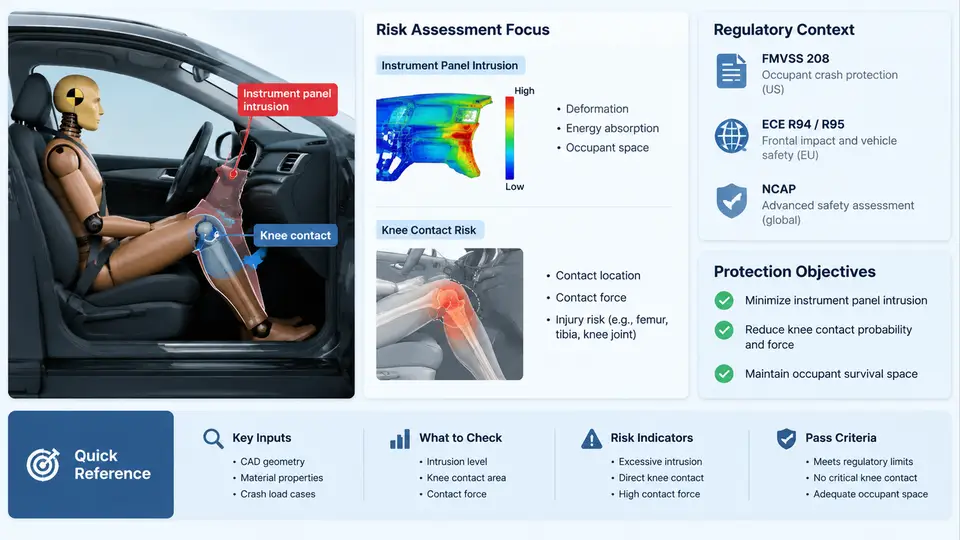
Knee contact with the instrument panel is one of the most common lower-extremity injury mechanisms in frontal crashes. Unlike the chest or head, the knees and femurs load directly against a relatively stiff, close-proximity structure — the lower instrument panel, knee bolster, steering column shroud, and glovebox region. When that structure intrudes rearward during a crash, the available ride-down distance shrinks, contact forces rise, and the risk of distal femur fracture, patella fracture, and knee ligament injury increases sharply. This course addresses how engineers quantify that risk: how intrusion is measured, how knee contact is characterized, how regulatory and consumer-test criteria are applied, and how design countermeasures are validated.
This first chapter establishes the frame for everything that follows. It defines the assessment scope, situates the work within the regulatory and consumer-rating landscape, and states the occupant protection objectives that drive the analysis. Subsequent chapters build the measurement methods, modeling techniques, and design iteration loops on this foundation.
What the assessment actually covers
The assessment has three interlocking objects of study, and it is worth separating them clearly because they are often conflated in practice.
- Intrusion — the rearward displacement of instrument panel and toe-pan structures relative to the occupant compartment, driven by powertrain and suspension components moving rearward in a frontal impact. Intrusion is a structural response, measured in millimeters and in time.
- Knee contact — the kinematic and kinetic interaction between the occupant's lower extremities and the panel surface: where contact occurs, when, at what velocity, and with what force and pressure distribution.
- Risk — the translation of those mechanical quantities into injury probability, using established injury criteria and tolerance curves.
A complete assessment therefore links structural deformation to occupant kinematics to injury outcome. An intrusion measurement alone says nothing about injury unless the occupant's position, restraint state, and contact geometry are known; conversely, a knee load measured in a sled test is only meaningful when the intrusion boundary conditions are representative.
Regulatory and consumer-rating context
Two distinct frameworks shape the requirements, and they serve different purposes.
Type-approval regulation establishes minimum legal performance. In frontal impact regulation, the occupant is represented by a standardized anthropomorphic test device (ATD) restrained in the driver and passenger positions, and the assessment focuses on head, neck, chest, and femur loads together with structural intrusion limits. Femur load is measured through the ATD's upper leg load cells, and the regulatory threshold is conventionally expressed as a compressive force limit per femur. Intrusion limits are specified for defined reference points on the toe pan, instrument panel, and steering assembly, measured after the impact. These provisions exist to guarantee a floor of structural and restraint performance across all vehicles placed on the market.
Consumer rating programs go further. They typically run higher-severity frontal tests, including a full-width rigid barrier configuration and an offset deformable barrier configuration, and they add a dedicated lower-extremity evaluation. In the offset test, the driver and front passenger ATDs carry knee slider instrumentation that measures the force transmitted through the knee-thigh-hip region, and the resulting values are converted into injury risk and then into a scored rating. Because consumer programs publish star ratings, they exert substantial market pressure and frequently drive design targets well beyond the legal minimum.
Beyond these two, several regional and fleet-specific protocols impose their own intrusion and lower-leg criteria. The assessment methodology in this course is deliberately framework-agnostic: it produces physical quantities (intrusion in millimeters, knee force in kilonewtons, contact pressure in megapascals) that can then be compared against whichever criterion set applies to the target market.
Occupant protection objectives
The engineering objective is not merely to pass a test but to manage the energy exchange between the occupant's lower extremities and the panel. Three objectives follow from that principle.
Preserve ride-down distance. The knee must be decelerated over the longest feasible distance. Intrusion directly consumes that distance, so structural countermeasures that limit powertrain rearward travel — reinforced longitudinal rails, dash cross-members, pedal-box breakaway — are occupant protection measures, not merely structural ones.
Distribute contact load. A concentrated load on the patella or the femoral condyles produces focal injury at modest total force. A knee bolster that spreads load across a broader area of the thigh and shin raises the force at which injury occurs. Geometry, foam stiffness, and panel surface curvature all matter here.
Avoid secondary hazards. The steering column, column shroud, glovebox door, and any hard trim edges can produce local penetration or point loading. The assessment must therefore consider the full contact surface, not just the nominal bolster.
The figure below shows how these elements connect: structural intrusion feeds the occupant's effective loading environment, which determines contact force and distribution, which in turn maps to injury risk and to the criteria used for judgment.
How the assessment is executed in practice
Although the detailed methods appear in later chapters, it is useful to see the working sequence now so the scope is concrete. A typical assessment proceeds as follows.
- Define the load case and reference frame. Select the crash configuration (for example, a 50 km/h full-width rigid barrier or a 64 km/h offset deformable barrier), the occupant size (50th percentile male ATD, or a smaller occupant where the program requires it), and the seating position. Fix the coordinate convention: rearward displacement toward the occupant is positive intrusion, and compressive knee force is reported as a positive magnitude. Every subsequent number depends on this convention being stated and held constant.
- Establish the intrusion boundary. From the structural model or physical test, extract the time-history displacement of the instrument panel lower surface and toe pan at the occupant's knee and shin locations. Report peak intrusion and the time at which it occurs, since the phase relationship with occupant forward motion determines the effective ride-down distance.
- Characterize the contact. Using ATD knee-slider data or a validated occupant model, determine contact timing, peak compressive force per knee, and the contact patch. Compare the measured force against the applicable femur or knee criterion.
- Evaluate against criteria and iterate. Convert force to injury risk, compare with the regulatory limit and the consumer-rating threshold, and identify the margin. If the margin is insufficient, adjust the countermeasure set — bolster stiffness, panel geometry, structural reinforcement — and repeat.
As a concrete illustration with representative (not measured) values: suppose a structural model predicts a peak lower-instrument-panel intrusion of 120 mm at 55 ms, and the occupant model predicts knee contact beginning at 48 ms with a peak compressive force of 6.8 kN per knee. If the applicable criterion is a femur load limit of 7.6 kN and the consumer threshold corresponds to roughly 4.5 kN for a full score, the design passes the legal limit with a 0.8 kN margin but falls short of the rating target. The engineer would then examine whether a softer bolster or additional structural reinforcement could reduce peak force without increasing intrusion beyond its own limit — a trade-off that the following chapters treat quantitatively.
Deliverables and judgment basis
By the end of the course, the assessment is expected to produce a defensible record containing: the load case and reference-frame definition; intrusion time histories at the specified reference points with peak values and timing; knee contact force time histories with peak values per knee; the injury risk conversion and the criteria applied; and a margin statement against each applicable framework. The judgment basis is always explicit — a result is "acceptable" only relative to a named criterion, and the margin to that criterion is reported alongside the result.
With this scope fixed, the next step is to examine the structural and biomechanical detail behind each link in the chain: how intrusion is generated and measured, how the knee-thigh-hip complex responds to loading, and how the criteria are derived and applied.