1. Far-side occupant protection fundamental
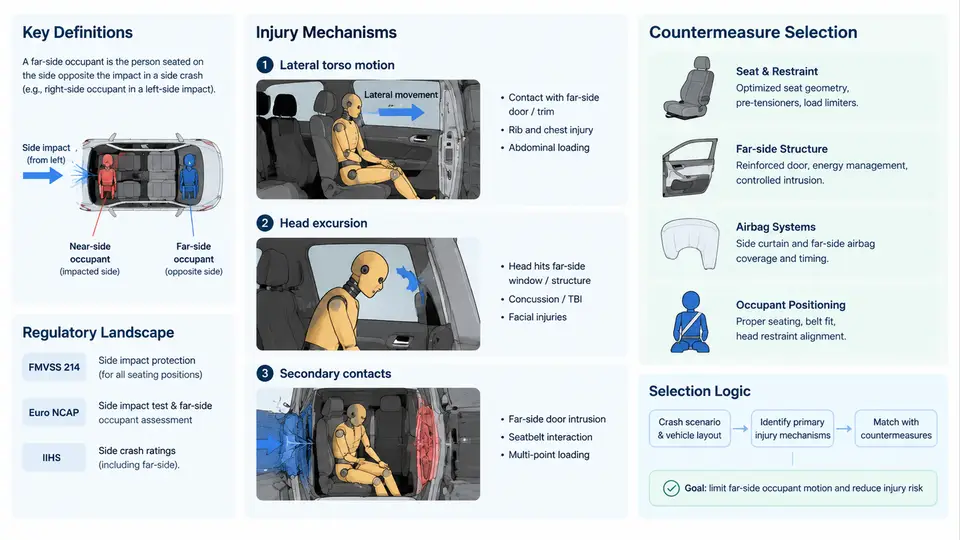
In a far-side crash, the occupant seated on the side of the vehicle opposite the impact receives the load. The struck side absorbs the collision energy; the far-side occupant, restrained only by the seat belt and possibly a side airbag, is thrown toward the vehicle centerline and then toward the struck side. This geometry produces kinematics and injury patterns that differ fundamentally from near-side and frontal events, and it is the reason far-side protection has become a distinct engineering discipline rather than an extension of side-impact design.
Defining the Far-Side Load Case
The distinction is geometric, not simply a matter of impact severity. Consider a left-hand-drive vehicle struck on the driver's side. The driver is the near-side occupant; the front passenger is the far-side occupant. The far-side occupant's body is accelerated laterally across the cabin, and the restraint system must manage that excursion without a direct structural barrier between the occupant and the intruding object.
Three parameters dominate the far-side problem:
- Lateral delta-v and pulse shape. Far-side occupants experience lower peak acceleration than near-side occupants but a longer, more complex pulse, because the struck-side structure and the occupant's own inertia interact over a longer interval.
- Occupant-to-interior geometry. The distance from the far-side occupant to the center console, the opposite door trim, and the opposite B-pillar determines how much excursion is available before contact.
- Restraint coupling. A three-point belt anchors the occupant at the outboard hip and shoulder. Under lateral loading, the torso rotates and the head translates toward the struck side, producing a characteristic "diagonal" motion path.
These three factors interact: a longer pulse allows more occupant excursion, which increases the likelihood of head contact with the opposite-side interior, while the belt geometry determines whether the torso rotates enough to expose the head and neck.
Regulatory and Rating Landscape
Far-side protection has historically been under-regulated relative to frontal and near-side impact. The principal regulatory instruments are:
| Instrument | Scope | Far-Side Relevance |
|---|---|---|
| FMVSS 208 | Occupant crash protection (US) | Primarily frontal; oblique and side provisions increasingly relevant |
| FMVSS 214 | Side impact protection (US) | Near-side focused; far-side not directly addressed |
| UN R94 / R95 | Frontal / side impact (EU) | Near-side oriented; far-side addressed indirectly |
| Euro NCAP far-side test | Rating protocol | Explicit far-side sled and vehicle tests with head and torso criteria |
| IIHS far-side rating | Rating protocol | Vehicle-to-vehicle and sled-based far-side evaluation |
The regulatory gap is significant: no binding federal standard in the US or EU currently mandates a dedicated far-side occupant test. Rating programs have filled this gap, and their protocols now drive most far-side countermeasure development. A practical consequence is that far-side performance is often evaluated against rating criteria (head injury, torso deflection, excursion) rather than a pass/fail regulatory threshold, which changes how engineers set targets.
Injury Mechanisms
Far-side injury patterns cluster into four mechanisms, each with a distinct physical pathway:
- Head contact with the opposite interior. The head translates across the cabin and strikes the opposite door trim, B-pillar, or center console. This is the dominant severe-injury pathway and the primary target of far-side airbags.
- Neck loading from head-torso lag. Because the belt restrains the torso at the outboard shoulder, the head lags and rotates, producing lateral bending and axial rotation of the neck. This can generate cervical injury even without direct head contact.
- Torso loading and rib deflection. The belt loads the outboard torso, and the occupant's own inertia compresses the inboard side against the center console or opposite seat. Rib deflection and abdominal loading are the relevant metrics.
- Submarining and belt slip-off. Under lateral and oblique loading, the lap belt can migrate off the iliac crest, and the shoulder belt can slip off the shoulder, degrading restraint coupling and allowing greater excursion.
These mechanisms are not independent. Head excursion is strongly coupled to torso rotation, which is in turn governed by belt geometry and pretensioner behavior. A countermeasure that reduces torso rotation (for example, a center-mounted airbag or a belt-integrated airbag) typically reduces head excursion as a secondary effect.
Kinematic Chain and Countermeasure Targets
The figure below traces the far-side occupant's motion from impact through the restraint response to the injury-relevant outcome, and maps each stage to the countermeasure that acts on it. The intent is to show where in the chain a given technology intervenes, not to imply a fixed sequence of design steps.
Practical Implications for Countermeasure Selection
The chain above clarifies why far-side countermeasure selection is not a single-technology decision. A center-mounted far-side airbag addresses head excursion directly but does little for torso rotation unless it is sized and positioned to also cushion the inboard torso. A belt pretensioner improves coupling and reduces excursion but cannot prevent head contact if the interior geometry is unfavorable. A belt-integrated airbag reduces torso loading but adds mass and packaging complexity to the retractor and buckle.
In practice, engineers evaluate candidate countermeasures against a defined far-side load case using a combination of sled testing and CAE. A typical evaluation sequence for a new seat or restraint variant is:
- Define the load case: select the rating protocol pulse (for example, a Euro NCAP far-side sled pulse), the ATD (typically a THOR or WorldSID variant depending on protocol), and the seating position.
- Establish a baseline: run the unrestrained-far-side or belt-only configuration to quantify head excursion and injury metrics without the candidate countermeasure.
- Add the countermeasure and re-run: compare head excursion, HIC, neck lateral bending moment, and torso deflection against the baseline and against the rating threshold.
- Check for adverse interactions: verify that the countermeasure does not degrade near-side or frontal performance, and that deployment timing does not create out-of-position loading.
The key takeaway for this chapter is that far-side protection is defined by a geometric asymmetry, governed by a rating-driven rather than regulation-driven landscape, and driven by a coupled kinematic chain in which head excursion is the dominant injury pathway. Countermeasure selection must therefore be evaluated against the full chain, not against a single metric, and must account for the interior geometry that the occupant will actually contact.