1. Restraint system maturity gates in vehic
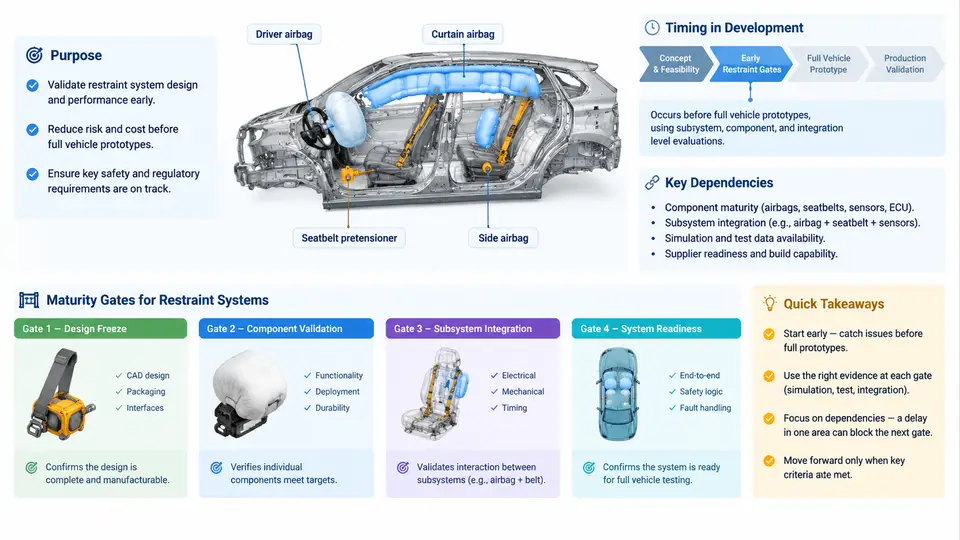
In vehicle development, a maturity gate is a formal decision checkpoint at which the restraint system must demonstrate a defined, evidence-backed level of readiness before the program is allowed to advance to the next phase. The restraint system — airbags, seat belts with pretensioners and load limiters, occupant classification, crash sensing and the associated ECU calibration — is one of the few subsystems whose performance can only be fully validated destructively. You cannot re-run a crash test on the same body. This makes maturity gates fundamentally different from, say, a software feature gate: the cost of discovering a defect late is measured in both program delay and occupant safety risk.
The purpose of a maturity gate is therefore threefold. First, it converts subjective readiness into objective evidence: a gate is passed only when specific deliverables exist at a defined confidence level. Second, it sequences irreversible spending — tooling for airbag modules, seat belt retractors and the sensing ECU is released only after the gate confirms the architecture is stable. Third, it allocates risk explicitly: any open item that is waived at a gate must be recorded with an owner, a closure date and a fallback plan.
Where the gates sit in the development timeline
A typical passenger-car program runs through concept, architecture freeze, A-sample (functional breadboard), B-sample (soft-tooled, representative geometry), C-sample (production tooling, production process), and production validation. Restraint maturity gates are usually aligned to these sample stages rather than to calendar dates, because the evidence a gate consumes is generated by building and testing those samples.
A practical gate structure looks like this:
| Gate | Typical timing anchor | Primary evidence required | Prototype dependency |
|---|---|---|---|
| G0 — Architecture & sensing concept | Before architecture freeze | Crash pulse targets, sensing channel layout, occupant packaging envelope, regulatory matrix | None; CAE and buck-level sled work only |
| G1 — A-sample functional confirmation | A-sample build + 4–8 weeks | Sled test correlation, ECU algorithm bench validation, deployment door opening force | Bucks and component-level hardware; no full body |
| G2 — B-sample system integration | B-sample build + 6–10 weeks | Full-vehicle frontal and side crash results vs. targets, OOP (out-of-position) status, EDR data integrity | First full-vehicle prototypes required |
| G3 — C-sample production intent | C-sample build + 8–12 weeks | Production-tooled hardware crash matrix, regulatory certification tests, field-issue robustness | Production-representative full vehicles |
The critical insight is that G0 and G1 are deliberately designed to be prototype-independent. Roughly 60–70% of restraint-system risk can be retired before a single full body exists, using sled tests, component fixtures and CAE. Programs that treat the first full-vehicle crash as their first real restraint test are effectively paying prototype prices for information that a $15k sled test could have produced.
Why full-vehicle prototypes are a scarce, late, and expensive resource
A full-vehicle prototype for restraint work must be body-in-white-complete, painted, trimmed, and fitted with the actual seat structures, steering column, instrument panel and headliner — because airbag deployment interacts with all of them. Each unit typically costs tens of thousands of dollars and consumes a build slot that is shared with NVH, durability and chassis teams. A frontal crash destroys the vehicle; a side crash destroys it plus the barrier fixture time.
This scarcity drives the central design principle of maturity gating: every full-vehicle test must answer a question that no cheaper test can answer. If a gate review cannot articulate which specific uncertainty a prototype crash resolves, that test should be deferred or replaced.
The dependency chain that gates actually enforce
Restraint maturity is not a single number; it is a chain of dependent evidence. Sensing calibration depends on the body structure's crash pulse, which depends on the front-end and side structure design, which depends on the architecture. Airbag module performance depends on the interior packaging, which depends on the seat and IP geometry. Occupant classification depends on the seat foam and sensor mat design. A gate that checks "airbag calibration complete" without checking the upstream pulse correlation is checking a number, not a maturity state.
What a gate review actually examines
A well-run restraint gate is not a slide presentation; it is an evidence audit. Reviewers should be able to trace each claim to a test report, a CAE correlation plot, or a signed-off calibration file. Three questions dominate:
- Is the upstream input stable? At G1, the crash pulse used for sled testing must be traceable to a frozen body structure definition. If the front-end design is still changing, the sled correlation is provisional and the gate should be conditional.
- Is the evidence at the right confidence level? A single successful sled test is not a correlation; a correlation requires a pulse match across the operating range (e.g., 16, 25, 32, 40, 56 km/h) with documented tolerance.
- What is the fallback if a prototype is late? Because G2 depends on full vehicles, programs must pre-agree on a substitute: extended sled matrix, component-level OOP fixtures, or a deferred gate with a hard closure date.
Practical example: a G1 gate that should not pass
Consider a program where the A-sample sled test at 56 km/h produces a chest deflection of 42 mm against a target of 38 mm, while CAE predicted 36 mm. The team proposes to pass G1 and "fix it at B-sample." A disciplined gate review would reject this for two reasons. First, the 6 mm gap between CAE and sled indicates the model is not correlated, so the CAE cannot be trusted to guide the fix. Second, the chest deflection margin is consumed before the full-vehicle test, where the pulse is typically harsher than the sled pulse. The correct gate action is conditional: hold G1 open, require a re-correlated CAE model and a repeat sled run with a revised load limiter, and only then release B-sample restraint hardware. This is exactly the kind of decision the gate exists to force — before prototype money is spent.
Designing the gate set for your program
When defining restraint maturity gates, work backwards from the irreversible decisions. Tooling release, certification test booking, and the start of production validation are the three points of no return. Place a gate immediately before each. Then ask, for every gate: what is the cheapest test that can retire the largest remaining uncertainty? In most programs the answer is a sled test or a component fixture, not a full vehicle — which is why the first two gates can and should be prototype-independent. The full-vehicle prototype is reserved for the questions that only a complete, trimmed, production-representative body can answer: real pulse, real interior interaction, real sensing environment, and real occupant kinematics.