1. Course introduction
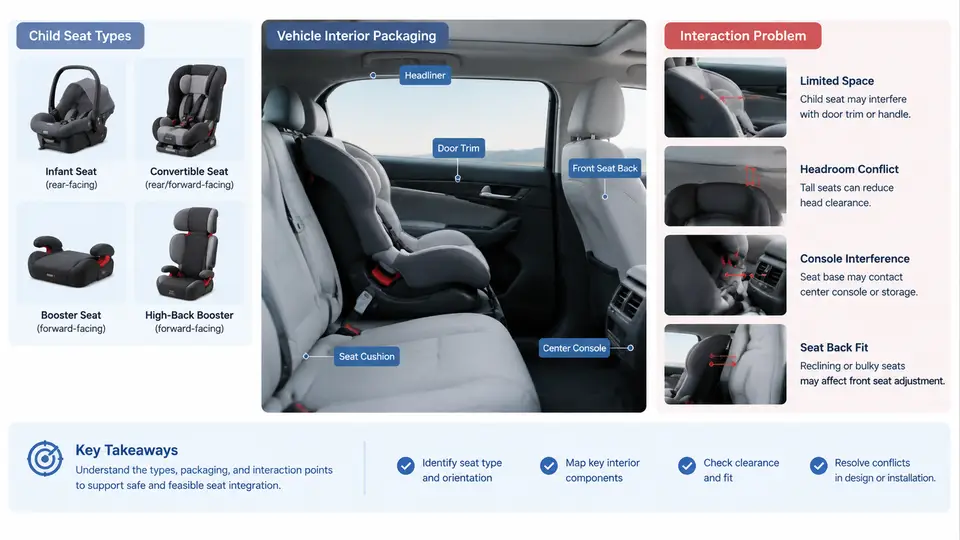
Child restraint systems (CRS) and vehicle interiors are developed by different organizations, against different specifications, and often on different timelines. Yet in the field, they must occupy the same physical volume, share the same seat cushion, and transfer load through the same belt anchors. When they do not fit together well, the consequences range from a parent struggling to route a buckle, to a seat that installs with excessive pitch or lateral tilt, to a belt path that cannot be tensioned correctly. This course treats that interface as an engineering discipline in its own right: a packaging and compatibility problem that can be measured, specified, and designed for.
This opening chapter establishes the three objects of study — the child seat, the vehicle interior, and the interaction between them — and defines the vocabulary and reference conventions used throughout the remaining chapters.
The three families of child seats
Child seats are conventionally grouped by the direction the child faces and by the physical principle that restrains the child. The grouping matters here because each family imposes a different geometric envelope and a different load path on the vehicle.
- Rear-facing infant seats (Group 0/0+). Typically a molded shell with an integrated carry handle, installed either on a base or directly with the vehicle belt. The child is restrained by an internal five-point harness. The seat's long axis points rearward, so the shell's back surface and the vehicle seat back form a near-parallel pair of surfaces that must be reconciled by recline adjustment.
- Rear-facing convertible and extended rear-facing seats. Larger shells that remain rear-facing to higher child weights. Their footprint on the vehicle cushion is long, and the top of the shell approaches the front seat back — the classic rear-facing legroom and front-seat travel conflict.
- Forward-facing seats with internal harness. Installed with the vehicle belt or ISOFIX/LATCH lower anchors plus a top tether. The load path runs through the lower anchors and the tether anchor, so the location and strength of the tether anchor become a packaging constraint.
- Booster seats (backless and high-back). No internal harness; the child is positioned so that the vehicle's three-point belt fits correctly. The booster's job is geometric: raise the child and guide the shoulder belt across the mid-shoulder and the lap belt across the upper thighs. Its performance therefore depends heavily on vehicle seat cushion angle, belt geometry, and buckle stalk length.
Two installation interfaces cut across all families: the vehicle seat belt (a flexible, geometry-dependent path) and rigid lower anchors such as ISOFIX or LATCH (a fixed, dimension-dependent path). A seat may support one or both. The choice changes which vehicle dimensions matter most.
What "vehicle interior packaging" actually contains
Packaging is the allocation of interior volume and hard points among occupants, structure, and mechanisms. For child seat compatibility, the relevant packaging elements are:
- Seat cushion geometry — cushion length, width, pan angle (typically expressed as a design or measured angle from horizontal), and the cushion-to-backrest included angle.
- Seat back geometry — backrest angle range, contour, and the position of the head restraint and its stalks.
- Belt geometry — buckle stalk length and stiffness, anchor positions, and the resulting lap and shoulder belt angles relative to the cushion.
- Lower anchor and tether anchor locations — spacing, depth below the cushion surface, and clearance around them.
- Surrounding volume — front seat back position and travel, door trim and armrest intrusion, roof and parcel shelf clearance, and rear cargo or third-row boundaries.
These are not independent. Shortening the cushion to gain rear legroom, for example, moves the belt buckle rearward and can make a booster's lap belt sit too far forward on the child's thighs. Packaging decisions propagate into compatibility outcomes.
The interaction problem, stated precisely
The interaction problem is the mismatch between the CRS envelope and the vehicle's available envelope and hard points. It shows up in four recurring forms:
- Geometric interference. The seat contacts the front seat back, door trim, or head restraint before it reaches its specified installation position, forcing the installer to move the front seat or accept a non-optimal recline.
- Belt path incompatibility. The buckle stalk is too long or too short, the belt routing is obstructed, or the belt cannot be tensioned because the geometry pulls the retractor into a lock-off conflict.
- Anchor accessibility. Lower anchors are buried too deep in the cushion bight, or the tether anchor is behind a cargo trim panel with insufficient clearance for the connector.
- Stability and support mismatch. The cushion contour or angle allows the seat base to rock, pitch, or tilt, so the installation does not meet the intended rigid-contact condition.
Each of these is measurable. That is the central premise of this course: compatibility is not a matter of opinion or trial-and-error at the dealership — it is a set of dimensions, angles, and clearances that can be specified, checked, and designed against.
Reference conventions used in this course
To keep measurements unambiguous, this course fixes the following conventions and applies them consistently in text, tables, and figures:
- Coordinate frame. Vehicle coordinates: X forward, Y to the vehicle's right, Z upward, origin at the vehicle datum. All positions are reported in this frame unless stated otherwise.
- Angles. Cushion and backrest angles are measured from the horizontal plane, positive when the surface rises toward the rear of the vehicle. A "flatter" cushion has a smaller angle.
- Clearance. Reported as the minimum distance between two surfaces, always positive; a negative value indicates interference.
- Installation state. "Nominal installation" means the CRS is installed per its instructions with the vehicle seat in the design position and the front seat at its rearmost travel unless a test specifies otherwise.
A worked compatibility check (illustrative example)
Consider a rear-facing infant seat with a shell depth of 720 mm measured from the vehicle cushion bight to the rear-most point of the shell, installed on a rear cushion whose bight-to-front-seat-back distance is 690 mm with the front seat at its rearmost position. The nominal clearance is 690 − 720 = −30 mm, i.e., 30 mm of interference. The installer has three levers: move the front seat forward (reduces front occupant legroom), increase the CRS recline (rotates the shell, trading depth for height and changing the child's recline angle), or select a different CRS. A packaging engineer would instead ask whether the 690 mm figure is a design target or an accident of the seat structure — and whether a 30 mm reduction in shell depth is achievable without compromising the child's head clearance to the shell.
Why this problem deserves a course
Regulations set minimum performance requirements, but they do not guarantee that any given CRS fits any given vehicle well. Field data and consumer testing consistently show that a meaningful share of real installations are compromised by geometry rather than by product defect. For the vehicle engineer, the practical question is how to package the rear seat so that the widest feasible range of CRS installs correctly. For the CRS engineer, it is how to shape the envelope so that it tolerates realistic vehicle variation. For the technician or evaluator, it is how to recognize and document a compatibility failure rather than misattribute it to user error.
The chapters that follow build the tools for each of these roles: measurement methods, envelope definitions, anchor and belt geometry, interference analysis, and verification procedures. The foundation laid here — the seat families, the packaging elements, and the four failure modes — is the vocabulary the rest of the course depends on.