1. Course introduction
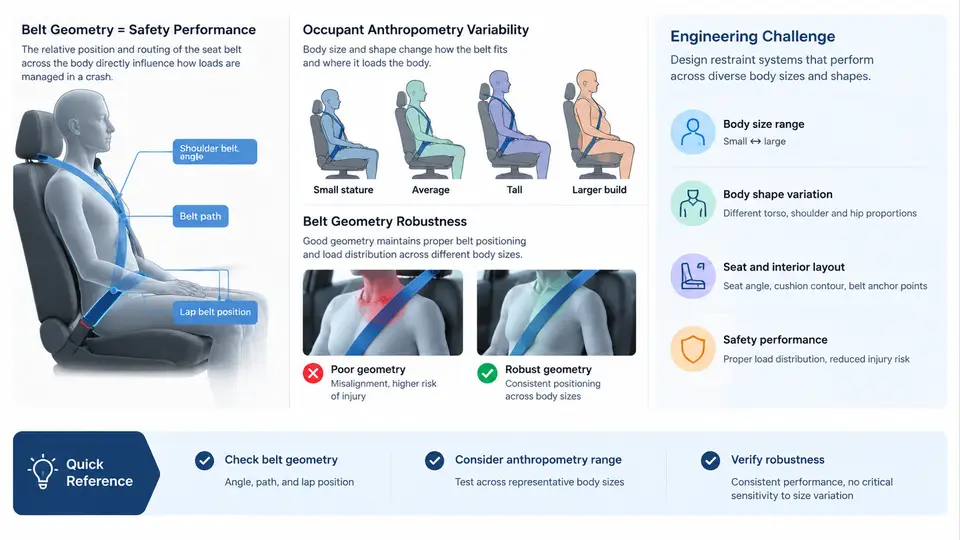
Seat belt restraint performance is often summarized by a single number — a star rating, a peak chest acceleration, a HIC value — but those numbers are produced under a specific, narrow set of conditions. A frontal crash test with a 50th-percentile male Hybrid III dummy at a fixed seat position tells you how the restraint system behaved for one body, in one posture, at one moment. Real occupants span a far wider envelope: a 5th-percentile female with a short torso and narrow shoulders, a 95th-percentile male with a long torso and broad chest, a pregnant occupant, a child in a booster, an elderly driver with reduced bone strength and a habitual forward-leaning posture. Belt geometry robustness is the property that determines whether the restraint system continues to deliver acceptable protection across that entire population, not just at the design point.
This chapter establishes the conceptual foundation for the rest of the course. We define what belt geometry robustness means as an engineering attribute, examine how occupant anthropometry varies and why that variation matters mechanically, and frame the central design tension: a geometry that is optimal for one body size is frequently suboptimal — sometimes unsafe — for another.
What "Belt Geometry" Actually Refers To
The term covers the spatial path of the webbing from its anchor points to the occupant and the way that path interacts with the body. The key geometric elements are:
- Upper anchorage (D-ring) position — height, fore-aft location, and outboard offset relative to the seat and occupant shoulder.
- Lower anchorage (buckle and outboard anchor) positions — fore-aft and lateral location relative to the pelvis.
- Webbing routing — the diagonal shoulder segment's angle across the chest and its clearance from the neck, and the lap segment's angle across the pelvis and its clearance from the abdomen.
- Retractor and pretensioner behavior — how much webbing is paid out or pulled in, which shifts the effective geometry during the crash.
- Seat and cushion geometry — the surface the occupant sits on, which sets the pelvis position that all belt geometry is referenced to.
These elements combine into a belt fit: the actual contact pattern of the webbing on the occupant's skeleton. Good belt fit loads the strong structures — the clavicle, the sternum, the iliac crests of the pelvis — and avoids the soft, injury-prone structures: the neck, the abdomen, and the lower rib cage. Robustness is the degree to which good belt fit is preserved as the occupant's body changes.
Why Anthropometry Breaks a Fixed Geometry
Consider a fixed D-ring height. For a tall occupant, the shoulder sits high, and the diagonal belt may pass close to the neck or ride over the shoulder's outer edge, reducing engagement. For a short occupant, the same D-ring may sit well above the shoulder, so the belt crosses the neck or slides off the shoulder entirely. The lap belt behaves similarly: a fixed buckle position that sits correctly on a large pelvis may ride up onto the abdomen of a small occupant, loading the soft tissue that the lap belt is specifically supposed to avoid.
The mechanical consequences are not cosmetic. Belt forces are transmitted through the contact area, so a belt that crosses the neck concentrates load on the cervical spine and carotid region; a belt that rides over the abdomen concentrates load on the liver, spleen, and bowel; a belt that slips off the shoulder leaves the upper torso unrestrained and allows excessive forward excursion, increasing head and chest injury risk. Each of these is a geometry-driven failure mode, and each becomes more likely as the occupant departs from the design anthropometry.
The Design Envelope and Its Trade-offs
Designers typically work against an occupant design envelope — a range of stature, sitting height, shoulder breadth, and pelvic breadth that the restraint must accommodate. The envelope is not arbitrary; it is derived from population anthropometric data (for example, the ANSUR II or CAESAR datasets) and from regulatory and consumer-test requirements that specify particular dummy sizes. The engineering challenge is that the envelope is multidimensional, and geometry adjustments that help one dimension often hurt another.
Raising the D-ring to clear the neck of a tall occupant, for instance, may cause the belt to sit too high on a short occupant and slip off the shoulder. Moving the buckle rearward to keep the lap belt off the abdomen of a small occupant may cause it to sit too low on a large occupant and load the thighs rather than the pelvis. These are genuine conflicts, and resolving them requires either adjustable geometry (height-adjustable D-rings, seat-integrated belt routing) or geometry that is deliberately optimized for the worst-case occupant rather than the average one.
Robustness as a Measurable Attribute
Treating robustness as an attribute means it must be quantified. In practice, engineers characterize belt fit using geometric metrics computed from occupant and belt-path data: the shoulder belt angle relative to horizontal, the lap belt angle relative to the seat cushion, the clearance between the belt and the neck, and the pelvis-to-belt offset that indicates whether the lap belt is seated on the iliac crests or has migrated onto the abdomen. These metrics can be extracted from physical mockups, from human body models in simulation, or from instrumented belt-fit manikins.
A robustness assessment then asks: across the design envelope, how much do these metrics vary, and do any occupants fall outside acceptable bounds? A system whose shoulder-belt angle stays within a target band for every occupant in the envelope is more robust than one that is ideal at the 50th percentile but drifts outside the band at both extremes. This framing converts a vague design aspiration into a testable criterion, and it is the basis for the quantitative methods developed later in the course.
The Engineering Challenge, Stated Plainly
The core difficulty is that belt geometry is a single physical configuration that must serve a distribution of bodies. Every fixed anchor point is a compromise, and the compromise is only acceptable if the resulting performance variation stays within injury-tolerance bounds for the whole population. Achieving that requires three things: a clear definition of the anthropometric envelope, a quantitative model of how geometry maps to belt fit and belt fit maps to injury risk, and a design strategy — adjustable geometry, optimized fixed geometry, or a combination — that keeps the worst-case occupant inside acceptable limits. The chapters that follow build each of these in turn, starting with the anthropometric data itself and moving toward the analysis methods that let engineers predict robustness before a single physical test is run.