1. Pretest NCAP readiness review fundamenta
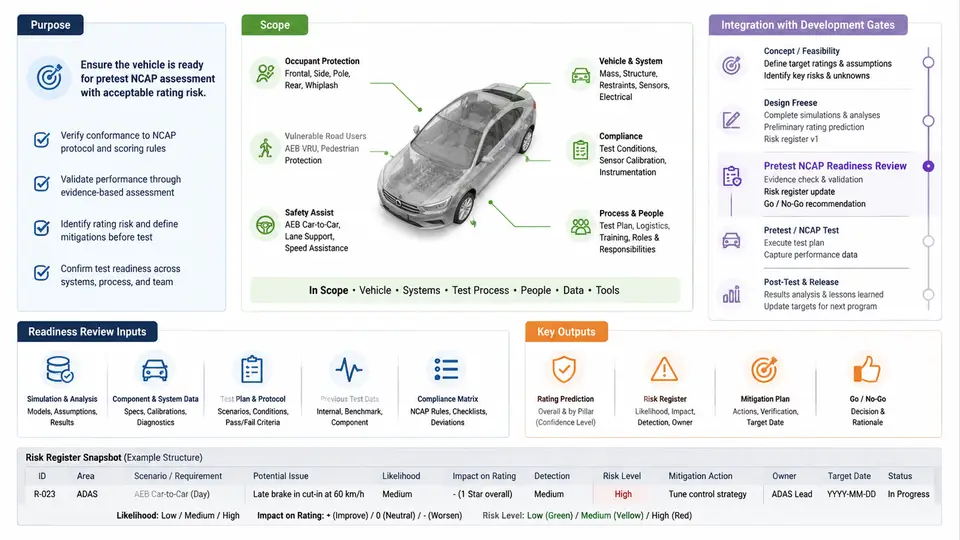
A pretest NCAP readiness review is a structured engineering assessment performed before a vehicle is submitted to an official New Car Assessment Programme (NCAP) test campaign. Its purpose is not to predict a star rating with false precision, but to establish, with documented evidence, whether the vehicle configuration, test articles, facilities, and analysis capability are mature enough that the official test will measure the vehicle's real performance rather than a preparation defect. In practice, a readiness review converts a vague question — "are we ready for NCAP?" — into a set of verifiable claims, each with an owner, an evidence artifact, and a pass/fail criterion.
The distinction between a readiness review and a development test is important. A development crash test asks "how does the structure behave?" A readiness review asks "if the official laboratory tested this exact build tomorrow, would the result be valid and representative?" The first is exploratory; the second is a gate. Confusing the two is the most common root cause of late-stage rating surprises, because teams arrive at the official test having validated performance but not the configuration and process that the rating depends on.
Purpose: What the Review Must Establish
A defensible readiness review typically establishes four things. First, configuration fidelity: the vehicle submitted matches the intended production intent for all rating-relevant parameters — kerb mass and mass distribution, tire specification and inflation pressure, seat and restraint hardware, airbag calibration, bumper and grille geometry, and any pedestrian-protection-relevant front-end parts. Second, test-article integrity: the specific vehicles or bodies designated for testing have been built to the released bill of materials, with no unapproved deviations, and their as-built records are traceable. Third, facility and method alignment: the test house, barrier, dummy fleet, calibration status, and instrumentation conform to the applicable NCAP protocol version. Fourth, analysis readiness: the CAE correlation status and the post-test analysis workflow are mature enough to interpret results and support any required re-test decision within the campaign timeline.
Each of these maps to a concrete failure mode. A mass deviation of even 30–40 kg can shift frontal occupant metrics; a tire with a different compound changes both frontal and side impact responses; a mismatched protocol version can invalidate a whole test series. The review exists to catch these before they become expensive.
Scope: What Belongs Inside the Boundary
Scope should be defined by the rating-relevant test matrix, not by organizational convenience. For a typical frontal-plus-side-plus-pedestrian programme, the in-scope items include: the frontal offset and full-width frontal configurations, side barrier and side pole configurations, pedestrian head and leg impact points, and any child restraint or active-safety items the target protocol scores. Out of scope, but explicitly recorded as such, are items deferred to a later gate or covered by a separate workstream.
A practical scoping technique is to build a configuration-to-test-point matrix: rows are rating-relevant vehicle parameters, columns are the individual test points, and each cell records whether the parameter affects that test point and what the required value is. This matrix becomes the backbone of the review evidence pack and prevents the classic omission where a parameter is validated for frontal but silently assumed for side.
Integration with Vehicle Development Gates
The readiness review is most effective when it is embedded in the existing development gate structure rather than run as a parallel, ad-hoc activity. A common and workable pattern places three readiness checkpoints across the programme:
- Concept/freeze gate (early): confirm the target NCAP protocol version, the rating-relevant parameter list, and the test matrix. Output: scoped parameter list and matrix skeleton.
- Pre-build gate (mid): confirm that the build configuration, tire and restraint releases, and CAE correlation plan are on track. Output: configuration baseline and open-item register.
- Pre-test gate (immediately before official testing): full evidence review against the matrix, sign-off on test articles, facility confirmation, and a documented go/no-go decision. Output: signed readiness record and risk register entries.
Placing the final checkpoint too early leaves configuration changes unverified; placing it too late leaves no time to correct a finding. The practical rule is that the pre-test gate should close with enough lead time to rebuild or re-source a test article if a nonconformance is found — typically several weeks for body-in-white or full-vehicle builds.
How the Review Is Actually Run
In execution, the review is evidence-driven. Each matrix cell is assigned an owner and an evidence type: a released drawing or BOM revision, a build record, a calibration certificate, a CAE correlation report, or a signed deviation. The reviewer's job is to confirm that the evidence exists, is current, and matches the intended test configuration. Findings are classified as blocking (must be resolved before test), conditional (acceptable with a documented mitigation), or observation (recorded, no action required).
Consider a representative example. A team preparing a frontal offset test records the driver airbag calibration as a matrix parameter. The evidence pack contains a calibration release at revision C, but the build record for the designated test vehicle shows revision B hardware. This is a blocking finding: the test article does not match the intended configuration. The corrective action is either to update the test article to revision C or to formally re-baseline the intended configuration to revision B with engineering justification — and the decision must be recorded before the test, not reconstructed afterward. This is exactly the kind of defect a readiness review is designed to surface while it is still cheap to fix.
The output of the review is not a pass/fail stamp alone. It is a readiness record — the signed matrix, the evidence index, the findings log with dispositions, and the residual risk register — that travels with the test campaign and supports later interpretation of results. When an official test produces an unexpected result, this record is what allows the team to distinguish a genuine vehicle performance issue from a preparation or configuration issue.
The diagram above shows how the three checkpoints feed a single evidence pack and converge on a documented go/no-go decision. The blocking-finding branch is deliberately drawn as a return path: a readiness review that cannot produce a blocking finding is not a review, it is a formality. The residual risk register that emerges from the decision feeds directly into the rating risk tracking that governs the rest of the campaign.
Common Pitfalls and How to Avoid Them
Three failure patterns recur. The first is evidence lag: the review is scheduled but the evidence pack is assembled from memory or reconstructed after the fact. The fix is to require evidence artifacts to be linked to the matrix at the moment each gate opens, not at the final review. The second is configuration drift: the vehicle changes after the baseline is frozen, and the review does not re-open. The fix is a change-control rule that any modification to a rating-relevant parameter automatically re-opens the affected matrix cells. The third is protocol mismatch: the team validates against an older NCAP protocol version than the one the official test will apply. The fix is to record the protocol version explicitly at Gate 1 and re-confirm it at Gate 3, since protocols are revised on a known cycle.
In summary, the pretest NCAP readiness review is a gate-integrated, evidence-based assessment whose value lies in converting configuration and process risk into explicit, owned, and dispositioned findings before the official test begins. Its scope is the rating-relevant test matrix, its currency is traceable evidence, and its output is a signed readiness record that both authorizes the test and supports later interpretation of the result.