1. NCAP rating eligibility fundamentals
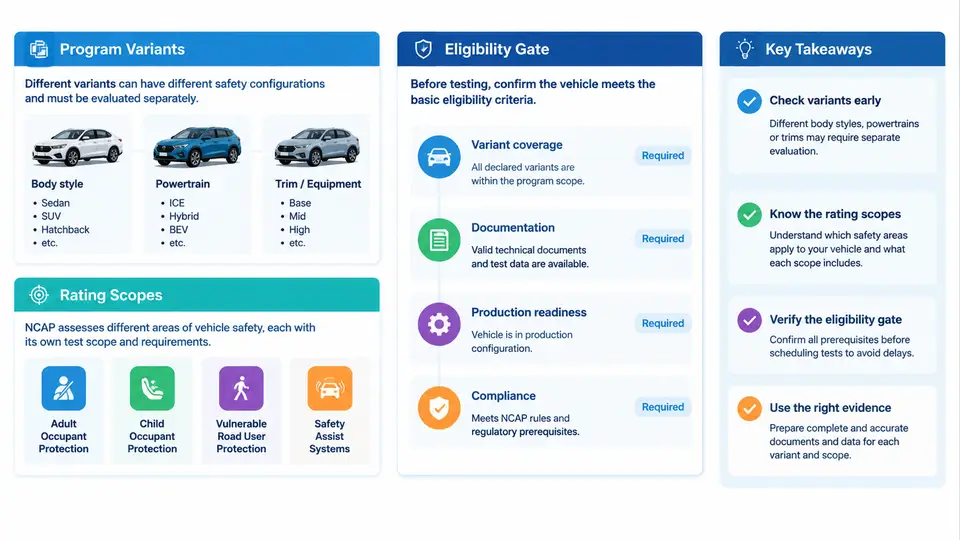
New Car Assessment Programmes (NCAPs) are consumer-facing safety rating schemes, not type-approval regimes. That single distinction drives almost everything about how a vehicle programme is planned. A type-approval test answers a legal question: does this vehicle meet a minimum regulatory requirement? An NCAP assessment answers a comparative question: how well does this vehicle protect its occupants and other road users relative to the programme's published protocol? Because the answer is comparative and published, the programme must first decide whether a given vehicle is even eligible to be rated. That decision is made before a single crash test is run, and it is where a large share of real-world programme delays originate.
Programme variants: one name, several rulebooks
"NCAP" is a family of programmes, each with its own governance, protocol versions, and market scope. The most commonly encountered variants in a global vehicle programme are:
- Euro NCAP — European market focus, with separate star ratings for Adult Occupant Protection, Child Occupant Protection, Vulnerable Road User (VRU) protection, and Safety Assist, combined into an overall star rating. Protocols are revised on a roughly triennial cycle with annual updates.
- Latin NCAP — covering Latin American markets, historically with a strong emphasis on basic structural performance and restraint fitment, and a distinct front/side impact and pedestrian test set.
- ASEAN NCAP — Southeast Asian markets, with its own weighting across adult occupant, child occupant, safety assist, and motorcycle safety categories.
- C-NCAP, JNCAP, KNCAP, ANCAP, Bharat NCAP — national or regional programmes, each publishing its own assessment protocol and star allocation rules.
- Global NCAP — an umbrella body that promotes the programmes and publishes its own assessment protocols for markets without a local scheme; it is not itself a single harmonised rating.
The practical consequence is that a vehicle cannot be described as "NCAP rated" without naming the programme and the protocol year. A five-star result under one programme's 2021 protocol says nothing about the same vehicle's outcome under another programme's 2024 protocol, and often very little about the same programme's 2024 protocol either, because thresholds and test items change.
Rating scope: what the stars actually cover
Each programme defines a rating scope: the set of vehicle configurations, body styles, and test items that the published result represents. Scope is where eligibility and evidence readiness intersect most sharply. Typical scope dimensions include:
| Scope dimension | What it constrains | Typical evidence implication |
|---|---|---|
| Body style / variant | Whether a hatchback result extends to the sedan or estate derivative | Structural equivalence justification, kerb mass and dimensional comparison |
| Powertrain | Whether an ICE result covers the BEV or PHEV version | Mass distribution, front-end structure, battery packaging, and restraint calibration differences |
| Hand of drive | Whether LHD testing covers RHD vehicles | Pedal box, steering column, and occupant packaging equivalence |
| Seating configuration | Number of rows, seat types, ISOFIX positions | Seat and restraint part numbers, anchor geometry, child restraint fitment list |
| Market / equipment level | Safety equipment fitted as standard vs optional | Standard-fit declaration, variant matrix, sales code mapping |
| Model year / protocol | Which protocol revision the result is valid under | Protocol version lock, test date, re-rating triggers |
A common misconception is that the star rating belongs to the model name. In practice it belongs to a defined scope. If the scope is not documented precisely, the rating cannot be defended when a derivative is launched, and the programme may require re-testing or restrict the published result.
The eligibility gate: the pre-test decision
Before a programme accepts a vehicle for assessment, it applies an eligibility gate. The gate is a set of pass/fail conditions that determine whether the vehicle can be rated at all, and if so, under which scope. Failing the gate does not mean the vehicle is unsafe; it means the evidence package is not yet sufficient for a rating to be published. The gate typically checks four families of conditions.
Programme and market eligibility. The vehicle must be on sale, or firmly committed to sale, in the programme's market, in the configuration to be tested. Programmes generally require a minimum sales volume or a documented launch plan, and they require that the tested configuration be representative of what customers can actually buy. A pre-production prototype with hand-built restraints is not eligible; a production-representative vehicle from the launch line is.
Configuration and standard-fit evidence. The safety equipment credited in the rating must be standard on the rated variant, not optional. This is verified through a variant matrix that maps sales codes to equipment, supported by order guides, price lists, and where necessary a physical vehicle inspection. Programmes increasingly require a signed declaration from the manufacturer that the tested specification matches the declared standard fit.
Test-item and facility readiness. The programme must be able to execute its full protocol on the vehicle: the required crash configurations, the pedestrian and VRU impact points, the active safety scenarios, and the child restraint installations. This depends on the vehicle's geometry (for example, whether the bonnet and bumper reference lines fall within the protocol's testable zones) and on the availability of calibrated facilities, instrumentation, and dummy inventory.
Documentation and protocol lock. The applicant must declare the protocol version under which the assessment will be conducted and provide the supporting documentation set: technical description, structural and restraint data, CAD or geometry data for impact point definition, and the child restraint compatibility list. The protocol version is locked at gate acceptance; a later protocol revision does not retroactively apply, but it does define the re-rating horizon.
How the gate, scope, and protocol interact
The figure below shows the relationship between the three concepts. The programme variant selects the rulebook; the rulebook defines the rating scope and the eligibility conditions; the gate evaluates the applicant's evidence against those conditions and either admits the vehicle into a defined scope or returns it for evidence remediation. Only after admission does the test programme begin.
Applying the gate in practice: a worked example
Consider a manufacturer planning a Euro NCAP assessment for a compact crossover. The vehicle will be sold in Europe in three variants: a 1.5-litre petrol front-wheel-drive, a 2.0-litre petrol all-wheel-drive, and a plug-in hybrid. All are five-door, left-hand drive, with two rows of seats. The intended rating scope is "the crossover range, 2024 protocol, LHD, five-seat."
The first gate question is whether the three variants can share one rating scope. The petrol FWD and AWD differ in mass and rear structure; the PHEV differs in floor structure, battery packaging, and front-end stiffness. A defensible scope decision requires structural and mass comparison against the programme's equivalence criteria, not an assumption. If the PHEV's front-end structure and kerb mass fall outside the equivalence band, the scope must either exclude the PHEV or the programme must be asked to assess it separately. Discovering this after the crash tests have been booked is expensive; discovering it at the gate is a documentation exercise.
The second gate question is standard-fit evidence. If autonomous emergency braking is standard on the 2.0-litre AWD but optional on the 1.5-litre FWD, the Safety Assist score cannot be claimed across the whole scope without either making the feature standard or narrowing the scope. The variant matrix and order guide are the evidence; a marketing brochure is not.
The third gate question is facility and test-item readiness. The programme's pedestrian impact points are defined from bonnet leading edge and bumper reference lines measured on the actual vehicle. If the vehicle's front-end geometry places the upper leg impact points outside the testable zone, the programme may apply a different assessment path, and the applicant needs to know this before committing to a test slot.
What "eligible" does and does not mean
Eligibility is a necessary but not sufficient condition for a good rating. Passing the gate confirms that the vehicle can be assessed within a defined scope under a locked protocol; it says nothing about the expected star outcome. A vehicle can be fully eligible and still score poorly, and a vehicle can be structurally excellent but ineligible because its standard-fit evidence is incomplete. Keeping these two questions separate is the discipline that makes the rest of the assessment programme predictable: the gate answers "can this be rated, and as what?", while the test programme answers "how well does it perform?".
The practical takeaway for the first chapter is a working definition. An NCAP rating is a published result for a defined scope under a named programme and protocol version, admitted through an eligibility gate that verifies market presence, standard-fit configuration, test-item feasibility, and documentation completeness. Every later evidence-readiness activity in this course builds on that definition: the scope determines what must be evidenced, the protocol determines how, and the gate determines when the evidence is sufficient to proceed.