1. Framing the compliance–rating gap
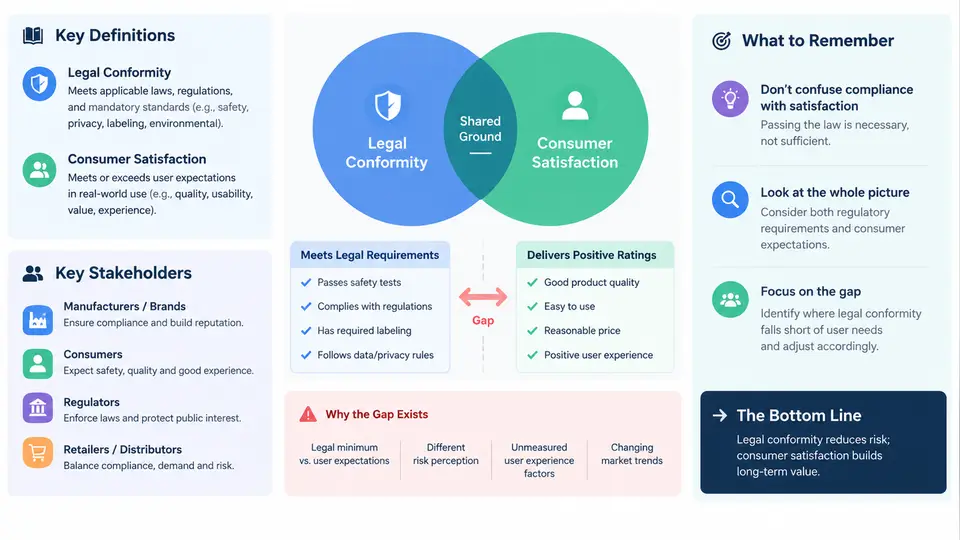
In regulated consumer markets, a product can be fully compliant with every applicable statute, standard, and certification requirement and still receive mediocre or poor ratings from the people who buy it. This divergence is the compliance–rating gap: the measurable distance between what a legal or regulatory framework requires and what consumers actually experience, value, and reward with their ratings. Understanding this gap is the foundation of the entire analysis discipline covered in this course, because it determines what we measure, whom we ask, and how we interpret the result.
Defining the two sides precisely
Legal conformity is a binary, externally adjudicated status. A product either meets a requirement or it does not, and the judgment is made against a written specification by an authority, a notified body, or an internal quality function acting on documented criteria. Conformity is evidenced by test reports, declarations of conformity, certificates, and audit records. Its scope is bounded: it covers only what the regulation chose to regulate.
Consumer rating, by contrast, is a continuous, self-selected, perception-driven signal. It aggregates individual judgments expressed on a scale (commonly 1–5 stars) and is shaped by expectation, price context, ease of use, aesthetics, support experience, and the comparison set the consumer carries in their head. A rating is not a measurement of a property; it is a summary of a relationship between expectation and delivered experience.
These two constructs differ along several dimensions that matter operationally:
| Dimension | Legal conformity | Consumer rating |
|---|---|---|
| Nature | Binary pass/fail against a specification | Continuous score from aggregated perception |
| Who judges | Regulator, notified body, internal QA | Self-selected end users |
| Scope | Only regulated attributes | Whole experience, including unregulated attributes |
| Evidence | Test reports, certificates, declarations | Reviews, star distributions, return reasons |
| Time horizon | Point-in-time, at type approval or audit | Continuous, post-purchase, cumulative |
| Failure mode | Non-conformity, recall, market withdrawal | Low stars, churn, negative word of mouth |
The critical asymmetry is scope. Regulation is a floor, not a specification of delight. A standard may mandate that a battery not exceed a surface temperature of 45 °C under defined load; it says nothing about whether the device feels slow, whether the app pairing takes four attempts, or whether the packaging is frustrating to open. Those unregulated attributes dominate ratings, which is precisely why conformity cannot predict satisfaction.
Stakeholders and what each one optimizes
The gap exists because different stakeholders are optimizing different objective functions, and the analysis only becomes actionable when those functions are made explicit.
- Regulators and market-surveillance authorities optimize for minimum safety, environmental, and information-integrity thresholds across the whole market. Their instrument is the requirement; their success metric is the absence of harm and the rate of non-conformity detected.
- Compliance and quality functions inside the manufacturer optimize for defensible evidence of conformity at acceptable cost. Their success metric is audit pass rate and the absence of findings, not star rating.
- Product and engineering teams optimize for feature delivery and performance against internal targets, which may or may not be derived from consumer research.
- Consumers optimize for perceived value relative to price and expectation. Their instrument is the review and the star; their success metric is whether the product did what they hoped, easily.
- Retailers and marketplaces optimize for conversion and return rate, and therefore weight ratings heavily because ratings drive both.
A gap opens wherever the compliance function's success metric and the consumer's success metric are not linked by any shared measurement. In many organizations they are not: the conformity dossier and the review corpus live in different systems, are owned by different teams, and are never joined.
Why legal conformity does not guarantee satisfaction
Four mechanisms account for most of the gap observed in practice.
1. The floor-versus-expectation mechanism. Requirements are set at a level that protects the population, not at a level that pleases the individual. Meeting a minimum threshold is, by construction, compatible with a mediocre experience. A product that just passes an acoustic limit may still be perceived as unacceptably loud relative to a competitor that passes comfortably.
2. The scope mechanism. Ratings are driven by attributes the regulation never addressed — onboarding friction, documentation clarity, app stability, spare-part availability, support responsiveness. These are frequently the top drivers in review text and are invisible in conformity evidence.
3. The expectation mechanism. Ratings are relative to expectation, and expectation is set by marketing, price, and prior category experience. A compliant product marketed with superlatives will be rated against those superlatives. The same physical performance yields different ratings at different price points and different promise levels.
4. The population mechanism. Conformity is assessed on a sample against a specification; ratings are produced by a self-selected, non-representative population that skews toward extreme experiences. A small subpopulation with an unregulated but severe pain point can dominate the visible score while remaining entirely outside the conformity sample.
How the two signals relate in practice
The diagram below places the two measurement systems side by side and shows where the gap is generated. On the left, the regulated attribute set is tested against the requirement and produces a conformity verdict. On the right, the full experience — regulated and unregulated attributes plus expectation — is filtered through a self-selected consumer population to produce a rating. The gap band in the middle is where analysis work happens.
Reading the gap correctly: a worked framing example
Consider a hypothetical connected kettle used to illustrate the framing, with all figures treated as illustrative assumptions rather than measured results. The conformity dossier shows the appliance passes the applicable electrical safety standard, meets the standby-power limit, and carries correct energy labelling. The conformity verdict is pass. The marketplace rating, however, sits at 3.1 stars, with the one- and two-star reviews clustering around three themes: the app loses the pairing after a router restart, the lid is stiff for users with limited grip strength, and the beep at boil completion is louder than expected at night.
None of these three themes is a non-conformity. Pairing persistence, lid actuation force, and audible alert level at night are either unregulated or regulated only in ways the product satisfies. Yet they account for the majority of negative reviews. The framing exercise is therefore to classify each theme against the four gap mechanisms: pairing persistence is an unregulated attribute (scope mechanism); the beep is a floor-versus-expectation issue because it passes the applicable limit but exceeds the expectation set by the quiet-kitchen marketing imagery; the lid is a subpopulation issue concentrated among a specific user group. This classification, not the star score itself, is the deliverable of the framing stage.
What the framing stage must produce
Before moving into measurement and analysis, the framing stage should leave behind four explicit artifacts: a defined regulated attribute list with the requirement and evidence source for each; a defined experience attribute list drawn from review text and support data, including attributes with no regulatory counterpart; a stakeholder map naming whose success metric each attribute serves; and a classification of each observed gap theme against the four mechanisms above. With these in place, the subsequent chapters can quantify the gap, attribute it to specific drivers, and decide whether the correct response is a compliance action, a product change, an expectation-management change, or no action at all.