1. Course overview
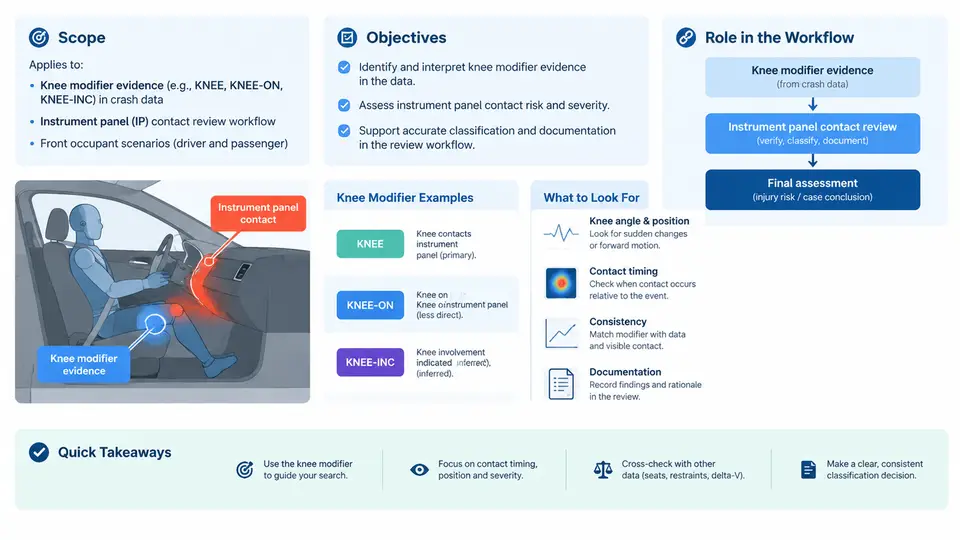
Instrument panel contact review sits at the intersection of occupant packaging, crashworthiness, and regulatory compliance. In frontal impact, the instrument panel (IP) is one of the primary contact surfaces for the occupant's lower extremities, and the knee bolster region is specifically engineered to manage knee-thigh-hip (KTH) loading. A knee modifier is the physical or structural feature — a bolster plate, energy-absorbing rib, foam block, or tuned bracket — that governs how that load path develops. Knee modifier evidence is the documented, traceable proof that the modifier behaves as intended across the design space: geometry, material, attachment, and occupant position. This course treats that evidence as a first-class engineering artifact, not an afterthought to the CAE report.
The scope of this course is deliberately bounded. We cover the evidence chain that supports IP contact review for the driver and front passenger knee region in frontal and oblique frontal loading, including the physical test data, simulation correlation, and geometric tolerance evidence that reviewers rely on. We do not attempt to cover full occupant restraint system design, airbag tuning, or complete vehicle crash certification; those are adjacent disciplines. Instead, the course focuses on the specific question a contact review board must answer: is the knee modifier evidence sufficient, current, and correctly interpreted to support the contact decision?
Why Knee Modifier Evidence Matters in the Review Workflow
Contact review is a gate. Before a design is released to tooling or a vehicle is signed off for a crash mode, the review board must confirm that the IP surface the occupant will actually strike is the surface that was analyzed. Knee modifier evidence closes the gap between the nominal CAD model and the as-built, as-positioned hardware. Without it, a review can pass on a model that no longer represents production intent — a classic and expensive failure mode.
Three properties make knee modifier evidence uniquely important in this workflow:
- It is position-sensitive. A knee bolster that is 8 mm too far forward or 5 mm too low changes the contact timing and the load distribution across the femur. Evidence must tie the modifier's location to a defined datum and tolerance band, not just a nominal coordinate.
- It is material- and rate-sensitive. Energy-absorbing foams and ribbed polymer bolsters behave differently at quasi-static and dynamic rates. Evidence must state the test rate and the material model basis used in correlation.
- It is configuration-dependent. Left-hand drive versus right-hand drive, power seat versus manual, and different trim levels can all change the knee modifier geometry or stiffness. Evidence must be traceable to the specific configuration under review.
In practice, the review board is not asking "does the knee modifier work?" in the abstract. It is asking a narrower, auditable question: for this configuration, at this build level, with this evidence set, does the contact behavior remain within the accepted envelope? The course is structured around making that question answerable.
The Evidence Chain and the Review Decision
The diagram below shows how knee modifier evidence flows into the contact review decision. It is a relationship view, not a process flow: each evidence source feeds a specific review criterion, and the criteria combine into a release decision with explicit failure branches.
The key structural insight in this diagram is that evidence sources do not feed the decision directly. Each source is interpreted against a specific criterion, and the criteria are independent. A strong sled test cannot compensate for a weak correlation basis, and a clean nominal geometry cannot compensate for an unexamined tolerance band. Reviewers who collapse these into a single "looks good" judgment are the ones who later discover that the analyzed surface was not the built surface.
What the Course Will Equip You to Do
By the end of the course, you should be able to perform the following tasks without relying on tribal knowledge:
- Assemble a defensible evidence package. Given a configuration and build level, identify which physical tests, CAE runs, geometry records, and material data are required, and recognize when a source is missing or stale.
- Read knee modifier evidence correctly. Interpret KTH load traces, force-displacement curves, and correlation deltas, distinguishing normal scatter from a genuine model-to-test mismatch.
- Apply tolerance and position reasoning. Translate a datum-referenced position and its tolerance band into a worst-case contact condition, and judge whether the load envelope still holds.
- Run a structured contact review. Use a repeatable review record that captures the configuration, evidence references, criterion outcomes, and the resulting decision with its conditions.
- Diagnose review failures. When a review returns conditional or fail, trace the outcome back to the specific evidence gap or criterion exceedance and define the corrective action.
A Worked Example of the Review Question
Consider a representative case used throughout the course. A passenger-side IP knee bolster is a ribbed polymer component attached to a steel cross-car beam. The nominal bolster front face is defined at a datum-referenced position, with a tolerance band of ±6 mm in the fore-aft direction. The sled test at the nominal position shows a peak KTH load within the accepted envelope, with a contact onset at a defined time after impact. The CAE model, correlated to that test, predicts a peak load within an agreed correlation tolerance.
Now the review question sharpens: at the worst-case build position — bolster 6 mm forward — does the predicted peak load remain inside the envelope, and does the contact onset shift enough to change the load distribution? If the CAE sweep across the tolerance band shows the peak load rising toward the envelope limit but not exceeding it, the criterion is satisfied and the review can pass with the tolerance band documented. If the sweep shows an exceedance at the forward extreme, the review is conditional or fails, and the corrective action is either a tolerance tightening, a geometry change, or additional physical evidence at the worst-case position. This is the kind of reasoning the course builds, and it is why evidence must be position-aware rather than nominal-only.
How the Course Is Organized
The course moves from foundations to execution. Early chapters establish the physical and regulatory context of knee modifier behavior and define the evidence types. Middle chapters develop the interpretation skills — reading load traces, assessing correlation, reasoning over tolerance bands, and handling rate effects. Later chapters turn to the review workflow itself: building the evidence package, running the review record, handling conditional outcomes, and closing evidence gaps. Throughout, the same representative case is carried forward so that each new concept attaches to a concrete object rather than an abstraction.
The through-line is simple: knee modifier evidence exists to make the contact review decision auditable. Every technique in this course serves that goal — not producing more data, but producing evidence that a reviewer can trace, interpret, and defend.