1. Regulatory landscape overview
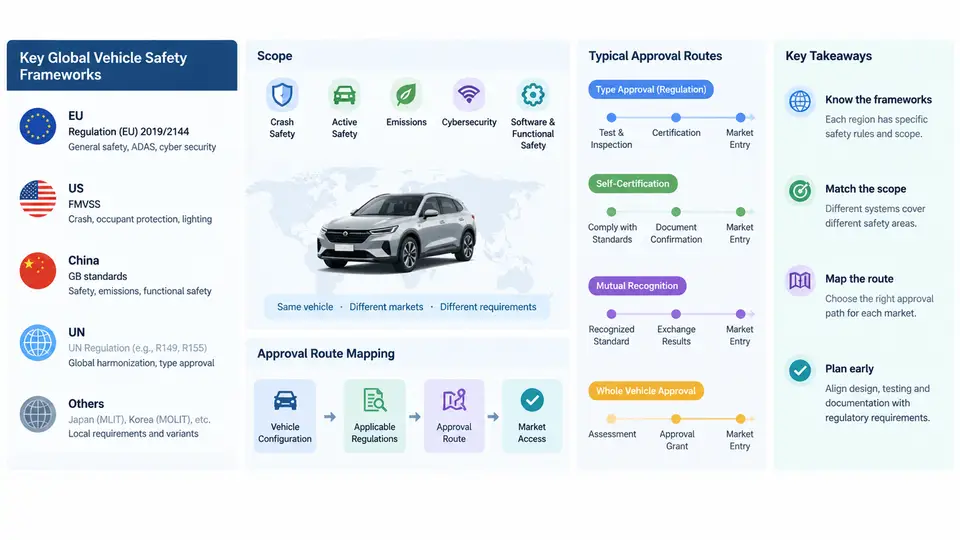
Vehicle safety regulation is not a single global rulebook. It is a patchwork of regional legal systems, each with its own scope, test procedures, administrative procedures, and acceptance criteria. A vehicle that is fully compliant in one market may be entirely unsellable in another, not because it is less safe, but because the evidence required to prove safety differs. For engineers, compliance managers, and program planners, the first practical skill is therefore not memorizing individual clauses but building a mental map of the frameworks and understanding how a product's design and evidence package must be routed through them.
This chapter establishes that map. It introduces the dominant regulatory frameworks, clarifies what each one actually governs, and defines approval route mapping as the discipline of translating a vehicle program's target markets into a concrete sequence of legal requirements, tests, documentation, and authority interactions.
The Three Dominant Regulatory Models
Global vehicle safety regulation clusters into three structurally different models. Understanding the model matters more than memorizing individual standards, because the model determines who approves the vehicle, what evidence is accepted, and how much design freedom remains.
The type-approval model is used in the European Union and in many jurisdictions that reference UN regulations. Under this model, an approval authority (in practice, a national authority such as Germany's KBA or the Netherlands' RDW) grants approval to a vehicle type after a technical service verifies conformity with the applicable UN Regulations or EU Regulations. The manufacturer submits a type-approval application, the technical service performs or witnesses the prescribed tests, and the authority issues an approval certificate that is then recognized across member states. The critical characteristic is ex-ante approval: the vehicle cannot be placed on the market until the certificate exists. The EU General Safety Regulation (EU) 2019/2144 is the current umbrella instrument, mandating a long list of advanced safety features — intelligent speed assistance, emergency lane keeping, driver drowsiness detection, event data recorders, and more — with staged application dates.
The self-certification model is the United States approach. Under the National Traffic and Motor Vehicle Safety Act, manufacturers certify that their vehicles comply with the Federal Motor Vehicle Safety Standards (FMVSS) and affix a certification label. NHTSA does not issue a pre-market approval; it audits, tests, and can order recalls. This shifts the burden of proof onto the manufacturer's own validation and documentation. FMVSS 208 (occupant crash protection), 214 (side impact), 226 (ejection mitigation), and 127 (automatic emergency braking) are representative examples of standards where the manufacturer must demonstrate compliance through its own test program.
The homologation-with-local-variation model describes most other major markets. China operates a compulsory certification system (CCC) built on GB standards, administered by certification bodies under SAMR, with its own test laboratories and its own China New Car Assessment Programme (C-NCAP) as a consumer-information layer. Japan applies its Safety Regulations for Road Vehicles, closely harmonized with UN Regulations but with national additions. India's CMVR and AIS standards, Korea's KMVSS, and the Gulf region's GSO standards each combine imported UN texts with local requirements. The practical consequence is that a UN Regulation number appearing in two markets does not guarantee identical test conditions or acceptance thresholds.
What Each Framework Actually Covers
Scope is where programs most often misjudge effort. The table below summarizes the coverage boundaries that drive route decisions.
| Framework | Legal basis | Core safety scope | Approval mechanism |
|---|---|---|---|
| EU / UNECE | EU 2019/2144; UN Regulations (1958 Agreement) | Active safety, passive crashworthiness, ADAS, cybersecurity (UN R155), software update (UN R156) | Type approval by authority + technical service |
| United States | FMVSS (49 CFR 571) | Crashworthiness, occupant protection, lighting, tires, AEB, ADAS transparency | Self-certification + NHTSA audit/recall |
| China | GB standards; CCC certification | Passive safety, active safety, battery/EV safety, ADAS | Compulsory certification by accredited body |
| Japan | Safety Regulations for Road Vehicles | Harmonized UN items plus national additions | Type approval / completion inspection |
| India | CMVR; AIS standards | Crash, braking, lighting, ADAS (staged) | Homologation by ARAI/ICAT |
Two scope observations deserve emphasis. First, the regulatory boundary is expanding from crash performance toward system behavior: UN R155 and R156 make cybersecurity management and software update management conditions of approval in UNECE markets, and equivalent expectations are emerging elsewhere. Second, consumer rating programs — Euro NCAP, C-NCAP, IIHS, JNCAP — are not law, but they frequently become de facto requirements through fleet purchasing, insurance, and marketing pressure. A complete route map should mark them as a separate, voluntary-but-commercially-binding layer.
Defining Approval Route Mapping
Approval route mapping is the structured process of converting a vehicle program's market ambitions into an executable compliance plan. It answers four questions for every target market: which legal instruments apply to this vehicle configuration, which tests and evidence are required, in what sequence they must be completed, and what authority interactions and lead times sit on the critical path.
The output is not a list of standards. It is a matrix that links each market to its applicable requirements, the responsible engineering function, the evidence artifact (test report, simulation correlation, management-system certificate), and the milestone at which that evidence must be frozen. A well-built route map exposes conflicts early — for example, a headlamp design that satisfies FMVSS photometry but fails UN R48 installation geometry, or a hood geometry tuned for pedestrian protection that compromises a US bumper standard.
The mapping process typically proceeds in four passes:
- Market and configuration scoping. Enumerate target markets and the vehicle variants (body styles, powertrains, drive sides, seating configurations) that will actually be sold. Regulatory applicability depends on configuration, not on nameplate.
- Requirement extraction. For each market-configuration pair, extract the applicable instruments and their version/amendment status. Record application dates, since staged mandates mean a vehicle's build date can change its obligation set.
- Evidence and test planning. Translate each requirement into the specific test, calculation, or management-system evidence accepted by that authority, and identify shared evidence that can serve multiple markets.
- Sequencing and risk analysis. Place evidence milestones on the program timeline, identify long-lead items (crash test vehicle builds, technical service bookings, certification audits), and flag requirements where design conflicts or interpretation uncertainty exist.
Reading the Landscape as a Routing Problem
The figure below expresses the landscape as a routing structure: a vehicle program enters from the left, and each market branch imposes its own gate, evidence type, and approval artifact. The intent is to show that the same vehicle can travel several routes simultaneously, but each route has a distinct gatekeeper and a distinct proof standard.
Why the Map Must Be Built Early
Approval route mapping has its highest value before design freeze. Once body-in-white geometry, restraint calibration, lighting modules, and electrical architecture are locked, the cost of discovering a market-specific requirement rises sharply. A program targeting both the EU and the US, for example, must reconcile UN R94/R95 crash pulse requirements with FMVSS 208 unbelted occupant criteria — a difference that affects restraint tuning and test matrix size, not merely paperwork. Similarly, a vehicle intended for UNECE markets must plan for UN R155 cybersecurity management-system certification, which requires organizational processes and supplier evidence that cannot be retrofitted late in a program.
A practical early deliverable is a route map register: one row per market-configuration pair, with columns for applicable instrument and amendment, application date, required evidence, responsible function, evidence milestone, and status. Even a first-pass register built from public regulation texts and authority guidance exposes the long-lead items and design conflicts that determine whether the program's market timing is achievable. The register is a living document; it is updated as regulations amend, as configurations change, and as test results close out evidence items.
With the frameworks, their scope boundaries, and the routing concept established, the remaining chapters of this course will examine individual instruments in depth, build out market-specific requirement sets, and develop the evidence and sequencing practices that turn a route map into an approvable program.