1. Frontal offset deformable barrier test o
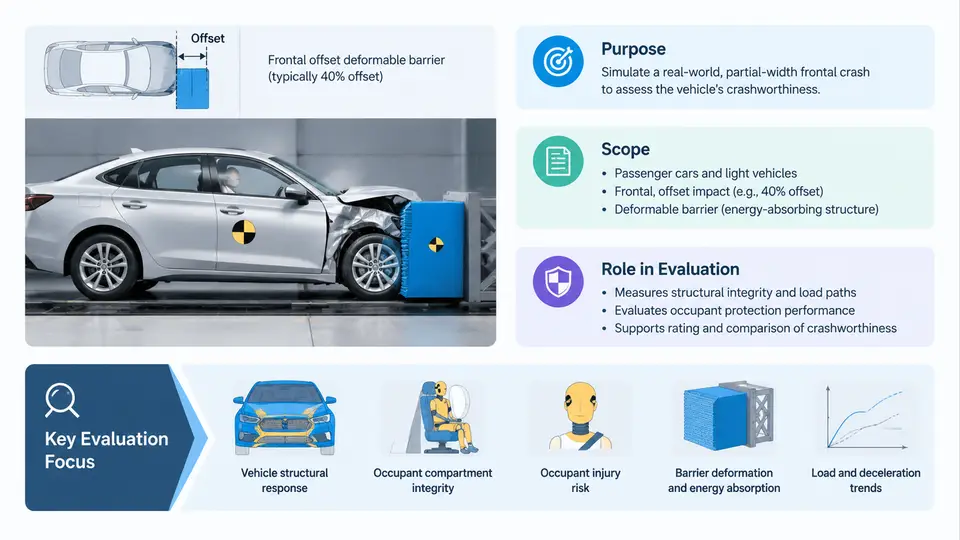
The Frontal Offset Deformable Barrier (FODB) test is one of the foundational crashworthiness evaluations used to characterize how a passenger vehicle protects its occupants when only part of the front structure engages an opposing object. Unlike a full-width rigid barrier impact, where the entire front end shares the load, an offset test concentrates the collision energy on roughly 40% of the vehicle width. This asymmetry is deliberate: it reproduces a very common real-world scenario—two vehicles of similar mass meeting slightly out of alignment, or a vehicle striking a tree, pole, or bridge abutment—and it exposes structural behaviors that a full-frontal test cannot reveal.
The purpose of the test is therefore twofold. First, it quantifies the crash energy management of the vehicle's front-end structure under asymmetric loading, including longitudinal rail deformation, subframe engagement, and the interaction between the impacted and non-impacted sides. Second, it evaluates the occupant compartment's ability to remain intact and to keep the restraint system—seat belts, airbags, and the steering column—working as intended. The deformable barrier itself is a critical part of the setup: it is not a rigid wall but a honeycomb aluminum block that crushes progressively, absorbing energy and producing a more realistic deceleration pulse than a rigid barrier would.
Why an Offset Test Exists
Full-width rigid barrier tests are excellent for verifying restraint system performance and symmetric structural collapse, but they tend to overstate the protection offered by the vehicle's front end because the load is distributed across the full width. In a real offset collision, the impacted side crushes deeply while the non-impacted side may barely deform, creating a strong yaw moment and a tendency for the occupant compartment to rotate. This rotation, combined with intrusion into the footwell and toe pan, is a major contributor to lower-extremity injuries. The FODB test was developed specifically to capture this asymmetric loading path and the resulting occupant kinematics.
The test also serves a regulatory and consumer-information role. In Europe, the offset deformable barrier test has been part of the UNECE Regulation No. 94 and Euro NCAP frontal assessment protocols for decades. In the United States, the Insurance Institute for Highway Safety (IIHS) uses a related but distinct moderate overlap frontal test with a rigid barrier and a 40% overlap. Understanding the FODB procedure is therefore essential for engineers who need to interpret test results across different regulatory regimes and to design vehicles that perform well in multiple markets.
Scope of the Test
The scope of a standard FODB test covers the vehicle, the barrier, the impact conditions, the instrumentation, and the occupant injury criteria. The vehicle is typically a production-representative model with a 50th-percentile male Hybrid III dummy in the driver seat and, depending on the protocol, a passenger dummy. The barrier is a fixed honeycomb block with defined crush strength and dimensions, mounted on a rigid concrete block. The impact speed is usually 56 km/h (35 mph) with a 40% overlap on the driver side, although protocol variations exist.
Instrumentation includes accelerometers on the vehicle body and barrier, load cells in the barrier face, and dummy sensors for head, neck, chest, and femur loads. The output is a set of injury criteria—Head Injury Criterion (HIC), chest deflection, neck tension and moment, and femur axial force—that are compared against threshold values. The test is considered successful when the occupant compartment maintains sufficient survival space and the measured injury values remain below the protocol limits.
Role in Crashworthiness Evaluation
Within a broader crashworthiness program, the FODB test occupies a specific and complementary position. It is not a substitute for full-frontal, side-impact, or rear-impact tests; rather, it fills the gap between symmetric frontal loading and highly asymmetric real-world collisions. The figure below illustrates how the FODB test fits into the overall evaluation chain and what each stage contributes.
The diagram makes the complementary nature of the FODB test explicit. The full-width frontal test verifies that the restraint system and symmetric structure work together; the FODB test then stresses the same vehicle under asymmetric loading, where the impacted rail must absorb a disproportionate share of the energy and the occupant compartment must resist rotation. Side impact tests address a different loading direction entirely. Together, these tests form a matrix that covers the most frequent and most severe real-world collision modes.
Practical Considerations for Engineers
When preparing a vehicle for an FODB test, several practical details matter. The barrier's honeycomb crush strength must match the protocol specification, because a barrier that is too stiff will produce an unrealistically high deceleration pulse and may cause the vehicle to rebound rather than deform. The overlap alignment must be set precisely: a 40% overlap means the barrier covers 40% of the vehicle width, measured from the driver side. A misalignment of even 50 mm can shift the load path and change the outcome significantly.
The vehicle's condition also matters. Tire pressure, suspension alignment, and fuel load are typically specified by the protocol, and deviations can affect the pitch and yaw behavior during impact. Instrumentation channels should be calibrated and checked against a known reference before the test, because a drifting accelerometer can invalidate the entire injury criteria calculation.
After the test, the engineer examines three things: the deformation pattern of the front structure, the intrusion into the occupant compartment, and the dummy injury values. A well-designed vehicle will show controlled folding of the impacted rail, limited intrusion into the footwell, and injury values below the thresholds. A poor result often shows rail buckling that bypasses the intended crush zone, excessive toe pan intrusion, or a restraint system that allowed the dummy's head to contact the steering wheel or A-pillar.
Summary
The Frontal Offset Deformable Barrier test is a targeted tool for evaluating asymmetric frontal crashworthiness. Its purpose is to expose structural and restraint behaviors that symmetric tests miss, its scope covers a defined vehicle-barrier-dummy configuration with specific instrumentation and injury criteria, and its role is to complement full-frontal and side-impact tests within a comprehensive safety evaluation program. For engineers working on vehicle structure, restraint tuning, or regulatory compliance, a solid grasp of the FODB procedure is essential groundwork for interpreting test results and making design decisions that improve real-world occupant protection.