1. Far-side occupant excursion fundamentals
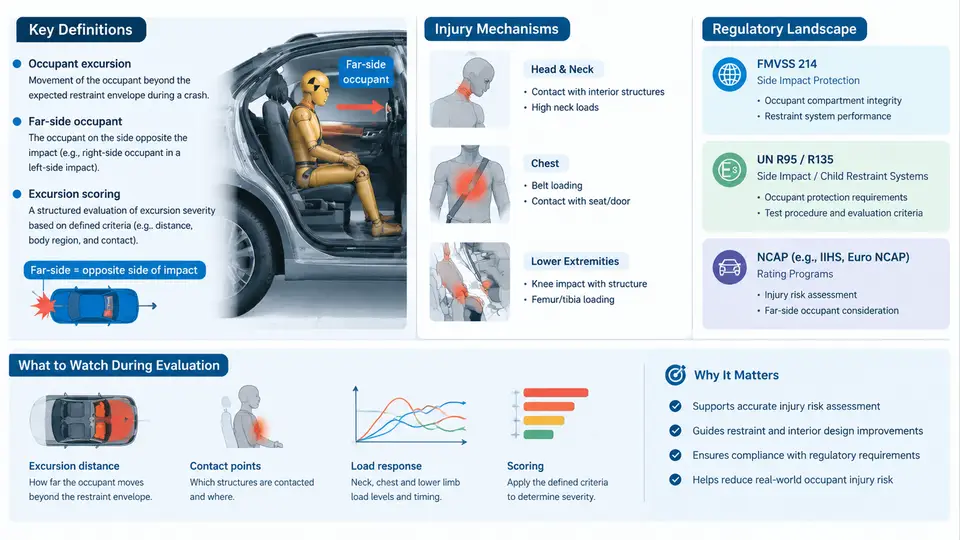
Far-side occupant excursion describes the lateral displacement of an occupant toward the vehicle centerline or the opposite side of the cabin during a crash, and the resulting interaction with the interior environment. It is the counterpart to the near-side problem that dominates conventional restraint design: in a near-side impact, the struck side's structure, door trim, and side airbag sit between the occupant and the intrusion, whereas in a far-side event the occupant is on the side away from the impact and is therefore accelerated toward the struck side, across the cabin. The occupant is restrained primarily by the seat belt and, in modern vehicles, by a far-side airbag deploying from the inboard seat bolster or center console. The engineering problem is not simply "the occupant moves sideways"; it is that the occupant's head and torso can slip out of the diagonal shoulder belt, translate across the seat, and load structures — the center console, the opposite seat, the opposite B-pillar or door trim, or another occupant — that were never designed as occupant contact surfaces.
Two definitions are worth fixing at the outset because they recur throughout scoring and test work. Excursion is the lateral displacement of a defined occupant landmark (typically the head center of gravity or the H-point) relative to the seat or to the vehicle centerline, measured over the crash event. Excursion scoring is the process of quantifying that displacement and the associated kinematic and injury metrics against defined criteria, so that a test can be judged pass/fail or ranked. Keeping the reference frame explicit is essential: a head excursion of 180 mm measured relative to the seat cushion is a different statement from 180 mm relative to the vehicle centerline, and mixing the two silently invalidates comparisons. In this course, unless stated otherwise, lateral displacement is reported relative to the seat reference point with positive direction toward the struck side, and vehicle-fixed quantities are labeled as such.
Why the occupant leaves the belt path
The dominant mechanism is geometric and inertial. In a far-side impact, the vehicle decelerates laterally; the occupant, by inertia, continues toward the impact side. The three-point belt's shoulder segment runs diagonally from the outboard upper anchor to the inboard buckle, so the belt's ability to resist inboard-to-outboard motion depends on the occupant's shoulder remaining behind the webbing. When the torso rotates or the shoulder moves inboard relative to the belt, the webbing can slide off the shoulder — commonly called belt slip-off or submarining of the shoulder — and the upper body is then largely unrestrained laterally. Contributing factors include low belt force limiting (which permits more torso travel), high seat recline, seat cushion geometry that allows the pelvis to slide, and the absence of a counterforce on the inboard side. The result is a characteristic kinematic sequence: pelvis translation, torso rotation, shoulder slip, head excursion, and finally head contact with the far-side interior or with the opposite occupant.
Injury mechanisms follow from that sequence. Head contact with the center console or opposite interior produces focal skull and facial loading; the lateral bending and axial rotation of the neck during head excursion produce cervical loading that is poorly tolerated compared with frontal flexion; and torso loading against the opposite seat or console can generate thoracic and abdominal injury. Where two occupants are involved, occupant-to-occupant contact adds a further, difficult-to-predict load path. The practical consequence for test evidence is that far-side assessment cannot rely on a single metric: head excursion, head contact location and timing, neck lateral bending moment, and belt geometry all carry information, and a test that "passes" on excursion alone may still show injurious head contact.
The regulatory and consumer-test landscape
Far-side protection has moved from a research topic to a regulated and rated requirement over roughly the last decade. The clearest regulatory anchor is FMVSS No. 228 in the United States, which specifies a dynamic far-side test using a belted occupant in a moving deformable barrier configuration and evaluates the occupant against injury criteria including head, neck, and torso measures. In Europe, UN Regulation No. 137 addresses far-side impact protection for belted occupants, and the Euro NCAP far-side mobile progressive deformable barrier (MPDB) and far-side occupant protection assessment have driven test configurations and dummy instrumentation in parallel. China's C-NCAP has likewise introduced far-side evaluation. The details differ — barrier mass and speed, impact angle, seat position, dummy type, and the specific criteria and limits — and those differences matter when a result is compared across programs.
Three practical consequences follow. First, the test configuration defines the loading direction and therefore the excursion direction; a 75° or 90° barrier angle produces a different occupant trajectory from a purely lateral pulse, and the scoring must use the configuration's own reference frame. Second, dummy selection constrains what can be measured: the THOR and WorldSID families provide different instrumentation sets and different biofidelity in lateral loading, so a metric available in one program may not exist in another. Third, the criteria are not a single number. Programs typically combine excursion or contact limits with injury assessment reference values (IARVs) for head, neck, and chest, and a result is judged against the full set rather than the most favorable one.
Reading a far-side test result
Consider a representative engineering example, with all values illustrative rather than measured. A belted occupant is tested in a lateral barrier configuration at a defined impact angle and speed. The post-test data show peak head lateral excursion of about 210 mm relative to the seat reference point at roughly 130 ms, with the head contacting the center console at 145 ms. The shoulder belt force peaks at about 4.5 kN and then drops sharply at 110 ms — a signature consistent with the webbing leaving the shoulder. The neck lateral bending moment rises after the belt force drop, indicating that the head is no longer being decelerated by the belt. In this example, the excursion value alone might sit near a limit, but the combination of belt force drop, late neck loading, and console contact tells a coherent story: the restraint lost the shoulder, and the head loaded the console. That is the kind of evidence a scoring review needs, and it is why the metric set matters more than any single number.
The regulatory landscape should be read with the same discipline. FMVSS No. 228, UN R137, Euro NCAP far-side assessment, and C-NCAP each define their own barrier, angle, dummy, and criteria; a vehicle developed to one program is not automatically compliant with another. When a program's criteria are cited, cite the configuration alongside them. And because far-side protection increasingly depends on a far-side airbag and on belt geometry rather than on structure alone, the test evidence must show not only that the occupant stayed within limits but that the restraint actually engaged — belt force present, airbag deployed, head path intercepted. That is the foundation on which the scoring methods and test-evidence practices in the following chapters are built.