1. MPDB test overview
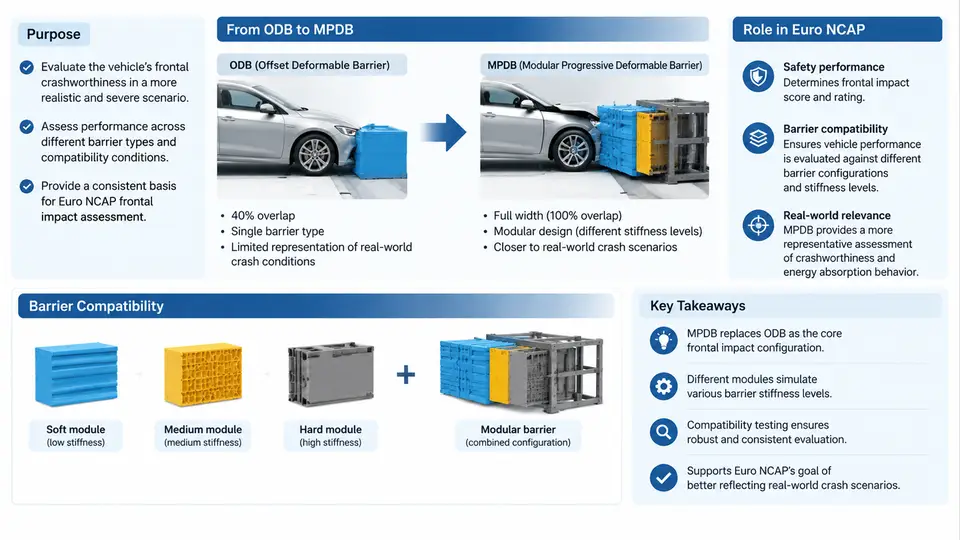
The Mobile Progressive Deformable Barrier (MPDB) test is the cornerstone of the current Euro NCAP frontal impact assessment. It replaces the long-serving Offset Deformable Barrier (ODB) test as the primary full-scale frontal crash configuration and, together with the frontal full-width rigid barrier test, forms a complementary pair that evaluates both self-protection and compatibility. Understanding why MPDB exists, how it evolved from ODB, and what it measures is essential before working with its configuration details, barrier properties, and compatibility metrics.
Purpose of the MPDB Test
MPDB was introduced to address a fundamental limitation of earlier frontal tests: they assessed how well a vehicle protects its own occupants but said little about how that vehicle behaves toward other road users in a collision. In real-world frontal crashes, the two involved vehicles rarely have equal mass, equal stiffness, or aligned structures. A heavy SUV striking a small hatchback, or a vehicle with a high, stiff front end hitting one with a low, soft front end, produces very different outcomes than a single-vehicle barrier test can capture.
The MPDB test therefore serves two intertwined purposes:
- Occupant protection assessment: Evaluate the restraint system and structural integrity of the tested vehicle using crash test dummies in the driver and passenger seats, capturing injury criteria across the head, neck, chest, abdomen, and legs.
- Compatibility assessment: Quantify how the tested vehicle interacts with the moving deformable barrier, which represents an opposing vehicle. This includes measuring the barrier's deformation, the deceleration pulse experienced by the barrier, and the resulting compatibility metrics that penalize aggressive front-end designs.
In short, MPDB asks two questions simultaneously: "Does this vehicle protect its own occupants?" and "Is this vehicle a good partner in a crash?" The second question is what distinguishes MPDB from its predecessors.
From ODB to MPDB: Why the Change Was Necessary
The ODB test, used in Euro NCAP for many years, ran the tested vehicle at 64 km/h into a fixed, honeycomb deformable barrier with 40% overlap. The barrier was stationary and its deformation properties were fixed. This configuration was effective at exposing structural weaknesses in the tested vehicle's front end and at driving restraint system development, but it had two structural shortcomings.
First, the ODB barrier was fixed to a rigid wall. All the kinetic energy of the moving vehicle had to be absorbed by the vehicle itself and by the barrier's deformation, with the wall providing an immovable reaction. In reality, the opposing vehicle moves, rotates, and absorbs energy. The ODB test therefore over-constrained the crash and produced a pulse that did not represent vehicle-to-vehicle collisions well.
Second, because the barrier was stationary and identical for every test, the ODB test could not differentiate between a mild-mannered vehicle and an aggressive one. A vehicle with an excessively stiff front structure and a high bumper would perform just as well against the fixed barrier as a more compatible design, even though on the road it would be far more dangerous to other vehicles.
MPDB resolves both issues. The barrier is mounted on a moving trolley that is propelled toward the tested vehicle, so both bodies are in motion and the crash more closely resembles a real vehicle-to-vehicle impact. The barrier itself is a progressive deformable element with a defined honeycomb structure and a load cell wall behind it, allowing engineers to measure the force distribution the tested vehicle imposes on the barrier. The overlap is 50%, and the closing speed is 50 km/h per vehicle (100 km/h closing speed), with the trolley mass and barrier properties standardized so results are comparable across vehicles.
The MPDB Test in the Euro NCAP Frontal Assessment
Within the Euro NCAP frontal impact assessment, MPDB does not stand alone. It is paired with the full-width rigid barrier (FRB) test, which runs the vehicle at 50 km/h into a rigid wall with 100% overlap. The two tests are deliberately complementary: FRB stresses the restraint system and occupant kinematics in a severe, high-deceleration event with full engagement of the front structure, while MPDB introduces the compatibility dimension and a more realistic two-body interaction. A vehicle that performs well in FRB but poorly in MPDB is likely to be self-protective but aggressive; one that performs well in MPDB but poorly in FRB may have restraint or structural deficiencies under high-severity loading.
The MPDB test contributes to the frontal impact score through occupant injury measurements and through compatibility metrics. The compatibility assessment uses the barrier's load cell wall data and the barrier trolley's deceleration to derive two families of metrics: those describing how the barrier deforms (including the barrier deformation and the resulting occupant load in the barrier, often expressed through a barrier-based injury proxy) and those describing the tested vehicle's aggressiveness. These metrics are combined into a compatibility score that rewards vehicles whose front-end stiffness and geometry distribute forces in a way that is less harmful to the opposing vehicle.
The following diagram shows the MPDB test layout and the data paths that feed the two assessment streams.
What the Test Actually Measures
During an MPDB test, the tested vehicle and the barrier trolley approach each other, each at 50 km/h, giving a closing speed of 100 km/h. The barrier's deformable element crushes against the tested vehicle's front end, and the load cell wall behind the barrier records the force distribution across the barrier face. Meanwhile, the dummies in the tested vehicle record accelerations and loads that are converted into injury criteria such as HIC, neck tension, chest deflection, and femur loads.
The compatibility side of the assessment is where MPDB departs most clearly from ODB. The load cell wall data reveal how the tested vehicle's front structure loads the barrier: a vehicle with a concentrated, high-stiffness load path will produce localized high forces, while a more compatible vehicle spreads the load. The barrier trolley's deceleration is also recorded, and together these signals feed metrics that describe the barrier's deformation and the severity imposed on the opposing vehicle. These metrics are not merely descriptive; they carry score weight in the Euro NCAP frontal assessment, which is why manufacturers now design front ends with compatibility in mind rather than optimizing solely for self-protection.
Why This Matters for Configuration and Barrier Compatibility Work
Because MPDB involves a moving barrier with defined mass, stiffness, and geometry, every element of the test configuration matters: the trolley mass, the barrier honeycomb properties, the overlap, the closing speed, the load cell wall layout, and the dummy positioning. Small deviations in barrier preparation or trolley setup can shift the measured forces and decelerations, which in turn affect the compatibility metrics. This is why the chapters that follow treat the barrier as an engineered object with its own calibration and acceptance criteria, not as a passive prop.
The evolution from ODB to MPDB also explains why legacy ODB experience cannot simply be transferred. An engineer familiar with ODB pulses, barrier crush patterns, and 40% overlap structural loading must recalibrate their intuition for a 50% overlap, two-body, 100 km/h closing-speed event with a load cell wall in the loop. The structural load paths, the timing of peak forces, and the relevance of barrier deformation all differ. Recognizing this shift is the first step toward correct MPDB configuration and meaningful compatibility assessment.
In summary, MPDB is best understood as Euro NCAP's answer to a real-world question that ODB could not fully address: how does a vehicle behave when it hits another vehicle rather than a wall? Its moving barrier, load cell wall, and compatibility metrics make the opposing vehicle a measured part of the test, and its pairing with the full-width rigid barrier gives the frontal assessment both a self-protection and a partner-protection dimension. The remaining chapters build on this foundation, moving from the purpose and evolution covered here into the concrete configuration, barrier properties, instrumentation, and compatibility evaluation that make the test reproducible and meaningful.